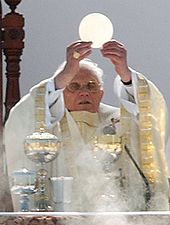
Pope Benedict XVI with Eucharist Host during Mass in 2007 (Fabio Pozzebom/ABr)
By COGwriter
Marcus was a second century heretic, who was apparently affiliated with the heretic Valentinus. There seems to be less information about him than several of the other second century heretics.
Did he have any ties to Alexandria? Was his "eucharist" acceptable to Christians? Do many who profess Christ still follow practices similar to those that Marcus was condemned for? If Christians originally "broke bread," where did the rounded unbroken "host" come from?
What did a relatively unknown heretic named Marcus do?
Little is actually truly known about Marcus.
The one book states:
Of Marcus himself we know nothing beyond the fact that he was one of the earlier pupils of Valentinus, or at any rate belonged to the earlier circle of Valentinian ideas. His date is vaguely placed somewhere about the middle of the second century; he is said to have taught in Asia Minor, and Jerome, two hundred years afterwards, states that he was an Egyptian (Mead, G.R.S. Fragments of a Faith Forgotten. Theosophical Publishing Society: London [1900] p. 359 http://www.sacred-texts.com/gno/fff/fff54.htm viewed 12/09/07).
The Catholic Encyclopedia states:
Marcus...The founder of the Marcosians and elder contemporary of St. Irenæus, who, c. A.D. 175, in his refutation addresses him as one apparently still living (Adv. Haer., I, xi, 3, where the "clarus magister" is Marcus, not Epiphanes; and I, xiii, 21). Irenaeus, from whom St. Epiphanius (Haer., xxxiv) and St. Hoppolytus (Haer., VI, xxxix-lv) quote, makes Marcus, a disciple of Valentius (q.v.), with whom Marcus's aeonology mainly agrees. St. Jerome (Ep. 75, 3) makes him a follower of Basilides, confusing him no doubt with Marcus of Memphis. Clement of Alexandria, himself infected with Gnosticism, actually uses Marcus number system though without acknowledgement (Strom, VI, xvi) (Arendzen JP. Transcribed by Joseph P. Thomas. Marcus. The Catholic Encyclopedia, Volume IX. Published 1910. New York: Robert Appleton Company. Nihil Obstat, October 1, 1910. Remy Lafort, Censor. Imprimatur. +John M. Farley, Archbishop of New York).
So it is believed that when Irenaeus refers to a "renowned teacher" below, that this is about Marcus:
Let us now look at the inconsistent opinions of those heretics (for there are some two or three of them), how they do not agree in treating the same points, but alike, in things and names, set forth opinions mutually discordant. The first of them, Valentinus, who adapted the principles of the heresy called "Gnostic" to the peculiar character of his own school...
There is another, who is a renowned teacher among them, and who, struggling to reach something more sublime, and to attain to a kind of higher knowledge, has explained the primary Tetrad as follows: There is [he says] a certain Proarche who existed before all things, surpassing all thought, speech, and nomenclature, whom I call Monotes (unity). Together with this Monotes there exists a power, which again I term Henotes (oneness). This Henotes and Monotes, being one, produced, yet not so as to bring forth [apart from themselves, as an emanation] the beginning of all things, an intelligent, unbegotten, and invisible being, which beginning language terms "Monad." With this Monad there co-exists a power of the same essence, which again I term Hen (One). These powers then— Monotes, and Henotes, and Monas, and Hen—produced the remaining company of the Æons (Irenaeus. Adversus Haereses, Book I, Chapter 11, Verses 1,3).
Hence Marcus may have had some association with Valentinus. Valentinus was from Alexandria.
Irenaeus considered that Marcion was demon-possessed and was a womanizer:
3. It appears probable enough that this man possesses a demon as his familiar spirit, by means of whom he seems able to prophesy, and also enables as many as he counts worthy to be partakers of his Charis themselves to prophesy. He devotes himself especially to women, and those such as are well-bred, and elegantly attired, and of great wealth, whom he frequently seeks to draw after him, by addressing them in such seductive words as these: "I am eager to make thee a partaker of my Charis, since the Father of all doth continually behold thy angel before His face. Now the place of thy angel is among us: it behoves us to become one. Receive first from me and by me [the gift of] Chaffs. Adorn thyself as a bride who is expecting her bridegroom, that thou mayest be what I am, and I what thou art. Establish the germ of light in thy nuptial chamber. Receive from me a spouse, and become receptive of him, while thou art received by him. Behold Charis has descended upon thee; open thy mouth and prophesy." On the woman replying," I have never at any time prophesied, nor do I know how to prophesy; "then engaging, for the second time, in certain invocations, so as to astound his deluded victim, he says to her," Open thy mouth, speak whatsoever occurs to thee, and thou shalt prophesy." She then, vainly puffed up and elated by these words, and greatly excited in soul by the expectation that it is herself who is to prophesy, her heart beating violently [from emotion], reaches the requisite pitch of audacity, and idly as well as impudently utters some nonsense as it happens. to occur to her, such as might be expected from one heated by an empty spirit. (Referring to this, one superior to me has observed, that the soul is both audacious and impudent when heated with empty air.) Henceforth she reckons herself a prophetess, and expresses her thanks to Marcus for having imparted to her of his own Chaffs. She then makes the effort to reward him, not only by the gift of her possessions (in which way he has collected a very large fortune), but also by yielding up to him her person, desiring in every way to be united to him, that she may become altogether one with him.
4. But already some of the most faithful women, possessed of the fear of God, and not being deceived (whom, nevertheless, he did his best to seduce like the rest by bidding them prophesy), abhorring and execrating him, have withdrawn from such a vile company of revellers. This they have done, as being well aware that the gift of prophecy is not conferred on men by Marcus, the magician, but that only those to whom God sends His grace from above possess the divinely-bestowed power of prophesying; and then they speak where and when God pleases, and not when Marcus orders them to do so. For that which commands is greater and of higher authority than that which is commanded, inasmuch as the former rules, while the latter is in a state of subjection. If, then, Marcus, or any one else, does command,-as these are accustomed continually at their feasts to play at drawing lots, and [in accordance with the lot] to command one another to prophesy, giving forth as oracles what is in harmony with their own desires,-it will follow that he who commands is greater and of higher authority than the prophetic spirit, though he is but a man, which is impossible. But such spirits as are commanded by these men, and speak when they desire it, are earthly and weak, audacious and impudent, sent forth by Satan for the seduction and perdition of those who do not hold fast that well-compacted faith which they received at first through the Church.
5. Moreover, that this Marcus compounds philters and love-potions, in order to insult the persons of some of these women, if not of all, those of them who have returned to the Church of God-a thing which frequently occurs-have acknowledged, confessing, too, that they have been defiled by him, and that they were filled with a burning passion towards him. A sad example of this occurred in the case of a certain Asiatic, one of our deacons, who had received him (Marcus) into his house. His wife, a woman of remarkable beauty, fell a victim both in mind and body to this magician, and, for a long time, travelled about with him. At last, when, with no small difficulty, the brethren had converted her, she spent her whole time in the exercise of public confession, weeping over and lamenting the defilement which she had received from this magician.
6. Some of his disciples, too, addicting themselves to the same practices, have deceived many silly women, and defiled them. They proclaim themselves as being "perfect," so that no one can be compared to them with respect to the immensity of their knowledge, nor even were you to mention Paul or Peter, or any other of the apostles. They assert that they themselves know more than all others, and that they alone have imbibed the greatness of the knowledge of that power which is unspeakable. They also maintain that they have attained to a height above all power, and that therefore they are free in every respect to act as they please, having no one to fear in anything. For they affirm, that because of the "Redemption" it has come to pass that they can neither be apprehended, nor even seen by the judge. But even if he should happen to lay hold upon them, then they might simply repeat these words, while standing in his presence along with the "Redemption: ""O thou, who sittest beside God, and the mystical, eternal Sige, thou through whom the angels (mightiness), who continually behold the face of the Father, having thee as their guide and introducer, do derive their forms from above, which she in the greatness of her daring inspiring with mind on account of the goodness of the Propator, produced us as their images, having her mind then intent upon the things above, as in a dream,-behold, the judge is at hand, and the crier orders me to make my defence. But do thou, as being acquainted with the affairs of both, present the cause of both of us to the judge, inasmuch as it is in reality but one cause." Now, as soon as the Mother hears these words, she puts the Homeric helmet of Pluto upon them, so that they may invisibly escape the judge. And then she immediately catches them up, conducts them into the bridal chamber, and hands them over to their consorts.
7. Such are the words and deeds by which, in our own district of the Rhone, they have deluded many women, who have their consciences seared as with a hot iron. Some of them, indeed, make a public confession of their sins; but others of them are ashamed to do this, and in a tacit kind of way, despairing of [attaining to] the life of God, have, some of them, apostatized altogether; while others hesitate between the two courses, and incur that which is implied in the proverb, "neither without nor within; "possessing this as the fruit from the seed of the children of knowledge. (Irenaeus. Adversus Haereses, Book I, Chapter 13, Verses 3-7).
It may be of interest to note that the sun and the zodiac circle were important to the Marcosians:
They maintain, then, that first of all the four elements, fire, water, earth, and air, were produced after the image of the primary Tetrad above, and that then, we add their operations, viz., heat, cold, dryness, and humidity, an exact likeness of the Ogdoad is presented. They next reckon up ten powers in the following manner:— There are seven globular bodies, which they also call heavens; then that globular body which contains these, which also they name the eighth heaven ; and, in addition to these, the sun and moon. These, being ten in number, they declare to be types of the invisible Decad , which proceeded from Logos and Zoe . As to the Duodecad , it is indicated by the zodiacal circle, as it is called; for they affirm that the twelve signs do most manifestly shadow forth the Duodecad , the daughter of Anthropos and Ecclesia...The sun also, who runs through his orbit in twelve months, and then returns to the same point in the circle... Also the circumference of the zodiacal circle itself contains three hundred and sixty degrees (for each of its signs comprises thirty); and thus also they affirm, that by means of this circle an image is preserved of that connection which exists between the twelve and the thirty. Still further, asserting that the earth is divided into twelve zones, and that in each zone it receives power from the heavens, according to the perpendicular [position of the sun above it], bringing forth productions corresponding to that power which sends down its influence upon it, they maintain that this is a most evident type of the Duodecad and its offspring. (Irenaeus. Adversus Haereses, Book I, Chapter 17, Verse 1) .
The eucharistic host resembles a circle: it is likely an astrological symbol (The Bible and Astrology) or a sun-deity symbol. As far as the 'ogdoad' goes, this led to the veneration of the 'eighth day' of the week, and now Sunday is considered to be the 'eighth day' by Catholics and Protestants, despite the fact that Marcus and his followers were clearly Gnostic heretics (read Sunday and Christianity and/or watch Sunday: First and Eighth Day?).
It should be noted that the accuracy of Irenaeus' reporting related to Marcus (and others) has been questioned. I, for example, found Irenaeus to not always be accurate (see article Irenaeus: The Most Dangerous Heretic?), but he is almost the only source of information we have on Marcus. Anyway, here are some other comments on his reporting:
A LONG section in Irenæus is our almost exclusive source for a knowledge of Marcus and his followers. Hippolytus and Epiphanius simply copy Irenæus and add nothing but new terms of condemnation, while our information from other sources is a question of lines and not of paragraphs. The unreliability of Irenæus as a chronicler of Gnostic views is already known to our readers, and in the case of Marcus and the Marcosians is more painfully patent than usual. It seems that some of the adherents of the school were to be found even among the rude populace of the Rhone valley, and the worthy Presbyter of Lyons was especially anxious to discount their influence. He begins the attack by retailing all the scandalous stories he can collect about Marcus, a man he had never seen, and who had not been nearer to the sheepfold of Lyons than Asia Minor, or at best Egypt! (Mead, G.R.S. Fragments of a Faith Forgotten. Theosophical Publishing Society: London [1900] p. 359 http://www.sacred-texts.com/gno/fff/fff54.htm viewed 12/09/07).
The so-called "apostolic succession" list of Greek Orthodox Patriarchate of Alexandria and All Africa lists one named Markos II as its bishop from 144 - 154 (Source: Greek Orthodox Patriarchate of Alexandria and All Africa. List of the Patriarchs of Alexandria and all Africa 42 AD up to today. http://www.greekorthodox-alexandria.org/main.htm 12/07/06.). Of course, Marcus/Markos was a fairly common name back then.
Eusebius claimed:
In Alexandria Marcus was appointed pastor, after Eumenes had filled the office thirteen years in all (Eusebius. Church History, Book IV, Chapter 11, Verse 6. Translated by Arthur Cushman McGiffert. Excerpted from Nicene and Post-Nicene Fathers, Series Two, Volume 1. Edited by Philip Schaff and Henry Wace. American Edition, 1890. Online Edition Copyright © 2004 by K. Knight).
Although not proven, one writer noted:
Marcus, the seventh bishop listed by Eusebius, could just as well have been the famed disciple of the second-century Valentinus (Coulter Fred. The New Testament In Its Original Order, Appendix U. York Publishing, Hollister, CA, 2004, p. 859).
And that is possible. While the Eastern Orthodox venerate the memory of a Marcus they claim was bishop of Alexandria from A.D. 144-154, Roman Catholics consider that there was a leading Gnostic heretic named Marcus in the second century. Some people believe that the Marcus described by Irenaeus may have gone to Egypt, although for 10-13 years this seems a bit of a stretch.
However, since the time period claimed by the Orthodox does fit the general time period that Marcus was believed to have been active, it may be possible that he visited Alexandria during the mid-second century and the dates of his influence (now called a "reign") were later estimated. The fact that Clement of Alexandria (a contemporary of Marcus) apparently used Marcus' numbering system, suggests that it is possible, but does not prove, that this could be the same Marcus.
As is shown here, Eusebius’ report and the listing by the “Greek Orthodox Patriarchate of Alexandria and All Africa” do not agree on the length of Marcus’ “reign”--hence there certainly is some confusion about him.
If Irenaeus’ Marcus and the Orthodox’s Marcus are the same person, it is clear that one in the list of Alexandria's Orthodox successors was condemned by Irenaeus as a heretic. And even if they are not, as will be shown later, some of the practices of consecration with mysterious invocations he was claimed to do were condemned in the second century--even though this is somewhat similar to practices adopted by the Roman and Orthodox Churches. Since Clement of Alexandria apparently was familiar with his writings and perhaps practices, it may be that it was at least partially from Marcus' influence that certain eucharistic practices were adopted.
Irenaeus summarized even more information:
1. In the first book, which immediately precedes this, exposing "knowledge falsely so called," I showed thee, my very dear friend, that the whole system devised, in many and opposite ways, by those who are of the school of Valentinus, was false and baseless. I also set forth the tenets of their predecessors, proving that they not only differed among themselves, but had long previously swerved from the truth itself. I further explained, with all diligence, the doctrine as well as practice of Marcus the magician, since he, too, belongs to these persons; and I carefully noticed the passages which they garble from the Scriptures, with the view of adapting them to their own fictions. Moreover, I minutely narrated the manner in which, by means of numbers, and by the twenty-four letters of the alphabet, they boldly endeavour to establish [what they regard as] truth. I have also related how they think and teach that creation at large was formed after the image of their invisible Pleroma, and what they hold respecting the Demiurge, declaring at the same time the doctrine of Simon Magus of Samaria, their progenitor, and of all those who succeeded him. I mentioned, too, the multitude of those Gnostics who are sprung from him, and noticed the points of difference between them, their several doctrines, and the order of their succession, while I set forth all those heresies which have been originated by them. I showed, moreover, that all these heretics, taking their rise from Simon, have introduced impious and irreligious doctrines into this life; and I explained the nature of their "redemption," and their method of initiating those who are rendered "perfect," along with their invocations and their mysteries (Irenaeus. Adversus haereses, Book II, Preface, Verse 1. Excerpted from Ante-Nicene Fathers, Volume 1. Edited by Alexander Roberts & James Donaldson. American Edition, 1885. Online Edition Copyright © 2004 by K. Knight).
Marcus, like Valentinus, apparently also believed in the Ogdoad and, furthermore Marcus claimed to see a female apparition:
1. This Marcus then, declaring that he alone was the matrix and receptacle of the Sige of Colorbasus, inasmuch as he was only-begotten, has brought to the birth in some such way as follows that which was committed to him of the defective Euthymesis. He declares that the infinitely exalted Tetrad descended upon him from the invisible and indescribable places in the form of a woman (for the world could not have borne it coming in its male form), and expounded to him alone its own nature, and the origin of all things, which it had never before revealed to any one either of gods or men...
4...And as Marcus waited in the expectation that she would say something more, the Tetrad again came forward and said, "Thou hast reckoned as contemptible that word which thou hast heard from the mouth of Aletheia. This which thou knowest and seemest to possess, is not an ancient name. For thou possessest the sound of it merely, whilst thou art ignorant of its power. For Jesus (Ihsous) is a name arithmetically symbolical, consisting of six letters, and is known by all those that belong to the called. But that which is among the Aeons of the Pleroma consists of many parts, and is of another form and shape, and is known by those [angels] who are joined in affinity with Him, and whose figures (mightinesses) are always present with Him.
5. Know, then, that the four-and-twenty letters which you possess are symbolical emanations of the three powers that contain the entire number of the elements above. For you are to reckon thus -- that the nine mute letters are [the images] of Pater and Aletheia, because they are without voice, that is, of such a nature as cannot be uttered or pronounced. But the semi-vowels represent Logos and Zoe, because they are, as it were, midway between the consonants and the vowels, partaking of the nature of both. The vowels, again, are representative of Anthropos and Ecclesia, inasmuch as a voice proceeding from Anthropos gave being to them all; for the sound of the voice imparted to them form. Thus, then, Logos and Zoe possess eight [of these letters]; Anthropos and Ecclesia seven; and Pater and Aletheia nine. But since the number allotted to each was unequal, He who existed in the Father came down, having been specially sent by Him from whom He was separated, for the rectification of what had taken place, that the unity of the Pleromas, being endowed with equality, might develop in all that one power which flows from all. Thus that division which had only seven letters, received the power of eight, and the three sets were rendered alike in point of number, all becoming Ogdoads; which three, when brought together, constitute the number four-and-twenty. The three elements, too (which he declares to exist in conjunction with three powers, and thus form the six from which have flowed the twenty-four letters), being quadrupled by the word of the ineffable Tetrad, give rise to the same number with them; and these elements he maintains to belong to Him who cannot be named. These, again, were endowed by the three powers with a resemblance to Him who is invisible. And he says that those letters which we call double are the images of the images of these elements; and if these be added to the four-and-twenty letters, by the force of analogy they form the number thirty (Book 1, Chapter 14, Verses 1,4,5).
(For more information related to apparitions, please see Mary, the Mother of Jesus and the Apparitions.)
The Marcosians seemed to have a female as the replacement for the Holy Spirit. The Catholic Encyclopedia reported:
The Marcosians said: "In [eis] the name of the unknown Father of all, in [eis] the Truth, the Mother of all, in him, who came down on Jesus [eis ton katelthonta eis Iesoun]". (Arendzen J. Gnosticism. The Catholic Encyclopedia)
(See also Did the True Church Ever Teach a Trinity?)
Marcus apparently claimed that Jesus was the 888:
2. But Jesus, he affirms, has the following unspeakable origin. From the mother of all things, that is, the first Tetrad; there came forth the second Tetrad, after the manner of a daughter; and thus an Ogdoad was formed, from which, again, a Decad proceeded: thus was produced a Decad and an Ogdoad. The Decad, then, being joined with the Ogdoad, and multiplying it ten times, gave rise to the number eighty; and, again, multiplying eighty ten times, produced the number eight hundred. Thus, then, the whole number of the letters proceeding from the Ogdoad [multiplied] into the Decad, is eight hundred and eighty-eight. This is the name of Jesus; for this name, if you reckon up the numerical value of the letters, amounts to eight hundred and eighty-eight. Thus, then, you have a clear statement of their opinion as to the origin of the supercelestial Jesus. Wherefore, also, the alphabet of the Greeks contains eight Monads, eight Decads, and eight Hecatads , which present the number eight hundred and eighty-eight, that is, Jesus, who is formed of all numbers; and on this account He is called Alpha and Omega, indicating His origin from all. And, again, they put the matter thus: If the first Tetrad be added up according to the progression of number, the number ten appears. For one, and two, and three, and four, when added together, form ten; and this, as they will have it, is Jesus. Moreover, Chreistus, he says, being a word of eight letters, indicates the first Ogdoad, and this, when multiplied by ten, gives birth to Jesus (888). And Christ the Son, he says, is also spoken of, that is, the Duodecad. For the name Son, (uios) contains four letters, and Christ (Chreistus) eight, which, being combined, point out the greatness of the Duodecad (Book 1, Chapter 15, Verse 8).
Although he received much of his materials from Irenaeus, it may be of interest to read some of what Hippolytus wrote about Marcus:
And this (Marcus), infusing (the aforesaid) mixture into a smaller cup, was in the habit of delivering it to a woman to offer up the Eucharistic prayer, while he himself stood by, and held (in his hand) another empty (chalice) larger than that...
But not even has this secret of theirs escaped (our scrutiny). For these opinions, however, we consent to pardon Valentinus and his school. But Marcus, imitating his teacher, himself also feigns a vision, imagining that in this way he would be magnified. For Valentinus likewise alleges that he had seen an infant child lately born; and questioning (this child), he proceeded to inquire who it might be. And (the child) replied, saying that he himself is the Logos, and then subjoined a sort of tragic legend...
But the generic and expressed names of the elements he called Aeons, and Logoi, and Roots, and Seeds, and Pleromas, and Fruits...the vain toil of Marcus wishes that the Progenitor (of things) should consist! Wherefore also (he maintains) that the Father, who knew that He was inseparable from Himself, gave (this depth) to the elements, which he likewise denominates Aeons. And he uttered aloud to each one of them its own peculiar pronunciation, from the fact that one could not pronounce the entire...
And (Marcus alleged) that the Quaternion, after having explained these things, spoke as follows: " Now, I wish also to exhibit to you Truth herself, for I have brought her down from the mansions above, in order that you may behold her naked, and become acquainted with her beauty; nay, also that you may hear her speak, and may marvel at her wisdom. Observe, " says the Quaternion, " then, first, the head above, Alpha (and long) O; the neck, B and P [si]; shoulders, along with hands, G and C [hi]; breasts, Delta and P [hi]; diaphragm,12 Eu; belly, Z and T; pudenda, Eta and S; thighs, T [h] and R; knees, Ip; calves, Ko; ankles, Lx [si]; feet, M and N. " This is in the body of Truth, according to Marcus...
But, after uttering these words, (Marcus details) that Truth, gazing upon him, and opening her mouth, spoke the discourse (just-alluded to). And (he tells us) that the discourse became a name, and that the name was that which we know and utter, viz., Christ Jesus, and that as soon as she had named this (name) she remained silent. While Marcus, however, was expecting that she was about to say more, the Quaternion, again advancing into the midst, speaks as follows: "You regarded as contemptible12 this discourse which you have heard from the mouth of Truth. And yet this which you know and seem long since to possess is not the name; for you have merely the sound of it, but are ignorant of the power. For Jesus is a remarkable name, having six letters,12 invoked12 by all belonging to the called (of Christ); whereas the other (name, that is, Christ,) consists of many parts, and is among the (five) Aeons of the Pleroma. (This name) is of another form and a different type, and is recognised by those existences who are connate with him, and whose magnitudes subsist with him continually...
And he says, as the result of this computation and that proportion,13 that in the similitude of an image He appeared who after the six days Himself ascended the mountain a fourth person, and became the sixth.13 And (he asserts) that He (likewise) descended and was detained by the Hebdomad, and thus became an illustrious Ogdoad...
I trust, therefore, that as regards these doctrines it is obvious to all possessed of a sound mind, that (these tenets) are unauthoritative, and far removed from the knowledge that is in accordance with Religion, and are mere portions of astrological discovery, and the arithmetical art of the Pythagoreans. And this assertion, you who are desirous of learning shall ascertain (to be true, by a reference to the previous books, where,) amongst other opinions elucidated by us, we have explained these doctrines likewise. In order, however, that we may prove it a more clear statement, viz., that these (Marcosians) are disciples not of Christ but of Pythagoras, I shall proceed to explain those opinions that have been derived (by these heretics) from Pythagoras concerning the meteoric (phenomena) of the starts15 as far as it is possible (to do so) by an epitome. Now the Pythagoreans make the following statements: that the universe consists of a Monad and Duad, and that by reckoning from a monad as far as four they thus generate a decade...
...these heretics, appropriating these opinions from the Pythagorean philosophy, and from over-spun theories of the astrologers, cast an imputation upon Christ, as though He had delivered these (doctrines). But since I suppose that the worthless opinions of these men have been sufficiently explained, and that it has been clearly proved whose disciples are Marcus and Colarbasus, who were successors of the school of Valentinus, let us see what statement likewise Basilides advances (Hippolytus. Refutation of All Heresies, Book VI, Extracts from Chapters 35-50. TRANSLATED BY J. H. MACMAHON, M.A.).
Thus like other heretics, Marcus apparently blended ideas from Greek pagan thought into his religion.
Concerning the Marcosians, Irenaeus also wrote:
1. I judge it necessary to add to these details also what, by garbling passages of Scripture, they try to persuade us concerning their Propator, who was unknown to all before the coming of Christ. Their object in this is to show that our Lord announced another Father than the Maker of this universe, whom, as we said before, they impiously declare to have been the fruit of a defect (Book 1, Chapter 19, Verse 1).
2. They maintain that those who have attained to perfect knowledge must of necessity be regenerated into that power which is above all. For it is otherwise impossible to find admittance within the Pleroma, since this [regeneration] it is which leads them down into the depths of Bythus. For the baptism instituted by the visible Jesus was for the remission of sins, but the redemption brought in by that Christ who descended upon Him, was for perfection; and they allege that the former is animal, but the latter spiritual (Book 1, Chapter 21, Verse 2).
But some of those beliefs perhaps came from Mithraism as The Catholic Encyclopedia indicates:
There were seven degrees of initiation into the mithraic mysteries. The consecrated one (mystes) became in succession crow (corax), occult (cryphius), soldier (miles), lion (leo), Persian (Perses), solar messenger (heliodromos), and father (pater). On solemn occasions they wore a garb appropriate to their name, and uttered sounds or performed gestures in keeping with what they personified. "Some flap their wings as birds imitating the sound of a crow, others roar as lions", says Pseudo-Augustine (Quaest. Vet. N. Test. In P.L., XXXIV, 2214). Crows, occults and soldiers formed the lower orders, a sort of catechumens; lions and those admitted to the other degrees were participants of the mysteries...The ceremonies of initiation for each degree must have been elaborate, but they are only vaguely known -- lustrations and bathings, branding with red-hot metal, anointing with honey, and others (Arendzen. J.P. Transcribed by John Looby. Mithraism. The Catholic Encyclopedia, Volume X. Published 1911. New York: Robert Appleton Company. Nihil Obstat, October 1, 1911. Remy Lafort, S.T.D., Censor. Imprimatur. +John Cardinal Farley, Archbishop of New York).
Historian and scholar K. Latourette reported related to Mithra and the early "Eucharist":
One of the earliest descriptions of the Eucharist, that by Justin Martyr, not far from the middle of the second century, recognizes the similarity to what was seen in one the mystery cults, Mithraism...it has been repeatedly asserted that in baptism and the Eucharist Christians borrowed from the mysteries and that Christianity was simply another one of these cults...The similarity is striking… baptized, which Justin calls "illumination"... (Latourette KS. A History of Christianity, Volume 1: to A.D. 1500. HarperCollins, San Francisco, 1975, pp. 198,200).
Of course, true Christianity could not "borrow" from the sun-cults, but some associated with Justin and those that follow his examples apparently have.
It should be understood that while Justin calls the newly baptized "illuminated", the Bible does not.
Interestingly, one of the objectives of mystery religions like Mithraism was to become illuminated? Notice the following:
FOR more than three centuries Mithraism was practised in the remotest provinces of the Roman empire and under the most diverse conditions...the promise of complete illumination, long withheld, fed the ardor of faith with the fascinating allurements of mystery...The gods were everywhere, and they mingled in every act of life; the fire that cooked the food and warmed the bodies of the faithful, the water that allayed their thirst and cleansed their persons, the very air that they breathed, and the light that illuminated their paths, were the objects of their adoration. Perhaps no other religion ever offered to its sectaries in a higher degree than Mithraism opportunities for prayer and motives for veneration (Cumont, Franz. Translated from the second revised French edition by Thomas J. McCormack. The Mysteries of Mithra. Chicago, Open Court [1903] pp. 104,120,149).
I suspect that some who had some connection with Mithraism professed Christ and that those ceremonies got picked up by apostates who Justin apparently distantly came into contact with. And even though Justin is attempting to state that Mithraism copied Christian ceremonies, the fact is that the Mithras ceremonies were in existence prior to Jesus coming.
The Encyclopædia Britannica states:
The liturgy of the Yasna was a remarkable anticipation of the mass in Christianity...The Mithraic sacramental banquet was derived from the Yasna ceremony, wine taking the place of the haoma and Mithra that of Ahura Mazdā. (James EO. Sacramental ideas and practices in the Indo-Iranian world. Encyclopædia Britannica. ©2013 Encyclopædia Britannica, Inc. http://www.britannica.com/EBchecked/topic/515366/sacrament/66288/Sacramental-ideas-and-practices-in-the-Indo-Iranian-world viewed 12/06/13)
It may be of interest to note that Mithraism had a lot of practices that many mainstream churches have adopted:
Birthdays
Christmas
Confirmation (within Catholicism mainly)
Dress of the clergy (mainly the Roman and Orthodox clergy)
Father being a name for the clergy (mainly the Roman and Orthodox clergy)
Heaven as a reward of the saved
Idols and icons
Immortality of the soul
Liturgy (mainly parts of the Roman and Orthodox liturgy)
Military service
Mystical Eucharist
Monks
A Roman pope (the Roman Church only, with some similarities within the Orthodox groups)
Seven sacraments
Sunday
A form of Trinitarianism
For more details, please see the article Do You Practice Mithraism?
Even though Roman Catholics consider that Marcus was a Gnostic heretic, he may have come up with a version of the Catholic eucharistic ceremony, and since he had other Mithratic practices, he apparently utilized them as well.
Notice what the Catholic saint Irenaeus wrote:
1. But there is another among these heretics, Marcus by name, who boasts himself as having improved upon his master. He is a perfect adept in magical impostures, and by this means drawing away a great number of men, and not a few women, he has induced them to join themselves to him, as to one who is possessed of the greatest knowledge and perfection, and who has received the highest power from the invisible and ineffable regions above. Thus it appears as if he really were the precursor of Antichrist. For, joining the buffooneries of Anaxilaus to the craftiness of the magi, as they are called, he is regarded by his senseless and cracked-brain followers as working miracles by these means.
2. Pretending to consecrate cups mixed with wine, and protracting to great length the word of invocation, he contrives to give them a purple and reddish colour, so that Charis, who is one of those that are superior to all things, should be thought to drop her own blood into that cup through means of his invocation, and that thus those who are present should be led to rejoice to taste of that cup, in order that, by so doing, the Charis, who is set forth by this magician, may also flow into them. Again, handing mixed cups to the women, he bids them consecrate these in his presence. When this has been done, he himself produces another cup of much larger size than that which the deluded woman has consecrated,) and pouting from the smaller one consecrated by the woman into that which has been brought forward by himself, he at the same time pronounces these words: "May that Chaffs who is before all things, and who transcends all knowledge and speech, fill thine inner man, and multiply in thee her own knowledge, by sowing the grain of mustard seed in thee as in good soil." Repeating certain other like words, and thus goading on the wretched woman [to madness], he then appears a worker of wonders when the large cup is seen to have been filled out of the small one, so as even to overflow by what has been obtained from it. By accomplishing several other similar things, he has completely deceived many, and drawn them away after him.
3. It appears probable enough that this man possesses a demon as his familiar spirit, by means of whom he seems able to prophesy, and also enables as many as he counts worthy to be partakers of his Charis themselves to prophesy (Book 1, Chapter 13, Verses 1-3).
It is of interest to note that the Roman Catholics now claim that Mary is in the eucharist, and Marcus may have been the first to associate a woman with a similar ceremony. It is also of interest to note that this particular Marcus was a religious heretic with mystic practices. Irenaeus correctly indicates, that he seems to have similarities to the one who would be the final Antichrist. And on this point Irenaeus is correct (Irenaeus seems to get confused in some of his later writings on Antichrist though).
It should also be understood that Irenaeus indicated that Marcus probably had a demon. The Apostle Paul indicated that those who did not handle the Passover bread and wine properly were eating for demons:
14 Therefore, my beloved, flee from idolatry. 15 I speak as to wise men; judge for yourselves what I say. 16 The cup of blessing which we bless, is it not the communion of the blood of Christ? The bread which we break, is it not the communion of the body of Christ? 17 For we, though many, are one bread and one body; for we all partake of that one bread.
18 Observe Israel after the flesh: Are not those who eat of the sacrifices partakers of the altar? 19 What am I saying then? That an idol is anything, or what is offered to idols is anything? 20 Rather, that the things which the Gentiles sacrifice they sacrifice to demons and not to God, and I do not want you to have fellowship with demons. 21 You cannot drink the cup of the Lord and the cup of demons; you cannot partake of the Lord's table and of the table of demons. (1 Corinthians 10:14-21, NKJV)
Changing the Passover to a different "Eucharist" would seem to be partaking of the table of demons. This is something that Marcus and others have done.
Notice that Catholic Priest and scholar Bagatti admits that the original "Eucharist" was not like the one that is now used by his church:
At first the celebration of the Eucharist or “the breaking of bread” was not associated with the readings and ritual prayers, but with the agape, in imitation of the Supper of the Lord. (Bagatti, Bellarmino. Translated by Eugene Hoade. The Church from the Circumcision. Nihil obstat: Marcus Adinolfi, 13 Maii 1970. Imprimi potest: Herminius Roncari, 14 Junii 1970. Imprimatur: +Albertus Gori, die 26 Junii 1970. Franciscan Printing Press, Jerusalem, 1971, p. 114)
By “Supper of the Lord,” Priest Bagatti essentially means the New Testament Passover—which is only an annual event (see also Early Christianity and the Eucharist?).
The eucharist ceremony that the then emerging Greco-Roman confederation of churches began to practice around the beginning of the third century was very similar to practices associated with Mithraism and possibly Marcus, as Tertullian of Carthage noted:
By the devil, of course, to whom pertain those wiles which pervert the truth, and who, by the mystic rites of his idols, vies even with the essential portions of the sacraments of God…Mithra there, (in the kingdom of Satan,) sets his marks on the foreheads of his soldiers; celebrates also the oblation of bread, and introduces an image of a resurrection, and before a sword wreathes a crown…is it not clear to us that the devil imitated the well-known moroseness of the Jewish law? Since, therefore he has shown such emulation in his great aim of expressing, in the concerns of his idolatry, those very things of which consists the administration of Christ's sacraments, it follows, of course, that the same being, possessing still the same genius, both set his heart upon, and succeeded in, adapting to his profane and rival creed the very documents of divine things and of the Christian saints—his interpretation from their interpretations, his words from their words, his parables from their parables (Tertullian. The Prescription against Heretics, Chapter 40. Translated by Peter Holmes, D.D., F.R.A.S.).
Thus, in North Africa it was acknowledged that sacramental practices that the Greco-Roman alliance were adopting were similar to those of Mithraism--which may have originally influenced Marcus. And while Tertullian hints that the devil caused Mithra followers to have some similar practices that his church had, it is most likely that these practices had been adopted by some who professed Christ that were influenced by followers of Mithra.
Roman Catholic scholars are aware of the connections, but tend to deny their relevance or brush them off:
The view most widely held today among upholders of the historico-religious theory is that the Eucharist and the Mass originated in the practices of the Persian Mithraism (Dieterich, H. T. Holtzmann, Pfleiderer, Robertson, etc.). "In the Mandaean mass" writes Cumont ("Mysterien des Mithra", Leipzig, 1903, p.118), "the celebrant consecrated bread and water, which he mixed with perfumed Haoma-juice, and ate this food while performing the functions of divine service". Tertullian in anger ascribed this mimicking of Christian rites to the "devil" and observed in astonishment (De prescript haeret, C. xl): "celebrat (Mithras) et panis oblationem." (Pohle. J. Transcribed by Joseph P. Thomas. Sacrifice of the Mass. The Catholic Encyclopedia, Volume X. Published 1911. New York: Robert Appleton Company. Nihil Obstat, October 1, 1911. Remy Lafort, S.T.D., Censor. Imprimatur. +John Cardinal Farley, Archbishop of New York).
There were seven degrees of initiation into the mithraic mysteries...The fathers conducted the worship. The chief of the fathers, a sort of pope, who always lived at Rome, was called "Pater Patrum" or Pater Patratus." The members below the degree of pater called one another "brother," and social distinctions were forgotten in Mithraic unity...A sacred meal was celebrated of bread and haoma juice for which in the West wine was substituted. This meal was supposed to give the participants super-natural virtue...Mithraism had a Eucharist, but the idea of a sacred banquet is as old as the human race and existed at all ages and amongst all peoples (Arendzen. J.P. Transcribed by John Looby. Mithraism. The Catholic Encyclopedia, Volume X. Published 1911. New York: Robert Appleton Company. Nihil Obstat, October 1, 1911. Remy Lafort, S.T.D., Censor. Imprimatur. +John Cardinal Farley, Archbishop of New York).
It is of interest to note that Mithraism had some type of Roman pope, had "fathers" conduct their worship services, and conducted a eucharist ceremony like the Roman Catholics still do.
Since Irenaeus originally condemned Marcus' bread and wine ceremony, and Tertullian noted that there was a similarity between the Mithra ceremony and the one he observed, it seems that Mithraism influenced Marcus and that somehow this may have influenced the Roman Church to adopt practices that one of its saints (Irenaeus) condemned.
Insert: Ecumenical Eucharist?
Mike Gendron’s August 2016 newsletter had to say about the Roman Catholic Mass and Eucharist:
Catholics must attend the weekly sacrifice of the Eucharist in order for the sins committed during the previous week to be forgiven. According to the Catechism, “The Eucharist is a sacrifice because it re-presents the sacrifice of the cross…the sacrifice of Christ and the sacrifice of the Eucharist are one single sacrifice: The victim is one and the same. In this divine sacrifice…the same Christ who offered himself once in a bloody manner on the altar of the cross is contained and is offered in an unbloody manner…this sacrifice is truly propitiatory” (CCC para. 1366,1367). In other words, Catholics are taught that divine justice (for their sins) is satisfied every time the Eucharist is offered to God.
Catholics are also taught that their redemption comes through the ongoing sacrifice of the Eucharist. “Every time this mystery is celebrated, the work of our redemption is carried on” (CCC, para. 1405). This blatantly denies the testimony of Scripture. When Jesus…”entered the holy place once for all, having obtained eternal redemption” (Heb. 9:12).
Catholics are given no choice but to believe these deceptive teachings. If they deny the physical presence of Jesus in the Eucharist, they are condemned by their religion. “If anyone denies, that in the sacrament of the most Holy Eucharist, are contained truly, really and substantially the body and blood together with the soul and divinity of our Lord Jesus Christ, and consequently the whole Christ…let him be anathema” (Canon 1, Council of Trent).
Mike Gendron is a former Roman Catholic.
Let me add that yes, the Bible is clear that Jesus only needed to be sacrificed once.
Pope Benedict XVI with Eucharist Host during Mass in 2007 (Fabio Pozzebom/ABr)
While Protestants do not always use the round eucharist host, many Protestants are working with the Church of Rome and promoting Pope Francis and his interfaith/ecumenical agenda.
Mike Gendron had the following related to that:
Rick Warren to Speak at Papal MassMore than 1.5 million people are expected for the Mass with Pope Francis in Philadelphia in September during the World Meeting of Families. Some of the speakers listed include Cardinal Tagle of Manila, Cardinal Sean O’Malley of Boston, Scott Hahn, Rick Warren and Rabbi Abraham Skorka. Underlining the ecumenical and interfaith element of the meeting, Archbishop Chaput said 30 percent of the speakers would be non-Catholic…
Mike’s Comment. The Vatican has been looking for compromisers in the evangelical world… Rick Warren, pastor of Saddleback Church in southern California, has been an easy target for many years. In a recent interview he said, “We have far more in common (with Catholics) than what divides us. We believe in the trinity…”…
Worship Pastor Encourages Unity with Rome
Darlene Zschech, who has published many popular worship albums under Integrity Music and Hosanna labels, is calling for her followers to unite with Roman Catholics. Her most popular Christian hymn has been “Shout to the Lord.” Last week, she performed on stage as a headliner at the Vatican’s Renewal of the Holy Spirit rally. On her Facebook page, Zschech breathlessly gushed, “The prep has begun in Rome. I can feel the prayers. Honoured to be singing this week, with Andrea Bocelli, Don Moen (Praise & Worship Leader), Noa (Achinoam Nini) with Pope Francis and thousands of worshippers gathering in St. Peter’s Square at the Vatican. This is a celebration of unity and peace in the Renewal of the Holy Spirit. Amazing days for the Body of Christ.”
The ecumenical and interfaith movements are not Christian. It is warned about in the Bible (Revelation 17-18). It is only after Babylon falls (Zechariah 2:6-7) and Jesus returns that true Christian unity will occur (Zechariah 2:10-11). The Bible warns that God’s people are NOT to be part of the movement that exists before Jesus returns (Revelation 18:4; watch also Do You Know That Babylon is Forming?).
But is there another way for those interested in the truth to be able to determine if the eucharistic host now used is from the Bible or not?
Yes.
A careful comparison of what is taught in the Bible and the Catechism of the Catholic Church along with eucharistic practices should make this clear to any truly interested in the truth.
Let's first start out with two translations of a quote from the Apostle Paul:
1 Be ye followers of me, as I also am of Christ. (1 Corinthians 11:1, Douay-Rheims)
1 Imitate me, just as I also imitate Christ. (1 Corinthians 11:1, NKJV)
The Apostle Paul is teaching that Christians are to follow or imitate him as he imitates Christ (the Greek word translated as follow/imitate above is mimetes; the English word mimic comes from it). Thus, all should be careful to carefully follow Jesus and the Apostle Paul in this regard.
Notice what the Apostle John wrote:
6 He who says he abides in Him ought himself also to walk just as He walked. (1 John 2:6)
Article 3, under the Seven Sacraments of the Church in the Catechism of the Catholic Church discusses the eucharist. Section II asks and answers the question, What is this Sacrament Called? Several names are listed, including "The Breaking of Bread" (#1329).
It also states the following:
1339 Jesus choose the time of the Passover...And he took bread, and when he had given thanks he broke it and gave it to them...(Catechism of the Catholic Church. Imprimatur Potest +Joseph Cardinal Ratzinger. Doubleday, NY 1995, p. 373)
Now the above is scriptural. Here are some related scriptures:
19 And the disciples did as Jesus appointed to them, and they prepared the pasch.
26 And whilst they were at supper, Jesus took bread, and blessed, and broke: and gave to his disciples, and said: Take ye, and eat. This is my body. (Matthew 26:19,26 Douay-Rheims)
22 And whilst they were eating, Jesus took bread; and blessing, broke, and gave to them, and said: Take ye. This is my body. (Mark 14:22, Douay-Rheims)
19 And taking bread, he gave thanks, and brake; and gave to them, saying: This is my body, which is given for you. Do this for a commemoration of me. (Luke 22:19, Douay-Rheims)
Notice, it is very clear that Jesus BROKE the bread on Passover (Pasch means Passover).
The Apostle Paul confirmed that it was the practice of the early Christians to break bread:
16 The chalice of benediction, which we bless, is it not the communion of the blood of Christ ? And the bread, which we break, is it not the partaking of the body of the Lord? (1 Corinthians 10:16, Douay-Rheims).
23 For I have received of the Lord that which also I delivered unto you, that the Lord Jesus, the same night in which he was betrayed, took bread.
24 And giving thanks, broke, and said: Take ye, and eat: this is my body, which shall be delivered for you: this do for the commemoration of me. (1 Corinthians 11:23-24, Douay-Rheims)
The Apostle Paul followed Jesus' practice and broke bread. Furthermore, notice what The Catholic Encyclopedia teaches in its article "Host":
...the first Christians...simply used the bread that served as food. It seems that the form differed but little from what it is in our day. The loaves discovered in an oven of a bakery at Pompeii weighed about a pound each. One of these, being perfectly preserved, measured about seven inches in diameter and was creased with seven ridges which facilitated the breaking of the loaf without the aid of a knife. ( "Host." The Catholic Encyclopedia. Vol. 7. Nihil Obstat. June 1, 1910. Remy Lafort, S.T.D., Censor. Imprimatur. +John Cardinal Farley, Archbishop of New York. New York: Robert Appleton Company, 1910. 28 Feb. 2011 <http://www.newadvent.org/cathen/07489d.htm>)
Notice the article basically says that the practice of the first Christians, which is consistent with the Bible, was to use normal loaves of bread that resemble what is still in use today. And that it was broken. (The article never says where the round host actually came from, other than it was first mentioned in writing in the fourth century by Epiphanius and that earlier paintings in catacombs and bas-reliefs showed something like that. But I should state that the oldest early painting in a catacomb I am aware of has a woman, Priscilla, presiding over the ceremony, so the Church of Rome may wish to be careful about relying on that as they do not allow women to do that. Hence, the earliest picture of the eucharist host did not come from what is practiced in today's Roman Catholicism--so the question from whence the Catholics adopted it remains.)
Notice the following:
23 For I received from the Lord that which I also delivered to you: that the Lord Jesus on the same night in which He was betrayed took bread; 24 and when He had given thanks, He broke it and said, "Take, eat; this is My body which is broken for you; do this in remembrance of Me." (1 Corinthians 11:23-24, NKJV)
23 For I have received of the Lord that which also I delivered unto you, that the Lord Jesus, the same night in which he was betrayed, took bread.
24 And giving thanks, broke, and said: Take ye, and eat: this is my body, which shall be delivered for you: this do for the commemoration of me. (1 Corinthians 11:23-24, Douay-Rheims)
Jesus broke the bread. That is also related to a prophecy of the Messiah's body being beaten for our healing (Isaiah 53:5).
Thus, to have a Passover/eucharistic ceremony where the bread is not broken is certainly not imitating Jesus, the Apostle Paul, nor the early Christians. It is a change that the Church of Rome must have gotten outside of the Bible.
Thus, to have a Passover/eucharistic ceremony where they bread is not broken is certainly not imitating Jesus, the Apostle Paul, nor the early Christians. It is a change that the Church of Rome must have gotten outside of the Bible.
Yet, in the eucharistic ceremonies in the Catholic Church, the bread is not broken. Instead, it is a round host that the Catechism of the Catholic Church says can/should be worshipped and adored (CCC #1378, p. 385). Yet, there is no indication that the early Christians or the apostles did anything like that.
They only taught that it was to be eaten.
Worshippers of sun-gods worshipped round symbols. Early Christians did not.
As far as the word "host," The Catholic Encyclopedia teaches:
The bread destined to receive Eucharistic Consecration is commonly called the host, and though this term may likewise be applied to the bread and wine of the Sacrifice, it is more especially reserved to the bread.
According to Ovid the word comes from hostis, enemy: "Hostibus a domitis hostia nomen habet", because the ancients offered their vanquished enemies as victims to the gods. However, it is possible that hostia is derived from hostire, to strike, as found in Pacuvius. ( "Host.")
The word "host" (or derivatives) do not appear to be a direct translation of any of the original Hebrew or Greek that the Bible was actually written in. Hence, it does not seem to be a biblical term, but instead may have pagan ties according to certain Catholic researchers.
Perhaps it should also be mentioned that some Roman Catholic priests, like Nicholas Gruner and Paul Kramer have raised concerns about eucharistic ceremonies in languages other than Latin. Notice the following:
Latin Mass...The truth is -- in English, Italian, and Spanish, among others -- the vernacular translations of the consecration of the wine makes it of doubtful validity...as has been demonstrated by Father Paul Kramer in his book The Suicide of Altering the Faith in Liturgy (Gruner N. Is Antichrist Coming Next? The Fatima Crusader, 96, Autumn 2010, p. 10).
Now, in case everyone is unaware of this, it should be pointed out that the original apostles spoke Greek (cf. Acts 21:37-39) and other languages, but there is no indication that any of them used Latin in any early Christian ceremony (and even if they did, it certainly was not a widespread, or universal, practice). Even Tertullian, the so-called "father of Latin theology" did not begin to write until around 190 A.D. Latin mass is a CHANGE.
Notice confirmation from the late Roman Catholic French Cardinal Jean-Guenole-Marie Daniélou:
At Rome, in particular, Greek continued to be the official language of the liturgy until as late as the fourth century. (Daniélou J. The Origins of Latin Christianity. Translated by David Smith and John Austin Baker. Westminster Press, 1977, p. 7)
Those who are true traditionalists would realize that the Passover services was not done in Latin and there is no valid reason to insist on Latin today. Those who insist on Latin and those who use a round host are absolutely altering the liturgy of the faith of the original Christians.
Cannot those who claim to be Catholic traditionalists see this?
It has been reported that there were many similarities between ancient pagan Egyptian practices and the Roman eucharist:
The Egyptians celebrated ten great mysteries on ten different nights of the year. The first was the night of the evening meal (literally the last supper), and the laying of offerings on the altar...
The altar or communion-table thus provisioned was the coffin lid. This also was continued in the ritual of Rome, for it is a fact that the earliest Christian altar was a coffin. According to Blunt's Dictionary of Doctrinal and Historical Theology (p. 16), this was a hollow chest, on the lid or mensa of which the eucharist was celebrated. This, as Egyptian, was the coffin of Osiris that constituted the altar on which the provisions were laid in Sekhem for the eucharistic meal. Hence the resurrection is described as "dawn upon the coffin of Osiris." Therefore he rose in spirit from the mummy in the coffin, beneath the lid which constituted the table. This was the body supposed to be eaten as the eucharist, which was represented by the provisions that were laid upon the altar for the sacramental meal...The first of the Osirian mysteries is the primary Christian sacrament. "Provisioning the altar " was continued by the Church of Rome. "The mysteries laid upon the altar" which preceded " the communion of the body and blood of Christ " were then eaten in the eucharistic meal (Neale, Rev. J. M., The Liturgies, Introd., p. 33). Thus we see in the camera obscura that the provisions laid on the altar or table represented the flesh and blood of the victim about to be eaten sacramentally. The night of the things that were laid upon the altar is the night of the great sacrifice, with Osiris as the victim. The things laid on the altar for the evening meal represented the body and blood of the Lord. These, as the bread and wine, or flesh and beer, were transelementecl or transubstantiated by the descent of Ra the holy spirit, which quickened and transformed the mummy Osiris into the risen sahu, the unleavened bread into the leavened, the water into wine. Osiris, the sacrifice, was the giver of himself as "the food which never perishes" (Rit, ch. 89).
The Christian liturgies are reckoned to be the "most pure sources of eucharistical doctrine." And liturgy appears to have been the groundwork of the Egyptian ritual. It is said by one of the priests (Rit., ch. i), "I am he who reciteth the liturgies of the soul who is lord of Tattu "—that is, of Osiris who establishes a soul for ever in conjunction with Ra the holy spirit in the mysteries of Amenta. In one character Osiris was eaten as the Bull of Eternity, who gave his flesh and blood as sustenance for humanity, and who was the divine providence as the provider of food. (Massey G. Ancient Egypt, the light of the world: a work of reclamation and restitution in twelve books, Volume 1. T. F. Unwin, 1907. Original from Princeton University, Digitized Mar 19, 2008, pp. 220-221)
A more recent author reported, somewhat "tongue-in-cheek":
Of course, average Catholics have no idea their beloved Eucharist is nothing more than an updated version of an ancient Babylonian occult practice. When this religion spread to Egypt, the Egyptians worshipped the sun god, Osiris, and the priests claimed "to have magical powers which enabled [the priests] to change the great Sun God, Osiris, into a wafer." Because the Eucharist is based upon the ancient worship of the sun, the host is made into the shape of a circle—the shape of the sun...Alberto warns that Catholics are also unaware that the initials on their hosts, IHS, really stand for the Egyptian gods Isis, Hoeb, and Seb. This was the origin of the Catholic practice of the Eucharist, the central act of worship in Roman Catholicism. ..
As this religious system was forming, many Christians realized the real occult nature of the Catholic Church and rejected it. They fled into the hills and took the true copies of the Scriptures with them. When they were caught, they were given the choice to convert or be killed. This is the origin of such groups as the Waldneses and Anabaptists. (Gonzalez D. Steps of Grace. Dog Ear Publishing, 2010, p. 39)
Now, some of the above seems to be his former belief and speculative (and understand that not all who were called Waldneses or Anabaptists were true Christians). Yet it is clear that the round host most certainly did not come from the Bible nor the earliest faithful Christians.
Some may argue that it matters not what ancient pagans did to worship their gods. But notice what the Bible teaches:
2 Destroy all the places in which the nations, that you shall possess, worshipped their gods upon high mountains, and hills, and under every shady tree: 3 Overthrow their altars, and break down their statues, burn their groves with fire, and break their idols in pieces: destroy their names out of those places. 4 You shall not do so to the Lord your God (Deuteronomy 12:2-4, Douay-Rheims)
29 When the Lord thy God shall have destroyed before thy face the nations, which then shalt go in to possess, and when thou shalt possess them, and dwell in their land: 30 Beware lest thou imitate them, after they are destroyed at thy coming in, and lest thou seek after their ceremonies, saying: As these nations have worshipped their gods, so will I also worship. 31 Thou shalt not do in like manner to the Lord thy God. For they have done to their gods all the abominations which the Lord abhorreth (Deuteronomy 12:29-31, Douay-Rheims).
So, God does not want altars like the pagans had to be used to worship Him. Nor does He want their practices continued.
And while some have argued that God allowed the pagans to have practices that they did so that they could later accept Christ, the reality is that the early Christians did not have a round eucharistic host that was consecrated over an altar. There is no justification in scripture nor in the earliest traditions of the Christian church for getting away from the practices of Jesus and Paul in this area.
As far as origin of the initials IHS, The Catholic Encyclopedia offers an alternative explanation:
IHS
A monogram of the name of Jesus Christ. From the third century the names of our Saviour are sometimes shortened, particularly in Christian inscriptions (IH and XP, for Jesus and Christus). In the next century the "sigla" (chi-rho) occurs not only as an abbreviation but also as a symbol . From the beginning, however, in Christian inscriptions the nomina sacra, or names of Jesus Christ, were shortened by contraction, thus IC and XC or IHS and XPS for Iesous Christos. These Greek monograms continued to be used in Latin during the Middle Ages. Eventually the right meaning was lost, and erroneous interpretation of IHS led to the faulty orthography "Jhesus"... Towards the close of the Middle Ages IHS became a symbol , quite like the chi-rho in the Constantinian period. ( "IHS." The Catholic Encyclopedia. Vol. 7. Nihil Obstat. June 1, 1910. Remy Lafort, S.T.D., Censor. Imprimatur. +John Cardinal Farley, Archbishop of New York. Robert Appleton Company, 1910. 28 Feb. 2011 <http://www.newadvent.org/cathen/07649a.htm>)
The familiar monogram I H S was first popularized by St. Bernardine of Siena in the early fifteenth century ( "Monogram of Christ." The Catholic Encyclopedia. Vol. 10. Nihil Obstat. October 1, 1911. Remy Lafort, S.T.D., Censor. Imprimatur. +John Cardinal Farley, Archbishop of New York. Robert Appleton Company, 1911. 28 Feb. 2011 <http://www.newadvent.org/cathen/10488a.htm>).
Notice the following from another Catholic author (bolding mine):
SAINT BERNADINE OF SIENA 1380-1444...He is especially remembered for his zeal...and he popularized, with the help of St. John Capistrano, a symbol representing the Holy Name. The Gothic letters for the name of Jesus, "IHS," were set in a blazing sun to whose tongues of fire and spreading rays he attributed mystical significance. For a time the Saint was denounced as a heretic and the symbol regarded as idolatrous...(Cruz JC. The Incorruptibles. Nihil Obstat Henry C. Bezon, November 11, 1974. Imprimatur +Philip M. Hannan, Archbishop of New Orleans, November 19, 1974. TAN Books 1977, p. 127)
IHS...{an} innovation over five hundred years ago. (Cruz, p. 127)
Notice that the IHS and the use of the sun as a symbols were innovations and that the promoter was properly condemned as a heretic when he initially promoted them. Innovations like that were NOT part of the earliest tradition of the Christian church and have pagan elements.
So, the Catholics are not truly clear where IHS came from, they suggest that IHS appeared in Catholicism no early than the fourth century, and that for centuries their church did not know the meaning of the abbreviation, it did not become popular until much later, and the one who popularized was denounced as a heretic promoting idolatry. This, of course, is not proof that IHS did or did not come from Egypt. Yet, the lack of knowing where IHS came from supports the overwhelming possibility that it might have come from outside of Christianity.
Conclusion
There is little actually known about Marcus. But Irenaeus considered him to be a "precursor of Antichrist." If Irenaeus' account of a mysterious eucharist-like ceremony is accurate, it appears that Marcus was influenced by Mithraism. And somehow, that practice, and others associated with Mithraism, influenced the Church of Rome to adopt practices that early people like Irenaeus condemned.
The practices of the eucharist that many now practice are not consistent with the practices of the early Christians. Instead, they are closer to the practices of sun-god worshippers. Early Christians followed the examples of Jesus and the Apostle Paul and broke bread--they did not have a round "host."
It may be of interest to note that Mithras was the sun-god and his birthday was December 25th (more information is included in the article What Does the Catholic Church Teach About Christmas and the Holy Days?).
It is not at all certain that this Marcus is the same as the one that the Orthodox Church claims succession through, but the truth is that they seem to have adopted some practices that he and the followers of Mithras held (see also Do You Practice Mithraism?).
Since more information seems to be available on Valentinus than Marcus, those interested in learning more of the beliefs that Marcus was probably exposed to should consider reading the article Valentinus the Trinitarian Heretic.
More on the Eucharist can be found in the article: Early Christianity and the Eucharist?
Back to Early Christianity page
Thiel B. Marcus, the Marcosians, and Mithraism: Developers of the Eucharist? www.cogwriter.com/marcus.htm (c) 2007/2010/2011/2012/2013/2014/2015/2018/2019/2020 0330