By COGwriter
Who was Polycarp of Smyrna? Why should you know about him?
If this faithful Christian leader were alive today, would he support the any of the Protestant, Roman Catholic, Eastern Orthodox churches or instead be part of a group like the Continuing Church of God?
This article will try to help answer those questions and more.
In addition to using the commonly known ancient sources, this article also including information found in the discovery of the Harris Fragments, which many who have heard of Polycarp are unfamiliar with.
This article contains materials that will shock some, so please be like the Bereans of old and "search the scriptures" and valid historical sources to demonstrate what if what is stated here is true (cf. Acts 17:10-11).
Here is a link to a YouTube video sermon you can watch about him titled: Polycarp of Smyrna: Why Christians should know more about him. Here is a link to a free online book on Christian history titled Continuing History of the Church of God. Here is a link to a free online book on the true Christian church titled Where is the True Christian Church Today?
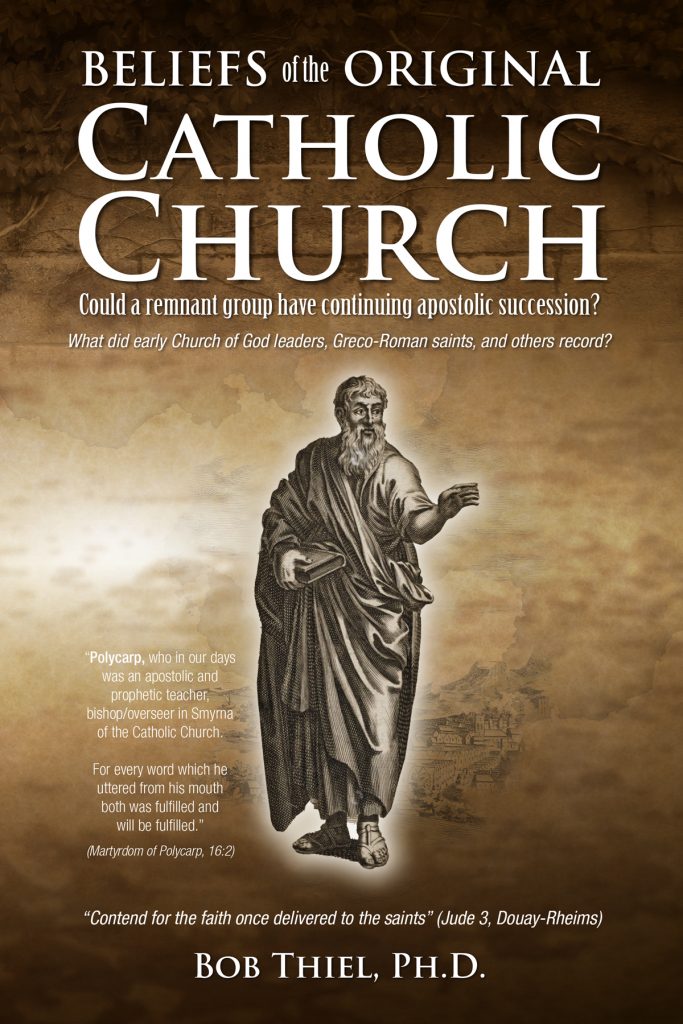
As far as books related to Polycarp go, here is a free online one: Beliefs of the Original Catholic Church.
Based upon information related to when he apparently died and certain ancient records, it appears that Polycarp was born around 52 A.D. His name is Greek, hence he is believed to have been a Gentile.
Here is a legend about his early years (written well after his death):
3. But after the departure of the Apostle, Strataeas succeeded to his teaching, and certain of those after him, whose names, so far as it is possible to discover who and what manner of men they were, I will set down. But for the present let us proceed at once to Polycarp.One whose name was Bucolus being bishop in Smyrna at that time, there was in those days a certain lady, devout and fearing God, conversant in good works, whose name was Callisto. An angel sent from the Lord stood by her and said to her in a vision of the night; 'Callisto, rise up and go to the gate called the Ephesian, and when thou hast gone forward a little in front of it, two men shall meet thee, having with them a little lad named Polycarp. Ask them, if he is for sale; and when they say "Yes," give them the price that they shall demand, and take and keep him with thee. This child is a native of the East.' Then she, the voice still ringing in her ears and her heart bounding with fear and joy, sat up and arose with haste, and without delay did as she was ordered. And with hurry and flurry she came to the aforesaid gate, and found as the angel told her, and she took him and brought him to her house and delighted in rearing him decently and nurturing him in the nurture of the Lord. And she was amazed, when she saw his intelligence and seemly behaviour and his aptitude for piety. And in point of affection she treated him as a son, while as regards promotion over the servants, gradually as he advanced in age he was made manager of her property. And further she gave into his hand the keys of the storehouses.
4. But when at length it befel that she went away from home for a time, she left Polycarp keeper of her house. And as he went in to measure out rations of food for the servants, he would be followed by widows and orphans and by many of the neighbourhood----all the destitute poor among the faithful----and they would ask to have given them, one corn, and others wine, others oil, and whatsoever each desired. But he, having from a child learnt the lesson of well-doing and having the commandments of God inscribed on the tablet of his soul and on the pages of his heart by the finger of God, even the Holy Spirit, fulfilled the precept, Give to him that asketh thee; and so he emptied all the store-rooms, bestowing lavishly on all that were in need.
5. But when at length Callisto returned after a long time, one of the domestics ran to her and said; 'You, my lady, setting at nought all your servants born in the house, placed everything in the hands of this young lad though he came from the East; and he during your absence from home plundered everything that there was and left nothing.' Then she, being disturbed by the harsh words of the accuser (for the charge was enough to ruffle even a tranquil soul, especially when it conjures up a semblance of pecuniary loss), swelled with indignation in her heart and overflowed with wrath, especially because she held it a very great |490 disaster that one befriended by God and given to her by Him should have squandered everything recklessly; for she did not yet know for what purpose he had employed these goods. Wherefore also very divided thoughts sprang up in her mind. So forthwith she called Polycarp by name, saying, 'Polycarp'; and on his obeying her summons she said, 'Bring me the keys of the closets.' And when he brought them and opened the doors, she went in and began to look round; and a miracle of the mighty working of the Lord Jesus Christ was wrought. For he, when he went in, groaned and prayed saying; 'O Lord God, the Father of Thy beloved Son, that in the presence of Thy prophet Elijah didst fill the vessels of the widow of Zarephath, give ear unto me, that in the name of Christ they all may be found filled.' Accordingly they were all found filled, so that she, thinking the slave had lied, was angry and ordered certain of the domestics [to beat him]. But Polycarp came forward and set himself straight, saying; 'Nay do not ill-treat another for my sake; but rather lay on me the blows intended for him; for he told no lie, but deserveth praise for his affection towards his mistress. But as for me, seeing that I did not spend with an evil intent but on the poor, the God and Father of the blessed Jesus Christ hath both filled the hungry and hath sent His angel to restore to thee thine own, that thou also mayest have to give still to the poor according to the custom which thou followest.' Having heard and seen these things, Callisto was filled with fear, advancing still more in faith and in good works, so that Polycarp became as a son to her; and departing this life in faith she left him her substance.
6. Now after the death of Callisto Polycarp advanced greatly in the faith that is in Christ and that pursues a virtuous life. And in his untiring diligence, he from his Eastern stock bore (if one may so say) blossom as a token of good fruit hereafter to come. For the men who dwell in the East are distinguished before all others for their love of learning and their attachment to the divine Scriptures. So having been brought to Asia and having come by the will of God to live in Smyrna, after making himself fully acquainted with the ways of the people of the country and distinguishing himself far beyond them, he discerned that for every servant of God, while the whole world is [his city], the heavenly Jerusalem is his true father-land; and that here on earth we are bidden to sojourn for a while and not to settle; for we are strangers and visitors. (Life of Polycarp)
From the more contemporaneous the records of history, we know that Polycarp lived, and later was martyred, in Asia Minor. This area, at the time, was basically an area dominated by Greeks and Greek speakers.
Irenaeus of Lyon c. 170 wrote in his letter to Florinus:
5. For when I was a boy, I saw you in lower Asia with Polycarp, moving in splendor in the royal court, and endeavoring to gain his approbation. 6. I remember the events of that time more clearly than those of recent years. For what boys learn, growing with their mind, becomes joined with it; so that I am able to describe the very place in which the blessed Polycarp sat as he discoursed, and his goings out and his comings in, and the manner of his life, and his physical appearance, and his discourses to the people, and the accounts which he gave of his intercourse with John and with the others who had seen the Lord. And as he remembered their words, and what he heard from them concerning the Lord, and concerning his miracles and his teaching, having received them from eyewitnesses of the 'Word of life,' Polycarp related all things in harmony with the Scriptures.
7. These things being told me by the mercy of God, I listened to them attentively, noting them down, not on paper, but in my heart. And continually, through God's grace, I recall them faithfully. And I am able to bear witness before God that if that blessed and apostolic presbyter had heard any such thing, he would have cried out, and stopped his ears, and as was his custom, would have exclaimed, O good God, unto what times have you spared me that I should endure these things? And he would have fled from the place where, sitting or standing, he had heard such words. 8. And this can be shown plainly from the letters which he sent, either to the neighboring churches for their confirmation, or to some of the brethren, admonishing and exhorting them. (Eusebius. The History of the Church. Book V, Chapter XX, verses 5-8. Digireads, Stilwel (KS), p. 112).
Polycarp wrote several letters, yet sadly, we only have one and part of another now.
Papias was a Church of God leader who lived in the late first century until apparently the early second century A.D. Statements from Papias tie the Apostle John to Polycarp:
Now testimony is borne to these things in writing by Papias, an ancient man, who was a hearer of John, and a friend of Polycarp, in the fourth of his books. (Fragments of Papias, From the Exposition of the Oracles of the Lord)
The Apostle John is believed to have lived as late as 100/102 A.D. Polycarp was a disciple of the Apostle John. Polycarp became the bishop/pastor of Smyrna from apostolic anointing. He led the Churches of God, in at least the Asia Minor area, for decades in the second century.
Around 155 A.D., Polycarp went to Rome to fight against various heresies that were there.
Polycarp himself lived until his was martyred around 156 A.D.
Although the Church of Rome and Eastern Orthodox consider him to be a saint, as this article will help prove, he held doctrines much more consistent with those of the Continuing Church of God. Polycarp was not a traditional Greco-Roman leader, but a Church of God leader.
Polycarp is also unique among any claimed to be a direct successor to any of the apostles:
Polycarp's Epistle to the Philippians contains a lot of information about what he believed and taught (note: the linked version of Polycarp's Epistle to the Philippians has been corrected by me due to omissions certain 19th century translators made). There was also a letter written about his martyrdom by the Smyrnaeans which gives some insight into him. Polycarp is discussed in writing by such early writers as Ignatius who write an entire letter to him (circa 108 A.D.). Irenaeus who claimed Polycarp was faithful (circa 170 A.D.), Polycrates who claimed that Polycarp was faithful (circa 190 A.D.). Tertullian who claimed that the true Christian church could be traced through him (circa 200 A.D.). Eusebius who wrote that Polycarp was faithful to the apostolic traditions (circa 330 A.D.).
Here is some of what Ignatius wrote:
Ignatius ... to Polycarp, bishop of the Smyrnaeans…So approving am I of your godly mind, which is as it were, grounded upon an unmovable rock, that my praise exceeds all bounds…Do not let those who appear to be trustworthy yet who teach strange doctrines baffle you. Stand firm, like an anvil…Grace will be…always…with Polycarp (Ignatius. Letter to Polycarp. In Holmes M.W. The Apostolic Fathers, Greek Texts and English Translations. Baker Books, Grand Rapids (MI), 2004, p. 194-201).
Ignatius...to the Church of God...which is at Smyrna, in Asia...See that you all follow the bishop, even as Jesus Christ does the Father, and the presbytery as you would the apostles...(Ignatius. Letter to the Smyrnaeans, Chapters 1,8. Translated by Alexander Roberts and James Donaldson. From Ante-Nicene Fathers, Vol. 1. Edited by Alexander Roberts, James Donaldson, and A. Cleveland Coxe. (Buffalo, NY: Christian Literature Publishing Co., 1885.) Revised and edited for New Advent by Kevin Knight. http://www.newadvent.org/fathers/0109.htm>)
The Ephesians from Smyrna (whence I also write to you), who are here for the glory of God, as you also are, who have in all things refreshed me, salute you, along with Polycarp, the bishop of the Smyrnæans. (Ignatius. Letter to the Magnesians, Chapter 15. Translated by Alexander Roberts and James Donaldson. From Ante-Nicene Fathers, Vol. 1. Edited by Alexander Roberts, James Donaldson, and A. Cleveland Coxe. (Buffalo, NY: Christian Literature Publishing Co., 1885.) Revised and edited for New Advent by Kevin Knight. http://www.newadvent.org/fathers/0105.htm>)
My soul be for yours and theirs whom, for the honour of God, you have sent to Smyrna; whence also I write to you, giving thanks unto the Lord, and loving Polycarp even as I do you. (Ignatius. Letter to the Ephesians, Chapter 21. Translated by Alexander Roberts and James Donaldson. From Ante-Nicene Fathers, Vol. 1. Edited by Alexander Roberts, James Donaldson, and A. Cleveland Coxe. (Buffalo, NY: Christian Literature Publishing Co., 1885.) Revised and edited for New Advent by Kevin Knight. http://www.newadvent.org/fathers/0104.htm>)
Polycarp, according to Ignatius, was the bishop (overseeing pastor) of the Church of God in Smyrna.
Unlike many in the early Church of God, Polycarp has several mentions in letters in surviving literature while he was alive. He also had several mentions in early literature after his death.
According to the so-called Apostolic Constitutions, the Apostles John, Philip, Bartholomew, Thomas, and Matthew taught the laying on of hands for clergy, including deacons (Apostolic Constitutions, Book VIII, Section 3, XVII-XXII; while the apostles did not write this book, some of the information in it appears consistent with apostolic practices, while other information is not). Since the Apostles would have believed the Bible, the laying on of hands would have been their teaching (Acts 6:5-6, 8:17, 13:2-3, 19:6,17; 2 Corinthians 1:21; 1 Timothy 4:14; 2 Timothy 1:6; Hebrews 6:2). The Apostle Philip, along with the Apostle John, likely ordained and anointed Polycarp of Smyrna as Polycarp was from Asia Minor and was appointed by more than one apostle.
Irenaeus, considered to be a saint by Church of Rome and Eastern Orthodox, claimed to have met Polycarp and recorded this about Polycarp (c. 180 A.D.):
But Polycarp also was not only instructed by apostles, and conversed with many who had seen Christ, but was also, by apostles in Asia, appointed bishop of the Church in Smyrna…always taught the things which he had learned from the apostles, and which the Church has handed down, and which alone are true. To these things all the Asiatic Churches testify, as do also those men who have succeeded Polycarp down to the present time...There is also a very powerful Epistle of Polycarp written to the Philippians, from which those who choose to do so, and are anxious about their salvation, can learn the character of his faith, and the preaching of the truth (Irenaeus. Adversus Haeres. Book III, Chapter 3, Verse 4).
Notice that Irenaeus is claiming that Polycarp was appointed bishop (pastor/overseer) of the Church in Smyrna by the apostles in Asia (which would most likely have been John and Philip and perhaps some others) and that his Letter to the Philippians taught the true faith. Notice also that Irenaeus is claiming that there was a list of men who have succeeded Polycarp until the late 2nd century and that they held to the teaching of the apostles. There is simply no reliable record of such transfer occurring in Rome or the other so-called "sees" of the Eastern Orthodox. Thus the only documented (and essentially universally accepted) apostle to “bishop” transfer of leadership for the 1st and 2nd centuries that continued until at least the end of the 2nd century was through Polycarp of Smyrna (more on "apostolic succession" can be found in the article simply titled Apostolic Succession).
Consider that we have from this early Roman Catholic source that Polycarp and his successors in Asia Minor (at least until the time that Irenaeus wrote this, around 180 A.D.) practiced the true teachings that they learned from the apostles (it should be noted that these churches had several doctrines that significantly differ from those currently held by the Roman Church, some of which are documented in the article Location of the Early Church: Another Look at Ephesus, Smyrna, and Rome).
This is also later (maybe 20 years later) essentially confirmed by Tertullian:
It is probable that Tertullian was aware of bishops of Rome prior to Clement (as Irenaeus wrote prior to him), as well as bishops of Smyrna prior to Polycarp, but that Tertullian felt that the apostolic succession could only have gone through Polycarp (who he listed first) or Clement. It must be understood that Tertullian's writing above, according The Catholic Encyclopedia, is one of the most important writings regarding the Catholic Church. Specifically the Catholic Church teaches:Anyhow the heresies are at best novelties, and have no continuity with the teaching of Christ. Perhaps some heretics may claim Apostolic antiquity: we reply: Let them publish the origins of their churches and unroll the catalogue of their bishops till now from the Apostles or from some bishop appointed by the Apostles, as the Smyrnaeans count from Polycarp and John, and the Romans from Clement and Peter; let heretics invent something to match this (Tertullian. Liber de praescriptione haereticorum. Circa 200 A.D. as cited in Chapman J. Transcribed by Lucy Tobin. Tertullian. The Catholic Encyclopedia, Volume XIV. Copyright © 1912 by Robert Appleton Company. Online Edition Copyright © 2003 by K. Knight. Nihil Obstat, July 1, 1912. Remy Lafort, S.T.D., Censor. Imprimatur. +John Cardinal Farley, Archbishop of New York).
Among the writings of the Fathers, the following are the principal works which bear on the doctrine of the Church: ST. IRENÆUS, Adv. Hereses in P.G., VII; TERTULLIAN, De Prescriptionibus in P. L... (Joyce G.H. Transcribed by Douglas J. Potter. The Church. The Catholic Encyclopedia, Volume III. Copyright © 1908 by Robert Appleton Company. Online Edition Copyright © 2003 by K. Knight. Nihil Obstat, November 1, 1908. Remy Lafort, S.T.D., Censor. Imprimatur. +John Cardinal Farley, Archbishop of New York).
Thus Catholics themselves must recognize the importance of these statements by Tertullian (as well as Irenaeus)--there were two churches with proper apostolic claims as far as he was concerned. And not just Rome--but one in Asia Minor that had been led by the Apostle John through Polycarp and his descendants.
The old Radio Church of God taught:
At Patmos the apostle John was finally released. Again at Ephesus he trained Polycarp who later carried forward the work of John and Philip. Polycarp and Polycrates are the last leaders of the Church in this part of the world of which we have any record. Lesson 49 - I Will Build My Church. Ambassador College Bible Correspondence Course, 1967
The late Pastor General of the old Worldwide/Radio Church of God wrote:
Jesus prophesied, "I will build my church." That Church, foretold Jesus, would never be extinguished. ... The true Church continued, a tiny "little flock," almost unnoticed by the world ...
It is significant that after his release John trained Polycarp elder of Smyrna, a city near Ephesus in the province of Asia. ... At neighboring Smyrna, Polycarp presided over the Church of God for half a century after John's death. Polycarp stood up boldly for the truth while many fell away and began having fellowship with the Catholic bishops of Rome. History relates that following the example of Peter, Paul and John, Polycarp wrote many letters to congregations and individuals, though all these have perished, save one in an edited version. (Armstrong HW. The Church They Couldn't Destroy. Good News, December 1981)
The old Worldwide Church of God also published the following related to Polycarp:
After the death of the apostle John about A.D. 100, leadership of the churches in Asia Minor was in the hands of Polycarp. That was not an easy time in history. The Roman government had begun to persecute the Christian Church in the days of. Nero. Other emperors followed suit over the next several centuries.
In the A.D. 150s the Romans severely persecuted Christians in Asia Minor. Polycarp, then an old man ..., still provided the spiritual leadership for the oppressed Christians.
The Roman senate had declared it atheism not to believe in the Roman gods. To be a declared follower of Jesus Christ, whom Pontius Pilate had crucified in A.D. 31, was forbidden.
Christians were sometimes called before magistrates and told to renounce their beliefs. Those who didn't were often tortured or cast into the arenas to fight wild beasts.
Such was the scene in A.D. 156 in the city of Smyrna where Polycarp resided.
A recent plague and an earthquake had convinced the superstitious townspeople that Christians were to blame for the disasters. "The Roman gods must be displeased," they reasoned.
In the middle of one cold night in February, Roman soldiers placed Polycarp under arrest. The next day as the Roman games were coming to a conclusion, he was brought before the magistrates and ordered to renounce Jesus. Polycarp's answer was, as quoted by the early church historian Eusebius: "Eighty and six years have I served him, and he never did me wrong; and how can I now blaspheme my King that has saved me?...Hear my free confession. I am a Christian."
The crowd demanded the lions be let loose. But the time for wild beast sports was over.
In a rage they heaped broken pieces of wood together and bound Polycarp to a pole to be burned at the stake. A great wind blew the flames away from Polycarp, and an executioner thrust a sword into him — ending the life of one of the great leaders of Christianity.
It is this kind of courage and dedication that truly makes a great leader. (Kelly R. Four Great Qualities of Leadership. Plain Truth, September 1984)
Interestingly, although he is not in the list of Bishops of Rome (since he was not Roman, that is logical), Polycarp is mentioned in the article on titled Hierarchy of the Early Church in The Catholic Encyclopedia:
A. Mention of Bishops by Polycrates
In a synodal letter written by Polycrates of Ephesus about the year 190 this bishop, sixty-five years of age, speaks of seven of his relatives who had been bishops before him. Besides these he mentions Polycarp and Papirius of Smyrna, Thraseas of Eumenea, Sagaris of Laodicea and Melito of Sardes (Eusebius, "Hist. Eccles.", v, 24, 2 sq.) (Borkowski S. De Dunin. Transcribed by Douglas J. Potter. Hierarchy of the Early Church. The Catholic Encyclopedia, Volume VII. Copyright © 1910 by Robert Appleton Company. Online Edition Copyright © 2003 by K. Knight. Nihil Obstat, June 1, 1910. Remy Lafort, S.T.D., Censor. Imprimatur. +John Cardinal Farley, Archbishop of New York).
It should also be noted that Polycrates also included bishops from Ephesus and elsewhere in that list. After a synod in 2011, the Greek Orthodox recognized a patriarch of Ephesus and that group put out the following list:
Hierarchical Succession of the Patriarchal See of Ephesus
Bishops of the Apostolic Throne
1. Apostle St. Timothy of the Seventy (65-80?) circa 80-95
2. Apostle St. Onesimus of the Seventy (80?-97?) circa 95-97
3. Apostle and Evangelist St. John The Theologian (65?-100?) circa 98-117 A.D.
4. St. Polycarp of Smyrna (100?-156)
5. St. Thraseas of Eumenia (156-160)
6. St. Sagarius of Laodicea (160-167)
7. St. Papirius of Smyrna (167-170)
8. St. Melito I of Sardis (170-180)
9. St. Polycrates of Ephesus (180-200)
10. St. Apollonius of Ephesus (200-210)Greek Orthodox Patriarchate of Ephesus, of All Asiana, and the Americas. http://ephesuspat.weebly.com/list-of-patriarchs.html viewed 02/19/15
(It should be noted that the Bible refers to Timothy as an evangelist in Timothy 4:5 and neither he nor Onesimus were biblically referred to as apostles.)
While it is true that there was apostolic succession from the Apostle John and including all of those leaders, the Greek Orthodox are misleading all by trying to hint that they are the true successors of these leaders--it is only groups like the Continuing Church of God that have the same teaching of those leaders--the Greek Orthodox do not.
It should also be noted that I put together a list of all the above from the Apostle John to Apollonius in 2008, with similar dates, showing how the true Christian Church, now best represented by the Continuing Church of God had apostolic succession from the Apostle John (I did NOT get this from the Greek Orthodox). This information was also part of a booklet in 2014 (see Continuing History of the Church of God. Nazarene Books, 2014, p. 45).
As we would start with the Apostle John, we would call the list of successors Smyrnaeans, partially because of the time that Polycarp arose in prominence.
Even The Catholic Encyclopedia recognize that the Smyrnaeans were a faithful church:
Smyrna...Christianity was preached to the inhabitants at an early date. As early as the year 93, there existed a Christian community directed by a bishop for whom St. John in the Apocalypse (i, II; ii, 8-11) has only words of praise…There were other Christians in the vicinity of the city and dependent on it to whom St. Polycarp wrote letters (Eusebius, "Hist. Eccl.", V, xxiv). When Polycarp was martyred…the Church of Smyrna sent an encyclical concerning his death to the Church of Philomelium and others (Vailhe’ S. Transcribed by Lucia Tobin. Smyrna. The Catholic Encyclopedia, Volume XIV. Copyright © d, proclaiming that he had received this one and sole truth from the apostles... John, the disciple of the Lord…exclaiming, "Let us fly, lest even the bath-house fall down, because Cerinthus, the enemy of the truth, is within." And Polycarp himself replied to Marcion, who met him on one occasion, and said, "Dost thou know me?" "I do know thee, the first-born of Satan" (Irenaeus. Adversus Haeres. Book III, Chapter 4, Verse 3 and Chapter 3, Verse 4).
Valentinus, Cerinthus, and Marcion are considered by Catholics and others to have been Gnostic heretics, while Hyginus, Pius, and Anicetus were claimed bishops of Rome. Thus these quotes from Irenaeus show that the supposed Roman bishops did not have a higher leadership role than Polycarp of Smyrna had, because it apparently took the stature of the visiting Polycarp to turn many Romans away from the Gnostic heretics. The other reality is that according to Tertullian, it took the Church of Rome decades before they got rid of those heretics (Tertullian. The Prescription against Heretics, Chapter 30. Translated by Peter Holmes. Electronic Version Copyright © 2006 by Kevin Knight. All rights reserved), thus suggesting that Rome tolerated heresies much more than Polycarp did.
Cerinthus taught allegorizing of scripture, taught that non-biblical tradition was more important than scripture, blended Gnostic teachings with the Bible, implemented improper festivals, claimed to be an apostle, and claimed that angels gave him messages. Although the Apostle John denounced him, many of his teachings eventually found their way into the Church of Rome. More on Cerinthus can be found in the article Cerinthus: An early heretic.
Marcion was possibly the first heretic to attempt to do away with the Sabbath. Valentinus of Rome, who Polycarp denounced, who is believed to have been the first affiliated with Christianity to teach the Trinitarian concept of three hypostasis or make any clear statement of ‘equality’ regarding three alleged persons of God--Valentinus also promoted the 'eighth day' ogdoad--a Gnostic concept.
But notice that the Church of Rome tolerated Marcion and Valentinus for decades, yet Polycarp denounced them. It should also be noted that even Roman Catholic recognized sources allege that Marcion and descendants of Valentinus had ties to the famous Simon Magus, who was mentioned in Acts 8:5-25.
Furthermore, Irenaeus also reported the following about Polycarp's visit to Rome and his meeting with the Roman Bishop Anicetus:
And when the blessed Polycarp was sojourning in Rome in the time of Anicetus, although a slight controversy had arisen among them as to certain other points…For neither could Anicetus persuade Polycarp to forego the observance [in his own way], inasmuch as these things had been always observed by John the disciple of our Lord, and by other apostles with whom he had been conversant; nor, on the other hand, could Polycarp succeed in persuading Anicetus to keep [the observance in his way], for he maintained that he was bound to adhere to the usage of the presbyters who preceded him. And in this state of affairs they held fellowship with each other; and Anicetus conceded to Polycarp in the Church the celebration of the Eucharist, by way of showing him respect; so that they parted in peace one from the other, maintaining peace with the whole Church, both those who did observe [this custom] and those who did not Irenaeus. (FRAGMENTS FROM THE LOST WRITINGS OF IRENAEUS. Translated by Alexander Roberts and James Donaldson. Excerpted from Volume I of The Ante-Nicene Fathers (Alexander Roberts and James Donaldson, editors); American Edition copyright © 1885. Electronic version copyright © 1997 by New Advent, Inc.).
Apparently Anicetus conceded enough (such as about Polycarp’s position on that and probably about Marcion—who Anicetus agreed was a heretic) that no recorded major ‘blowup’ between the two survived. It appears that Anicetus, tried to satisfy Polycarp to some degree, and tried to appear not to be a complete heretic.
But were the churches in Asia Minor and Rome truly in peace after that?
No, they were not.
The Catholic monk Epiphanius wrote:
For long ago, even from the earliest days, the Passover was celebrated at different times in the church…In the time of Polycarp and Victor, the east was at odds with the west and they would not accept letters of commendation from each other (Epiphanius. The Panarion of Epiphanius of Salamis, Books II and III (Sects 47-80), De Fide). Section VI, Verse 9,7. Translated by Frank Williams. EJ Brill, New York, 1994, p.411).
It appears likely that Polycarp, when he returned to Asia Minor, told the Christians there that he was successful in turning some away from heretics such as Marcion and Valentinus. He probably was so disgusted by his Roman experience that he let those in Asia Minor know that they should not receive doctrine or other instruction from any in Rome--he also specifically would not change Passover observance to Sunday. This seems to be confirmed by Polycrates' writings a few decades later who was quite willing to tell the 'Bishop of Rome' that none in his region would accept Victor's views above the Bible. Polycarp likely told Polycrates' personally or told someone in contact with Polycrates'.
Eamon Duffy, a Catholic scholar and a member of the Pontifical Historical Commission claims that although Eusebius implies that Victor called for some significant synods, everyone responded to Victor, and then he attempted to excommunicate those in Asia Minor (though was stopped from doing so by Irenaeus per Eusebius. Church History. Book V, Chapter 24, verses 11,18, p. 115), this is probably not what happened (Duffy, Eamon. Saints & Sinners: A History of the Popes. Yale University Press, New Haven (CT), 2002, pp. 15-16).
Essentially E. Duffy seems to believe that there were some in or near Rome who still observed Passover on the 14th. As this differed from Victor’s practices, Victor asked what the practices in other areas he had contact with were. Then he asked what others did, mainly in Alexandria and Greco-Jerusalem, then decided to put out of his Roman area churches those who kept the 14th (at that time some Roman churches met on Saturday and Sunday, and one would suspect that those who met on Saturday were more inclined to keep Passover on the 14th). E. Duffy seems to feel that the local churches who kept the 14th Passover may have asked those in Asia Minor for their assistance to deal with Victor, perhaps because they sometimes interacted with his followers (private meeting places for an illegal religion were scarce in Rome, and those loyal to Rome and Asia Minor apparently may have sometimes met together).
There are many reasons that E. Duffy seems to be correct, including Polycrates' writing.
A 19th century scholar indicated that Bishop Victor’s concerns were related to one called Blastus in Rome, indicating that there was a local matter concerning this:
When the priest Blastus sought to establish at Rome the Jewish customs in celebrating Easter, Pope Victor resolved to procure uniformity…(Birkhaeuser, Jodocus Adolph. History of the Church, from Its First Establishment to Our Own Times: Designed for the Use of Ecclesiastical Seminaries and Colleges. Published by F. Pustet, 1898. Original from the New York Public Library, Digitized Jun 21, 2006, p.96)
(I presume, as I have not seen the original Greek, the term priest above comes from the word presbyter as the Roman Catholic priesthood as now known was not likely to have been established for another century or so. Also, the term Passover and not Easter was used at that time, nor was the Bishop of Rome then called Pope.)
Furthermore, The Catholic Encyclopedia admits that there was a problem in Rome from an Oriental (a term it uses for someone from Asia Minor) at that time. This is likely one who had ties to Polycrates.
In Rome itself, where Pope Victor naturally enforced the observance of Easter on Sunday by all Christians in the capital, an Oriental named Blastus, with a few followers, opposed the pope and brought about a schism, which, however, did not grow in importance…(Kirsch J.P. Transcribed by Michael T. Barrett. Pope St. Victor I. The Catholic Encyclopedia, Volume XV. Copyright © 1912 by Robert Appleton Company., NY. Nihil Obstat, October 1, 1912. Remy Lafort, S.T.D., Censor. Imprimatur. +John Cardinal Farley, Archbishop of New York, pp. 408-409)
What was Blastus’ specific problem according to Tertullian? It was that Blastus kept Passover on the 14th and observed other biblical laws as Tertullian (or possibly Pseudo-Tertullian?) reported:
In addition to all these, there is likewise Blastus, who would latently introduce Judaism. For he says the passover is not to be kept otherwise than according to the law of Moses, on the fourteenth of the month (Tertullian. Against All Heresies, Chapter 8. Translated by S. Thelwall).
Interestingly, while Eusebius knew of, and seems to have had, a writing by Irenaeus which he called “to Blastus On Schism” (Eusebius. The History of the Church, Book V, Chapter XX, Verse 1, p. 112), Eusebius did not report what it said. Doing so likely would have highlighted more of the differences between those trying to be faithful and the practices of the emerging Greco-Roman confederation. This could have raised concerns for Emperor Constantine that Eusebius probably did not want raised.
Interestingly, E. Duffy seems to believe that this incident may have been reported by Eusebius essentially to assist him in coming up with a final solution for the “perpetual problem” of when to observe Passover.
What these writings in this section seem to show is that the aged Polycarp went to Rome to primarily deal with Gnostic heretics that claimed to be Christian. It was Polycarp, and no "bishop of Rome," who was successful in turning Christians away from these heretics. It was Polycarp, and no Roman bishop, who was the faithful "heretic fighter" in the second century.
Furthermore, Polycarp himself wrote that “many” (which likely included many in Rome and others with affiliation) were following vain/false forms of Christianity:
“For whosoever does not confess that Jesus Christ has come in the flesh, is antichrist,” and whosoever does not confess the testimony of the cross, is of the devil; and whosoever perverts the oracles of the Lord to his own lusts, and says that there is neither a resurrection nor a judgment, he is the first-born of Satan. Wherefore, forsaking the vanity of many, and their false doctrines, let us return to the word which has been handed down to us from the beginning (Polycarp. Letter to the Philippians, Chapter VII).
Polycarp wanted Christians to forsake the vanity of many who claimed to be Christians, but really were accepting allegory and tradition above the word of God (see also What is the Appropriate Form of Biblical Interpretation?). The 'vanity of many' was also related to the 'mystery of lawlessness' that the Apostle Paul warned about in 2 Thessalonians 2:7 (see also: Mystery of Iniquity) and that apostates like Simon Magus and Marcion of Pontus promoted.
Notice the following:
Polycarp in his letter To the Philippians . . . invites his recipients to abandon the vanity of the multitude and their false doctrines (τάς ψευδιδασκαλίας), to return to the word that was transmitted from the beginning … (Monroy MS. The Church of Smyrna: History and Theology of a Primitive Christian Community. Peter Lang edition, 2015)
Polycarp’s successors in the Church of God not only hold to his doctrines, we also urge all to abandon the false doctrines that the Greco-Roman multitudes have embraced and to hold to the original faith as the Bible urges (Jude 3).
Like the Continuing Church of God, Polycarp apparently felt that the true church would be a “little flock” (Luke 12:32) or “remnant” (Romans 9:27; 11:5) since he warned about “the vanity of many.” Thus, it should be of little surprise that the true church would be small throughout history. By warning about “the vanity of many,” Polycarp was admonishing the Church of God to be separate. And a distance, a separation, occurred throughout history. Both Polycrates of Ephesus and Serapion of Antioch were witnesses to this separation into the third century.
Sadly, most of "the many" who claim that Polycarp was a saint of their faith do not have the same teachings or practices that Polycarp did. Nor will they keep "the word which has been handed down to us from the beginning" (cf. Jude 3).
It should also be noted that according to E. Duffy, a statement in Eusebius’ account that the presbyters “sent the eucharist” to the Quartodeciman churches (Eusebius. Church History. Book V, Chapter 24, verse 15, p. 115 ) proves that this was originally a local matter.
Why?
E. Duffy explains:
…because any fragments of the eucharistic bread sent on the long sea journey to the churches of Asia Minor would have gone mouldy or hard long before they reached their destination…Victor was not brawling randomly around the Mediterranean spoiling for a fight, but trying to impose uniformity of practice on all the churches in his own city, as part of a more general quest for internal unity and order. The churches of proconsular Asia may well have protested the condemnation of a custom…but Victor’s excommunication was aimed at Asian congregations in Rome, not broadside at churches over whom he which had no direct jurisdiction. (Duffy, pp. 15-16)
E. Duffy’s explanation does make sense.
Instead of indicating any real superiority of the Church of Rome, Polycrates’ letter clearly supports the view that the Church of God in Asia Minor towards the end of the 2nd century considered the Bible, and not Rome, as authoritative.
Although the Church of Rome wishes to act like they had 'full communion' with Polycarp, and they call him a saint, they endorsed a policy from Emperor Theodosius (late fourth century) of killing people continued to keep Passover on the fourteenth as Polycarp did.
The region of Asia Minor kept itself separate from the main groups in Rome and the Alexandria until they were taken over in the mid-late third century (Eusebius. The History of the Church, Book VII, Chapter V, Verse I, p. 147). Polycarp most definitely was NOT in 'full communion' with Rome and his 'apostolic successors' were not either. If so, Polycrates would not have been in able to respond like he did, and with the backing of the other bishops in Asia Minor (his response is shown later in this paper).
Where did the idea of the Holy Spirit being one hypostasis of a trinity come from?
It did not come from Polycarp. It actually came from the famous heretic Valentinus in the early to mid 2nd century (note that Valentinus is considered to be a heretic by Catholics, Orthodox, Protestant, and Church of God adherents).
Here is what it is recorded that a one-time 4th century Catholic bishop named Marcellus of Ancyra wrote about Valentinus' writings, which appears to be discussing perhaps the earliest citation about the Holy Spirit extant (other than scriptural references or references that make no specific claims):
Now with the heresy of the Ariomaniacs, which has corrupted the Church of God...These then teach three hypostases, just as Valentinus the heresiarch first invented in the book entitled by him 'On the Three Natures'. For he was the first to invent three hypostases and three persons of the Father, Son and Holy Spirit, and he is discovered to have filched this from Hermes and Plato (Source: Logan A. Marcellus of Ancyra (Pseudo-Anthimus), 'On the Holy Church': Text, Translation and Commentary. Verses 8-9. Journal of Theological Studies, NS, Volume 51, Pt. 1, April 2000, p.95).
Hence the idea of the Holy Spirit as one of three hypostasis, while it did appear in the 2nd century, was developed by a heretic.
Regarding that heretic, the Catholic historian Irenaeus (c. 180 A.D.) noted that Polycarp had to go to Rome to stop people from listening to his teachings:
To these things all the Asiatic Churches testify, as do also those men who have succeeded Polycarp down to the present time -- a man who was of much greater weight, and a more stedfast witness of truth, than Valentinus, and Marcion, and the rest of the heretics. He it was who, coming to Rome in the time of Anicetus caused many to turn away from the aforesaid heretics to the Church of God, proclaiming that he had received this one and sole truth from the apostles...(Irenaeus. Adversus Haeres. Book III, Chapter 3, Verse 4).
Also, Polycarp called the Father God and Jesus God, he never referred to the Holy Spirit that way (see Polycarp's Letter to the Philippians). Here is the only extant direct quote from Polycarp that clearly mentions the Holy Spirit:
I bless you because you have considered me worthy of this day and hour, that I might receive a place among the number of martyrs in the cup of your Christ, to the resurrection of eternal life, both of soul and of body, in the incorruptibility of the Holy Spirit. May I be received among them in your presence today, as a rich and acceptable sacrifice, as you have prepared and revealed beforehand, and have now accomplished, you who are the faithful and true God. For this reason, indeed for all things, I praise you, I bless you, I glorify you, through the eternal and heavenly High-priest, Jesus Christ, your beloved Son, through whom to you with him and the Holy Spirit be glory both now and for the ages to come. Amen (The Martyrdom of Polycarp, 14:2-3. In Holmes M.W. The Apostolic Fathers, Greek Texts and English Translations. Baker Books, Grand Rapids (MI), 2004, p.239).
More historical and scriptural information on the Holy Spirit can be found in the article Did Early Christians Think the Holy Spirit Was A Separate Person in a Trinity?
More historical and scriptural information on the Godhead can be found in the article Binitarian View: One God, Two Beings Before the Beginning.
Polycarp was a binitarian (a type of Semi-Arian) as he taught that Jesus was the Christ, the Son of God, and also God and that the Father was God; but he did not teach that about the Holy Spirit.
Polycarp of Smyrna wrote:
But may the God and Father of our Lord Jesus Christ, and Jesus Christ Himself, who is the Son of God, and our everlasting High Priest, build you up in faith and truth, and in all meekness, gentleness, patience, long-suffering, forbearance, and purity; and may He bestow on you a lot and portion among His saints, and on us with you, and on all that are under heaven, who shall believe in our Lord and God Jesus Christ, and in His Father, who "raised Him from the dead (Polycarp. Letter to the Philippians. From Ante-Nicene Fathers, Volume 1as edited by Alexander Roberts & James Donaldson. American Edition, 1885. Chapter 12 modified by B. Thiel to correct omission in translation).
For whosoever does not confess that Jesus Christ has come in the flesh, is antichrist (Polycarp, Chapter VII. Letter to the Philippians. From Ante-Nicene Fathers, Volume 1as edited by Alexander Roberts & James Donaldson. American Edition, 1885).
Him who died for us, and for our sakes was raised again by God from the dead (Polycarp, Chapter IX. Letter to the Philippians. From Ante-Nicene Fathers, Volume 1as edited by Alexander Roberts & James Donaldson. American Edition, 1885).
These statements from Polycarp are consistent with the apparent positions of all groups that I am aware of that profess any form of Christianity, except those that are unitarian or affiliated with the Jehovah's Witnesses. More information can be found in the article Did Early Christians Consider that Jesus was God? The deity of the Father is the apparent position of all groups that I am aware of that profess any form of Christianity. However, more information can be found in the article Is The Father God?
Now although trinitarians would agree with those statements from Polycarp, there is no proof that Polycarp believed the heretical Valentinus who taught that God was three hypostases. Valentinus was a heretic that Polycarp denounced (an article of related interest may be Did the True Church Ever Teach a Trinity?
Even scholars like the Catholic Mauricio Saavedra Monroy recognize that Polycarp made binitarian statements:
As for the binitarian confessional formula, which confesses the Father and the Son, we likewise find examples in Polycarp and Ignatius. (Monroy MS. The Church of Smyrna: History and Theology of a Primitive Christian Community. Peter Lang edition, 2015, p. 292)
Much more historical and scriptural information on the Godhead can be found in the article Binitarian View: One God, Two Beings Before the Beginning.
Polycarp taught about the Kingdom of God:
"Blessed are the poor, and those that are persecuted for righteousness' sake, for theirs is the kingdom of God" (Polycarp. Letter to the Philippians, Chapter II. From Ante-Nicene Fathers, Volume 1as edited by Alexander Roberts & James Donaldson. American Edition, 1885).
Knowing, then, that "God is not mocked," we ought to walk worthy of His commandment and glory ...For it is well that they should be cut off from the lusts that are in the world, since "every lust warreth against the spirit; " and "neither fornicators, nor effeminate, nor abusers of themselves with mankind, shall inherit the kingdom of God," nor those who do things inconsistent and unbecoming (Polycarp. Letter to the Philippians, Chapter V. From Ante-Nicene Fathers, Volume 1as edited by Alexander Roberts & James Donaldson. American Edition, 1885).
And on the following sabbath he said; 'Hear ye my exhortation, beloved children of God. I adjured you when the bishops were present, and now again I exhort you all to walk decorously and worthily in the way of the Lord...Watch ye, and again Be ye ready, Let not your hearts be weighed down, the new commandment concerning love one towards another, His advent suddenly manifest as of rapid lightning, the great judgment by fire, the eternal life, His immortal kingdom. And all things whatsoever being taught of God ye know, when ye search the inspired Scriptures, engrave with the pen of the Holy Spirit on your hearts, that the commandments may abide in you indelible.' (Life of Polycarp, Chapter 24. (1889) from J. B. Lightfoot, The Apostolic Fathers, vol. 3.2, pp. 488-506)
More information on what early Christians taught about the Kingdom can be found in the free online booklet: The Gospel of the Kingdom of God.
Those in the early church, such as Polycarp, did not endorse it or participate in military service.
Polycarp wrote:
But He who raised Him up from the dead will raise up us also, if we do His will, and walk in His commandments, and love what He loved, keeping ourselves from all unrighteousness, covetousness, love of money, evil speaking, falsewitness; "not rendering evil for evil, or railing for railing," or blow for blow, or cursing for cursing (Polycarp. Letter to the Philippians, Chapter II. From Ante-Nicene Fathers, Volume 1as edited by Alexander Roberts & James Donaldson. American Edition, 1885).
It would be impossible to love what Jesus loved and to kill people. The admonition to not retaliate blow by blow could be seen as a stance as supporting the concept that the second century church was against military service.
More information, including the related scriptures, can be found in the article Military Service and the COGs
Sometime in the second century, some leader in Rome decided to change the date of Passover (see Easter). However, the faithful leaders in Asia Minor would not accept that.
As mentioned before, around 155 A.D. Polycarp of Smyrna went to Rome to deal with various heretics and he tried to persuade the Anicetus not to change Passover to an Easter Sunday holiday (Irenaeus. FRAGMENTS FROM THE LOST WRITINGS OF IRENAEUS. Translated by Alexander Roberts and James Donaldson. Excerpted from Volume I of The Ante-Nicene Fathers (Alexander Roberts and James Donaldson, editors); American Edition copyright © 1885. Electronic version copyright © 1997 by New Advent, Inc).
The Catholic writer Eusebius recorded that Polycrates of Ephesus, around 195 A.D. wrote the following to the Roman Bishop Victor who wanted all who professed Christ to change Passover from the 14th of Nisan to Sunday:
We observe the exact day; neither adding, nor taking away. For in Asia also great lights have fallen asleep, which shall rise again on the day of the Lord's coming, when he shall come with glory from heaven, and shall seek out all the saints. Among these are Philip, one of the twelve apostles, who fell asleep in Hierapolis; and his two aged virgin daughters, and another daughter, who lived in the Holy Spirit and now rests at Ephesus; and, moreover, John, who was both a witness and a teacher, who reclined upon the bosom of the Lord, and, being a priest, wore the sacerdotal plate. He fell asleep at Ephesus. And Polycarp in Smyrna, who was a bishop and martyr; and Thraseas, bishop and martyr from Eumenia, who fell asleep in Smyrna. Why need I mention the bishop and martyr Sagaris who fell asleep in Laodicea, or the blessed Papirius, or Melito, the Eunuch who lived altogether in the Holy Spirit, and who lies in Sardis, awaiting the episcopate from heaven, when he shall rise from the dead ? All these observed the fourteenth day of the passover according to the Gospel, deviating in no respect, but following the rule of faith. And I also, Polycrates, the least of you all, do according to the tradition of my relatives, some of whom I have closely followed. For seven of my relatives were bishops; and I am the eighth. And my relatives always observed the day when the people put away the leaven. I, therefore, brethren, who have lived sixty-five years in the Lord, and have met with the brethren throughout the world, and have gone through every Holy Scripture, am not affrighted by terrifying words. For those greater than I have said ' We ought to obey God rather than man'...I could mention the bishops who were present, whom I summoned at your desire; whose names, should I write them, would constitute a great multitude. And they, beholding my littleness, gave their consent to the letter, knowing that I did not bear my gray hairs in vain, but had always governed my life by the Lord Jesus (Eusebius. The History of the Church, Book V, Chapter XXIV, Verses 2-7 . Translated by A. Cushman McGiffert. Digireads.com Publishing, Stilwell (KS), 2005, p. 114)
Hence it is clear that throughout the second century, that Polycarp and the churches in Asia Minor continued to observe the Passover on the 14th of Nisan, unlike the Romans.
Polycarp's position on the Passover is markedly different from that of most Protestant, Roman Catholic, Eastern Orthodox churches or instead is more consistent with that of the Continuing Church of God.
For more details, please see the article Passover and the Early Church; there is also a detailed YouTube video available titled History of the Christian Passover.
Polycarp taught the resurrection of the dead as he wrote:
But He who raised Him up from the dead will raise up us also, if we do His will, and walk in His commandments, and love what He loved (Polycarp. Letter to the Philippians, Chapter II. From Ante-Nicene Fathers, Volume 1 as edited by Alexander Roberts & James Donaldson. American Edition, 1885).
Polycarp taught that the body and soul were to be resurrected, hence he taught against the immortality of the soul doctrine (see also Did Early Christians Believe that Humans Possessed Immortality?):
I bless you for because you have considered me worthy of this day and hour, that I might receive a place among the number of martyrs in the cup of your Christ, to the resurrection to eternal life, both of soul and of body, in the incorruptibility of the Holy Spirit (The Martyrdom of Polycarp, 14:2. In Holmes M.W. The Apostolic Fathers, Greek Texts and English Translations. Baker Books, Grand Rapids (MI), 2004, p.239).
But not everyone will be pleased with the resurrection as Polycarp also taught the following:
Polycarp said; 'Thou threatenest that fire which burneth for a season and after a little while is quenched: for thou art ignorant of the fire of the future judgment and eternal punishment, which is reserved for the ungodly (The Martyrdom of Polycarp 11:2).
Polycarp's position on the resurrection tends to differ from that of Protestant, Roman Catholic, Eastern Orthodox churches or instead is more consistent with that of the Continuing Church of God.
More on this subject can be found in the article What Did the Early Church Teach About the Resurrection?
Would Polycarp have kept the seventh-day Sabbath?
Yes.
Before going further, perhaps it should also be mentioned that a 2nd century collection of writings (which contains some erroneous doctrines), related to the Apostle John, has the following:
John … on the seventh day, it being the Lord's day, he said to them: Now it is time for me also to partake of food. …
John went to Ephesus, and regulated all the teaching of the church, holding many conferences, and reminding them of what the Lord had said to them, and what duty he had assigned to each. And when he was old and changed, he ordered Polycarp to be bishop over the church. (Acts of the Holy Apostle and Evangelist John the Theologian. Translated by Alexander Walker. From Ante-Nicene Fathers, Vol. 8. Edited by Alexander Roberts, James Donaldson, and A. Cleveland Coxe)
While the above is not scripture, notice that it identifies the “Lord’s Day” as the seventh day of the week, and also points to the belief that John put Polycarp over the church. So, neither of those are new concepts in the 21st century. Furthermore, the idea that the seventh day if the Lord’s Day is consistent with Jesus’ words in Matthew 12:8 Mark 2:28, and Luke 6:5 stating He is “Lord of the Sabbath” day.
Polycarp kept the seventh day Sabbath.
How do we now this?
There are at least seven reasons:
According to the letter The Martyrdom of Polycarp by the Smyrnaeans:
"on the day of the preparation, at the hour of dinner, there came out pursuers and horsemen" and Polycarp was killed "on the day of the great Sabbath (The Martyrdom of Polycarp, Bishop of Smyrna, Verses 7.1 & 8.1. Charles H. Hoole's 1885 translation. © 2001 Peter Kirby).
The use of these two expressions ("day of the preparation" and "the day of the great Sabbath") strongly indicates that those in Polycarp's area were still keeping the Sabbath and Holy Days in the latter portion of the 2nd century. Otherwise, since Asia Minor (including Smyrna) was a Gentile area, the terms preparation and great Sabbath would not have been relevant.
"Specifically, Vita Pol. {Life of Polycarp} supplies evidence ... for Christian gatherings on the Sabbath" (Hartog P, ed. Polycarp's Epistle to the Philippians and the Martyrdom of Polycarp:Introduction, Text, and Commentary. University Press, 2013, p. 6).
Furthermore, since when Polycarp visited Rome, he confronted the heretic Marcion. It should be noted that Marcion was may have been the first who professed Christianity to write against Sabbath observance. And according to Irenaeus, Polycarp turned Christians away from the heretic Marcion (Irenaeus. Adversus Haeres. Book III, Chapter 3, Verse 4).
Traditionally, within the Greco-Roman churches, the 23rd of February is the "Feast of Polycarp." The idea of the festival of Polycarp then is based on a belief of some that Polycarp was martyred on February 23rd. Some Protestants also consider February 23 as the feast of Polycarp--but this date seems based on a misunderstanding.
Notice what The Martyrdom of Polycarp says about the time of his death:
Now, the blessed Polycarp suffered martyrdom on the second day of the month Xanthicus just begun, the seventh day before the Kalends of May, on the great Sabbath, at the eighth hour. He was taken by Herod, Philip the Trallian being high priest, Statius Quadratus being proconsul, but Jesus Christ being King for ever, to whom be glory, honour, majesty, and an everlasting throne, from generation to generation. Amen. (The Martyrdom of Polycarp. Chapter 21. Translated by Alexander Roberts and James Donaldson. From Ante-Nicene Fathers, Vol. 1. Edited by Alexander Roberts, James Donaldson, and A. Cleveland Coxe. (Buffalo, NY: Christian Literature Publishing Co., 1885)
Although many claim that Polycarp was killed in February, the idea of a great Sabbath (cf. John 19:31) would be a reference to a Holy Day, which may or may not have fallen on the day we commonly call Saturday. Yet, because the the preparation day being associated with it, the martyrdom likely was on a Saturday. Certain scholars, like Adolphus Hilgenfeld have concluded that Polycarp was killed on the First Day of Unleavened Bread:
Hilgenfeld ... adopts the day given by the Paschale Chronicle, vii Kal. April. ..., so that Polycarp must have suffered on the 15th Nisan, i.e. on the First Day of Unleavened Bread. (Lightfoot JB. S. Ignatius. S. Polycarp: Revised Texts with Instructions, Notes, Dissertations, and Translations, Volume 1, 2nd edition. Macmillan, 1889. Original from the University of California Digitized Feb 1, 2012, p. 45)
Bucher ... further calculates that in A.D. 169, March 26 coincided with Nisan 15, the First Day of Unleavened Bread. ... In like manner, Ussher ... adopts 169 as the year of the martyrdom and accepts the day as given in the Paschale Chronicle. (Ibid, p. 702)
R. Cacitti ... related the expression 'great sabbat' to the quartadecimen celebration ... (Dehandschutter B. Polycarpiana. Leuvan University Press, 2007, p. 87)
I do not believe that the martyrdom of Polycarp took place in February around Purim as the term 'great Sabbath' was not used for weekly Sabbaths that occurred that time of the year nor was Purim a Sabbath. Even Catholic scholars like Mauricio Saavedra Monroy recognize that the Passover season is alluded to as the time in the Martyrdom (Monroy MS. The Church of Smyrna: History and Theology of a Primitive Christian Community. Peter Lang edition, 2015, pp. 284, 318). Let me state that a martyrdom of 158 also coincides with the first Day of Unleavened Bread being on a Saturday.
So why the confusion on the date of his death?
There may also be a confusion here since the Macedonian month of Xanthicus corresponds to the Roman month of February, but also the month of April on the Syro-Macedonian calendar, widespread in the East. (Monroy MS. The Church of Smyrna: History and Theology of a Primitive Christian Community. Peter Lang edition, 2015, p. 280)
There is also more about this as there is further confirmation about the fact that those in Smyrna kept the same holy days in the third century. Notice something related to the elder (and claimed Roman Catholic saint) Pionius of Smyrna in the mid-third century:
2. On the second day of the sixth month, on the occasion of a great Sabbath, and on the anniversary of the blessed martyr Polycarp, while the persecution of Decius was still on, there were arrested the presbyter Pionius...
3. It was Saturday and after they had prayed and taken the sacred bread with water, Polemon the temple verger came in on them with his men in order to seek out the Christians and drag them off to offer sacrifice and to taste forbidden meats. "Surely you are aware," said the verger, "of the emperor' edict commanding us to sacrifice to the gods." "We are aware," said Pionius, "of the commandments of God ordering us to worship him alone."
Polemon said: "Come then to the market-place; there you will change your minds."
Sabina and Asclepiades said: "We obey the living God." He led them off then without restraint and as they walked along everyone saw that they were wearing their chains, and such a crowd rushed up in haste as it were for a strange sight, that they jostled one another. As they came into the forum, by the eastern Stoa and the double gate, all the forum and the upper storeys of the porches were crowded with Greeks, Jews, and women. They were on holiday because it was a great Sabbath. They drew near, looking towards the tribunal steps and the voting urns. (The Martyrdom of Pionius and his Companions, Chapters 2,3. Text from H. Musurillo, The Acts of the Christian Martyrs (Oxford, 1972), 137-167. http://archive.is/abf7S accessed 07/25/15)
Note: This particular “great Sabbath” is believed by certain scholars to have taken place on the first Day of Unleavened Bread; (see Lightfoot JB. S. Ignatius. S. Polycarp: Revised Texts with Instructions, Notes, Dissertations, and Translations, Volume 1, 2nd edition. Macmillan, 1889, pp. 45,702), however for it to have fallen on a Saturday, it would have been the 7th, the last, Day of Unleavened Bread in either 249 or 252 A.D.
It perhaps should also be noted that Pionius of Smyrna and his companions also refused to consume biblically unclean meats then as well (Ibid, Chapters 3 & 6; see also The New Testament Church, History, and Unclean Meats)--that would also be further indication that Polycarp would have not eaten them as well.
The 17th century historian William Cave reported that the early Christians in Asia Minor (which he called "the Eastern parts"), kept the Sabbath. Notice his report:
...the Sabbath or Saturday (for so the word sabbatum is constantly used in the writings of the fathers, when speaking of it as it relates to Christians) was held by them in great veneration, and especially in the Eastern parts honoured with all the public solemnities of religion...This is plain, not only from some passages in Ignatius and Clemens's Constitutions, but from writers of more unquestionable credit and authority. Athanasius, bishop of Alexandria, tells us, that they assembled on Saturdays, not that they were infected with Judaism, but only to worship Jesus Christ, the Lord of the sabbath (Cave William, D.D. Primitive Christianity: or the Religion of the Ancient Christians in the First Ages of the Gospel. 1840 edition revised by H. Cary. Oxford, London, pp. 84,85).
Sozomen, in the mid-fifth century reported:
The people of Constantinople, and almost everywhere, assemble together on the Sabbath as well as on the first day of the week, which custom is never observed at Rome or at Alexandria (Sozomen. THE ECCLESIASTICAL HISTORY OF SOZOMEN. Comprising a History of the Church, from a.d. 323 to a.d. 425. Book VII, Chapter XIX. Translated from the Greek. Revised by Chester D. Hartranft, Hartford Theological Seminary UNDER THE EDITORIAL SUPERVISION OF PHILIP SCHAFF, D.D., LL.D., AND HENRY WACE, D.D., Professor of Church History in the Union Theological Seminary, New York. Principal of King's College, London. T&T CLARK, EDINBURGH, circa 1846).
This shows that Sabbath keeping continued in parts of Asia Minor through the time of Sardis and into what is sometimes considered to be the Pergamos era, but that Rome and Alexandria were only observing Sunday (even though they observed the Sabbath until at least the early second century).
For the fifth reason (which is why I wrote "at least four"), please see the section of this paper titled The Life of Polycarp.
It may be of interest to note that a Jewish Rabbi Ifaac in the 15th century considered that Polycarp was a Nazarene as he wrote:
Polycarp…Born late in the reign of Nero, he became a Nazarene (Hoffman , David. Chronicles from Cartaphilus: The Wandering Jew. Published by T. Bosworth, 1853. Original from the University of Michigan. Digitized Sep 7, 2007, p. 636)
Although Ifaac has the wrong birth time (Polycarp appears to have been born in the reign of Claudius), the fact is that Polycarp had the beliefs and practices of various ones called Nazarenes. The Apostle Paul was called a Nazarene (Acts 24:5) and most account of Nazarenes show that they held to practices like Sabbath-keeping (see Nazarene Christianity: Were the Original Christians Nazarenes?).
Polycarp taught:
In whom, though now ye see Him not, ye believe, and believing, rejoice with joy unspeakable and full of glory; " into which joy many desire to enter, knowing that "by grace ye are saved, not of works," but by the will of God through Jesus Christ (Polycarp. Letter to the Philippians, Chapter I. From Ante-Nicene Fathers, Volume 1as edited by Alexander Roberts & James Donaldson. American Edition, 1885).
Although we are not saved by works, Polycarp taught that violating the commandments, and behaviors like engaging in homosexuality, meant that one would not inherit the Kingdom of God:
Of course, The Bible Condemns Homosexuality and other sins as did Polycarp.Knowing, then, that "God is not mocked," we ought to walk worthy of His commandment and glory ...For it is well that they should be cut off from the lusts that are in the world, since "every lust warreth against the spirit; " and "neither fornicators, nor effeminate, nor abusers of themselves with mankind, shall inherit the kingdom of God," nor those who do things inconsistent and unbecoming (Polycarp. Letter to the Philippians, Chapter V. From Ante-Nicene Fathers, Volume 1as edited by Alexander Roberts & James Donaldson. American Edition, 1885).
The letter called The Martyrdom of Polycarp contains some quotes from Polycarp when he was facing death. I personally thought that Polycarp had quite a sense of humor during this ordeal, as the following details:
9:1 But as Polycarp entered into the stadium, a voice came to him from heaven; 'Be strong, Polycarp, and play the man.' And no one saw the speaker, but those of our people who were present heard the voice. And at length, when he was brought up, there was a great tumult, for they heard that Polycarp had been apprehended.
9:2 When then he was brought before him, the proconsul enquired whether he were the man. And on his confessing that he was, he tried to persuade him to a denial saying, 'Have respect to thine age,' and other things in accordance therewith, as it is their wont to say; 'Swear by the genius of Caesar; repent and say, Away with the atheists.' Then Polycarp with solemn countenance looked upon the whole multitude of lawless heathen that were in the stadium, and waved his hand to them; and groaning and looking up to heaven he said, 'Away with the atheists.'
Polycarp, of course, did not consider that he or other Christians were atheists, which is why I thought the above account was humorous. The complete account can be found in the letter called The Martyrdom of Polycarp.
Polycarp wrote:
But He who raised Him up from the dead will raise up us also, if we do His will, and walk in His commandments, and love what He loved, keeping ourselves from all unrighteousness, covetousness, love of money, evil speaking, falsewitness; "not rendering evil for evil, or railing for railing," or blow for blow, or cursing for cursing (Polycarp. Letter to the Philippians, Chapter II. From Ante-Nicene Fathers, Volume 1as edited by Alexander Roberts & James Donaldson. American Edition, 1885).
"But the love of money is the root of all evils." Knowing, therefore, that "as we brought nothing into the world, so we can carry nothing out," let us arm ourselves with the armour of righteousness; and let us teach, first of all, ourselves to walk in the commandments of the Lord. Next, [teach] your wives [to walk] in the faith given to them, and in love and purity tenderly loving their own husbands in all truth, and loving all [others] equally in all chastity; and to train up their children in the knowledge and fear of God. Teach the widows to be discreet as respects the faith of the Lord, praying continually for all, being far from all slandering, evil-speaking, false-witnessing, love of money, and every kind of evil (Polycarp. Letter to the Philippians, Chapter IV. From Ante-Nicene Fathers, Volume 1as edited by Alexander Roberts & James Donaldson. American Edition, 1885).
Knowing, then, that "God is not mocked," we ought to walk worthy of His commandment and glory ...For it is well that they should be cut off from the lusts that are in the world, since "every lust warreth against the spirit; " and "neither fornicators, nor effeminate, nor abusers of themselves with mankind, shall inherit the kingdom of God," nor those who do things inconsistent and unbecoming (Polycarp. Letter to the Philippians, Chapter V. From Ante-Nicene Fathers, Volume 1as edited by Alexander Roberts & James Donaldson. American Edition, 1885).
I exhort you, therefore, that ye abstain from covetousness, and that ye be chaste and truthful. "Abstain from every form of evil." For if a man cannot govern himself in such matters, how shall he enjoin them on others ? If a man does not keep himself from covetousness, he shall be defiled by idolatry, and shall be judged as one of the heathen. But who of us are ignorant of the judgment of the Lord ? (Polycarp. Letter to the Philippians, Chapter XI. From Ante-Nicene Fathers, Volume 1as edited by Alexander Roberts & James Donaldson. American Edition, 1885).
In the above, Polycarp referred to at least seven commandments (numbers 1,2,3,5,7,9,10). And probably nine (6,8), related to murder (plus Polycarp said not to repay "blow for blow") and stealing (and he wrote against the "love of money" which can lead to stealing).
Furthermore, since in Polycarp's area, when reporting his martyrdom, the Smyrnaeans referred to Friday as the "day of preparation" and mentioned "the great Sabbath", it is obvious that the fourth commandment about the Sabbath was also kept. Also, he kept the Sabbath according to certain sources, such as the Life of Polycarp.
Related articles of interest may be:
What Did Jesus Teach About the Ten Commandments? This article quotes what Jesus actually said about them (His words are in red).
Were the Ten Commandments Nailed to the Cross? Some have said so. This article provides some biblical quotes to answer this important question.
What Did Paul Actually Teach About the Ten Commandments? Many say Paul taught against the ten commandments. Is this true? This article quotes Paul with his words in green.
Are the Ten Commandment Still in Effect? This article quotes the ten commandments and combines some of the previous articles into one article about the ten commandments. The commandments are shown at Mount Sinai, before Mount Sinai, in the teachings of Jesus, after the crucifixion, and in the teachings of Paul. It addresses the most common "traditions of men" regarding them as well.
Were the Pharisees Condemned for Keeping the Law? Many believe that, but what does your Bible say? If they were not condemned for that, what were they condemned for?
The Ten Commandments Reflect Love, Breaking them is Evil Some feel that the ten commandments are a burden. Is that what Jesus, Paul, Peter, James, and John taught?
Was the Commandment to Love the Only Command? Some have stated that John's writings teach this, but is that what the Bible really says?
The Ten Commandments and the Early Church Did Jesus and the Early Church keep the ten commandments? What order were they in? Here are quotes from the Bible and early writings.
When Polycarp was about to be martyred, notice what his critics said:
When this was proclaimed by the herald, the entire, Gentiles as well as Jews living in Smyrna cried out with uncontrollable wrath with a loud shout: "This is the teacher of Asia, the father of the Christians, the destroyer of our gods, who teaches many not to sacrifice or worship" (The Martyrdom of Polycarp, 12:2. In Holmes M.W. The Apostolic Fathers, Greek Texts and English Translations. Baker Books, Grand Rapids (MI), 2004, p.236).
They referred to Polycarp as the father of the Christians. Thus, Polycarp was considered by various ones to have been the main Christian leader and main teacher at that time. This was not reported about any claimed early 'bishop of Rome.'
It is also of interest to note that since the Jews and the Gentiles objected to Polycarp teaching that physical sacrifices should not be continued, this demonstrates Polycarp had read that in New Testament (specifically the Book of Hebrews).
Now, perhaps it should be mentioned here that Polycarp is sometimes used as proof that infant baptism was used by the early true Church. This is false. Notice some claim/tradition that supposedly proves infant baptism (I have read similar claims from other Catholic writers. Note: Any bolding is in the source):
St. Polycarp, who was the disciple of the Apostle John himself (as well as an associate of the Apostle Philip). And, in AD 155, St. Polycarp said this at his execution:
"Polycarp declared, 'Eighty and six years have I served Him, and He never did me injury. How can I blaspheme my King and Savior?" (Polycarp, Martyrdom of Polycarp 9 c. AD 156)
Now, it is well documented that "The Martyrdom of Polycarp" was written the year after the saint's execution; and so the quote above is extremely reliable. It is also well documented that Polycarp was 86 years old at the time of his death. Therefore, if the saint claims to have served Jesus for 86 years, it therefore follows that he was Baptized as an infant. And, in another place, we are told that Polycarp was Baptized by none other than the Apostle John! :-) Therefore, at least in the case of St. John, we can show conclusively that the Apostles Baptized infants (Bonocore MJ. Infant Baptism. Apolonio’s Catholic Apologetics. http://www.bringyou.to/apologetics/a26.htm viewed 10/06/08).
Polycarp stated at his martyrdom (167/8 A.D.) that he had been in the “service of Christ” for eighty-six years. Other recorded dates from Polycarp’s life make it likely that eighty-six years was his age from birth. Joachim Jeremias, in The Origins of Infant Baptism, concludes the following from these facts: “This shows at any rate that his parents were already Christians, or at least were converted quite soon after his birth. If his parents were pagans at his birth, he would have been baptized with the ‘house’ at their conversion. But even if his parents were Christians, the words ‘service of Christ for eighty-six years’ support a baptism soon after his birth rather than one as a child of ‘mature years’…for which there is no evidence at all.” (Bajis J. Infant Baptism. Greek Orthodox Archdiocese of America. http://www.goarch.org/ourfaith/ourfaith7067 viewed 07/04/15)
Now while the above may sound plausible, the truth is that the above claim is based upon two assumptions: 1) That Polycarp claimed to have been baptized as an infant--which he did not; and 2) that he was claiming he was 86, which he never actually said). Here are some translated quotes from the Harris Fragments, with one addition from me in {}:
Polycarp...He was… {an} old man, being one hundred and f[our] of age. He continued to walk [i]n the canons which he had learned from his youth from John the a[p]ostle. (Weidman, Frederick W. Polycarp and John: The Harris Fragments and Their Challenge to Literary Traditions. University of Notre Dame Press, Notre Dame (IL), 1999, pp. 43,44).
Thus, if Polycarp lived to be 104, then he was baptized at age 18, and not baptized as an infant.
Polycarp had to have been older than 86 when he died to have possibly been appointed a bishop by any of the original apostles, especially if this happened when Polycarp was around age forty. Notice what Coptic Orthodox Bishop Youssef has claimed
Polycarp...Appointed to be Bishop of the See of Smyrna by the Apostles themselves, at the age of 40, he provides us with an important link in our long historical chain of Orthodox tradition clasping together the Apostles and the Second Century Church. (Youssef HG, Bishop. St. Polycarp the Blessed Peacemaker. Coptic Orthodox Diocese of the Southern United States. http://suscopts.org/resources/literature/174/st-polycarp-the-beloved-peacemaker/ viewed 12/01/2012.)
If Polycarp only lived to age 86, all the original apostles would have been dead by then (an 86 year-long life, would have made Polycarp 40 around 116 A.D. and John seems to have died over a decade prior). But if Polycarp lived to 104, he would have been 40 in 92 A.D. and the Apostle John (who was alive then), and possibly others such as Philip could have ordained him then. Although some suggest that 104 is too old, let me also add that Eusebius reported that Simeon, successor to the Apostle James in Jerusalem, was killed at age 120 (Eusebius. Church History, Book VIII, Chapter 32, vs. 3 & 6).
Perhaps it may be of interest to mention that in 1821, “Cler. Gloc.” wrote that Polycarp was placed in charge of the “See of Smyrna” for around seventy years, that he calculated that Polycarp probably lived around 100 years based upon other historical records, and that the idea Polycarp died at age 86 was a “misconception”(Gloc. C. Letter to the Remembrancer, August 1821. As shown in Scott W. Garden F. Mozely JB. The Christian remembrancer. Printed for F.C. & J. Rivington, 1821. Original from the New York Public Library, Digitized Nov 21, 2007, p. 454).
Irenaeus wrote that Polycarp lived A VERY LONG TIME and was martyred when he was A VERY OLD MAN:
4. But Polycarp also was not only instructed by apostles, and conversed with many who had seen Christ, but was also, by apostles in Asia, appointed bishop of the Church in Smyrna, whom I also saw in my early youth, for he tarried [on earth] a very long time, and, when a very old man, gloriously and most nobly suffering martyrdom, (Against Heresies. Book III, Chapter 3, verse 4)
It is logical to believe that Polycarp was baptized when he was 18 years of age and lived to be 104.
More on the subject of baptism can be found in the article Baptism and the Early Church.
There is a partially questionable book containing what seems to be fantasies, called The Life of Polycarp that is of some interest. This book, which seems to somewhat based on some truths in the second century, was changed--at least slightly--in or by the fourth century (other scholars agree with me that the text was tampered with after originally written. See Monroy MS. The Church of Smyrna: History and Theology of a Primitive Christian Community. Peter Lang edition, 2015, p. 31). Yet, the Life of Polycarp contains some possibly helpful information about Polycarp.
For example, it specifically mentions the Sabbath, Passover, the Days of Unleavened Bread, Pentecost, and the Last Great Day of the Feast of Tabernacles. And it endorses keeping them:
In the days of unleavened bread Paul, coming down from Galatia, arrived in Asia, considering the repose among the faithful in Smyrna to be a great refreshment in Christ Jesus after his severe toil, and intending afterwards to depart to Jerusalem. So in Smyrna he went to visit Strataeas, who had been his hearer in Pamphylia, being a son of Eunice the daughter of Lois. These are they of whom he makes mention when writing to Timothy, saying; Of the unfeigned faith that is in thee, which dwelt first in thy grandmother Lois and in thy mother Eunice; whence we find that Strataeas was a brother of Timothy. Paul then, entering his house and gathering together the faithful there, speaks to them concerning the Passover and the Pentecost, reminding them of the New Covenant of the offering of bread and the cup; how that they ought most assuredly to celebrate it during the days of unleavened bread, but to hold fast the new mystery of the Passion and Resurrection. For here the Apostle plainly teaches that we ought neither to keep it outside the season of unleavened bread, as the heretics do, especially the Phrygians...but named the days of unleavened bread, the Passover, and the Pentecost, thus ratifying the Gospel (Pionius. Life of Polycarp, Chapter 2. Translated by J. B. Lightfoot, The Apostolic Fathers, vol. 3.2, 1889, pp.488-506).
What must one say, when even He that was gentler than all men so appeals and cries out at the feast of Tabernacles? For it is written; And on the last day, the great day of the feast, Jesus stood and cried saying, If any man thirsteth, let him come to Me and drink (Chapter 19).
And on the sabbath, when prayer had been made long time on bended knee, he, as was his custom, got up to read; and every eye was fixed upon him. Now the lesson was the Epistles of Paul to Timothy and to Titus, in which he says what manner of man a bishop ought to be. And he was so well fitted for the office that the hearers said one to another that he lacked none of those qualities which Paul requires in one who has the care of a church. When then, after the reading and the instruction of the bishops and the discourses of the presbyters, the deacons were sent to the laity to enquire whom they would have, they said with one accord, 'Let Polycarp be our pastor and teacher' (Chapter 22).
And on the following sabbath he said; 'Hear ye my exhortation, beloved children of God...' (Chapter 24).
Hence, there is an ancient document that claims that Polycarp did keep the Sabbath and the Holy Days (of course, other ancient documents, as shown in this article, support this). And there would have been no reason for Greco-Roman supporters in the 4th century to change the document to indicate that he did so, hence The Life of Polycarp does claim that Polycarp kept the Sabbath and the Holy Days (yet, there are reasons to believe that one or more added information about Sunday, hence that is one reason that I consider that The Life of Polycarp was tampered with). Polycarp is recorded as speaking on the Sabbath (for more on the true Christian liturgy, check out the article: What was the Liturgy of the Early Church?)
The Life of Polycarp also shows that Polycarp believed, studied, and used the Scriptures:
Polycarp advanced greatly in the faith that is in Christ and that pursues a virtuous life. And in his untiring diligence, he from his Eastern stock bore (if one may so say) blossom as a token of good fruit hereafter to come. For the men who dwell in the East are distinguished before all others for their love of learning and their attachment to the divine Scriptures...Thus reflecting on this with a godly delight he offered himself day and night wholly and entirely as a consecrated sacrifice to God, exercising himself in the oracles contained in the divine Scriptures and in continual services of prayer and in devotion to all those who needed either attention or relief and in contentment of living (Chapter 6).
Such was his behaviour towards those from whom no benefit could be got. But bad men he avoided as mad dogs or wild beasts or venomous serpents; for he remembered the Scripture (Chapter 7).
...proving this from all the Scriptures (Chapter 13).
For he would extend his discourse to great length on diverse subjects, and from the actual Scripture which was read he would furnish edification with all demonstration and conviction (Chapter 18).
So also he pursued the reading of the Scriptures from childhood to old age, himself reading in church; and he recommended it to others, saying that the reading of the law and the prophets was the forerunner of grace, preparing and making straight the ways of the Lord, that is the hearts, which are like tablets whereon certain harsh beliefs and conceptions that were written before perfect knowledge came, are through the inculcation of the Old Testament, and the correct interpretation following thereupon, first smoothed and levelled, that, when the Holy Spirit comes as a pen, the grace and joy of the voice of the Gospel and of the doctrine of the immortal and heavenly Christ may be inscribed on them (Chapter 19).
The wealth of the grace given by Christ to Polycarp has led us on, while recording his course of life, to explain in turn the character of his teaching likewise. How he used to interpret the Scriptures, we will defer relating till another time, setting it forth in order and showing our successors also how to minister correct instruction in the holy and inspired Scriptures (Chapter 19).
And all things whatsoever being taught of God ye know, when ye search the inspired Scriptures, engrave with the pen of the Holy Spirit on your hearts, that the commandments may abide in you indelible.' Thus speaking in this way from time to time, and being persistent in his teaching, he edified and saved both himself and his hearers (Chapters 24-25).
The Life of Polycarp also shows that Polycarp believed in proper church governance:
And without any delay, not many days after, gathering together bishops from the cities round about and making preparations for the reception of the visitors, they took measures for the appointment of a successor to preside over the Church...When then, after the reading and the instruction of the bishops and the discourses of the presbyters, the deacons were sent to the laity to enquire whom they would have, they said with one accord, 'Let Polycarp be our pastor and teacher'...then having assented, they appointed him {Polycarp}... (Chapters 21,22).
Now among others whom Polycarp appointed deacons was one named Camerius, who also became bishop the third in succession from him and next after Papirius. This man Polycarp took with him and went into the country, for he was careful to superintend the churches scattered through the villages also (Chapter 27).
Thus, according to The Life of Polycarp, Polycarp was an original believer in keeping Judaeo-Christian practices, emphasized scripture (not tradition), and believed in proper church governance (for more on governance, please see The Bible, Peter, Paul, John, Polycarp, Herbert W. Armstrong, Roderick C. Meredith, and Bob Thiel on Church Government).
{An odd part of The Life of Polycarp, though is that it does not mention the apostles, and most other sources indicate that John and/or other apostles placed Polycarp in charge (though technically they could have been part of the bishops/presbyters that The Life of Polycarp mentions, as John called himself a presbyter in both 2 John 1 and 3 John 1).}
There is also a writing that may have been written by Polycarp know as Polycarp, Fragments from Victor of Capua. Basically, because it tells about the Apostle John being saved from boiling oil in Rome, allegedly before he was exiled to Patmos (Revelation 1:9), some dispute that Polycarp wrote it. In that Fragments from Victor of Capua book, directly or indirectly, all four Gospel accounts are referenced.
With all these doctrines and positions from Polycarp that disagree with the Roman Catholics and Eastern Orthodox, one would think they would not like him, but the opposite is true. Both consider Polycarp to have been a faithful saint.
The Orthodox Church teaches that Polycarp was a successor to the Apostles:
As a sharer of the ways and a successor to the throne of the Apostles, O inspired of God, thou foundest discipline to be a means of ascent to divine vision. Wherefore, having rightly divided the word of truth, thou didst also contest for the Faith even unto blood, O Hieromartyr Polycarp ... This apostolic and prophetic man, and model of faith and truth, was a disciple of John the Evangelist (Polycarp the Holy Martyr & Bishop of Smyrna. Greek Archdiocese of America. http://www.goarch.org/en/chapel/saints.asp?contentid=439 8/27/05).
Christianity spread far and wide throughout the known world, but the Good News of Christ aroused intense opposition, and the first three centuries of the Church were characterized by sporadic, but bloody, persecutions. Church tradition is full of the lives of these early martyrs for the faith, and one cannot but admire the courage and perseverance of these heroes who willingly gave up their lives rather than denounce Christ. Among these were...Polycarp, Bishop of Smyrna, burned at the stake when over eighty years old (from "These Truths We Hold - The Holy Orthodox Church: Her Life and Teachings." Compiled and Edited by A Monk of St. Tikhon's Monastery. Copyright 1986 by the St. Tikhon's Seminary Press, South Canaan, Pennsylvania 18459).
You've got Polycarp ... He was Bishop of Smyrna by about 100 A.D. Early writers like Irenaeus tell us he was the spiritual son of the Apostle John" (Gillquist PE. Becoming Orthodox. Wolgemuth & Hyatt, Brentwood (TN), 1989, p.39).
The Roman Catholics teach:
St. Polycarp Martyr (A.D. 69-155) ... Four out of the seven genuine epistles of St. Ignatius were written from Smyrna. In two of these -- Magnesians and Ephesians -- he speaks of Polycarp. The seventh Epistle was addressed to Polycarp. It contains little or nothing of historical interest in connexion with St. Polycarp...The Epistle of St. Polycarp was a reply to one from the Philippians, in which they had asked St. Polycarp to address them some words of exhortation; to forward by his own messenger a letter addressed by them to the Church of Antioch...Polycarp's Epistle sentence after sentence is frequently made up of passages from the Evangelical and Apostolic writings...In St. Irenaeus, Polycarp comes before us preeminently as a link with the past...The Asiatic Christians differed from the rest of the Church in their manner of observing Easter. While the other Churches kept the feast on a Sunday, the Asiatics celebrated it on the 14th of Nisan, whatever day of the week this might fall on...In Asia the Apostolic Age lingered on till St. John died about A.D. 100; and the sub-Apostolic Age till 155, when St. Polycarp was martyred...Of Polycarp he says, "he was not only taught by the Apostles, and lived in familiar intercourse with many that had seen Christ, but also received his appointment in Asia from the Apostles as Bishop in the Church of Smyrna". (Bacchus F.J. Transcribed by Marie Jutras. St. Polycarp. The Catholic Encyclopedia, Volume XII. Copyright © 1911 by Robert Appleton Company. Online Edition Copyright © 2003 by K. Knight. Nihil Obstat, June 1, 1911. Remy Lafort, S.T.D., Censor. Imprimatur. +John Cardinal Farley, Archbishop of New York).
By "Easter" the Roman Catholics originally meant Passover, as it was not called Easter for quite some time later. (Please see the article Did Early Christians Celebrate Easter?).
Even in the 21st century, the Roman Catholic Church claims Polycarp as a successor to the Apostles:
Polycarp was the bishop of Smyrna, today the city of Izmir, on the west coast of Turkey. He was part of the generation of church leaders who succeeded the apostles. According to one tradition, he was taught by the apostle John and was appointed to his office by the apostles himself...This indeed was one of God's chosen ones--the amazing martyr, Polycarp, an apostolic and prophetic teacher...(Zanchettin L, ed. The Martyrdom of Polycarp: Who would have thought the old man had so much courage? the WORD among us--The #1 Monthly Devotional for Catholics. 2006; Volume 25, Number 4, pp. 69,74).
But it is clear from both the above quotes that the Eastern Orthodox and Roman Catholic churches considered that Polycarp was a saint, faithful to the original apostolic teachings. The fact that he was a traveling prophetic teacher (he visited Rome as well as parts of Asia Minor) indicates he was a prophetic evangelist.
Of course:
A Binitarian view, that acknowledged the Holy Spirit, was held by the apostolic and post-apostolic true Christian leaders, like Polycarp.
Hierarchical church governance was advocated by Polycarp.
Christmas was not observed by Polycarp nor any professing Christ prior to the third century, or ever by those holding to early teachings.
Deification for Christians was taught by the early leaders of the Church, including Polycarp.
Easter per se was not observed by the apostolic church, and Polycarp fought against it.
The Fall Holy Days were observed by true early Christians, including Polycarp.
The Father was considered to be God by all early professing Christians, including Polycarp.
Polycarp taught against idols (and that would include icons).
Polycarp taught against the immortality of the soul.
Jesus was considered to be God by the true Christians, including Polycarp.
The Kingdom of God was taught by Polycarp.
Leavened Bread was removed from the homes of early Christians like Polycarp.
Lent was not observed by Polycarp.
Limbo was not taught by Polycarp.
Military Service was not allowed for true early Christians like Polycarp.
Millenarianism (a literal thousand year reign of Christ on Earth, often called the millennium) was taught by the early Christians who succeeded Polycarp.
Passover was kept on the 14th of Nisan by Polycarp.
Purgatory was not taught by Polycarp.
The Resurrection of the dead was taught Polycarp.
The Sabbath was observed on Saturday by Polycarp.
The Ten Commandments were observed by the apostolic and true post-apostolic Christians, including Polycarp–and in the order that the genuine Church of God claims they are in.
We of the Continuing Church of God have the same beliefs and practices (see also Statement of Beliefs of the Continuing Church of God).
Notice what one of the writings in the so-called Apostolic Fathers reported about Polycarp:
…the elect, of whom this most admirable Polycarp was one, having in our own times been an apostolic and prophetic teacher, and bishop of the Catholic Church which is in Smyrna. (The Smyrnaeans. The Encyclical Epistle of the Church at Smyrna Concerning the Martyrdom of the Holy Polycarp, 16.2. In Ante-Nicene Fathers by Roberts and Donaldson, Volume 4, 1885. Hendrickson Publishers, Peabody (MA), printing 1999, p. 42)
It is interesting to note that the "bishop of the Catholic Church" is in Smyrna, not Rome. And even if the term should be translated as "Holy Church" instead of "Catholic Church," Catholics tend to believe it that "Catholic" is the correct term here. Note: this is the second time the term 'catholic church' is found in the literature, and the first time was also in a reference to the Church of God in Smyrna (Ignatius. Letter to the Smyrnæans, Chapter 8). The fact is that the same is never said of Rome in this period of time (they took the term later).
Furthermore, if Polycarp is a saint to the Greco-Romans, why do they not have the same teachings and practices?
It also should be understood that others realized that Polycarp was over more than simply the Church of God in Smyrna. Notice what Hieronymus wrote (in Latin) about Illustrious Men of Faith:
Polycarpus Joannis apostoli discipulus, et ab eo Smyrna episcopus or- dinatus, totius Asia princeps fuit.(As cited in Clinton HF. An Epitome of the Civil and Literary Chronology of Rome and Constantinople: From the Death of Augustus to the Death of Heraclius. University Press, 1853. Original from Harvard University Digitized Jan 29, 2008, p. 374)
Here is a translation into English:
Polycarp {was a} disciple of the apostle John and bishop of Smyrna, as arranged, and by him, {he} was the chief of the whole of the province of Asia.
Polycarp was in charge of the Church of God as far as could have been regularly reached at that time.
Polycarp vs. Martin Luther
The Continuing Church of God is NOT Protestant (for details, check out the free online book: Hope of Salvation: How the Continuing Church of God differs from Protestantism).
While the Continuing Church of God looks to early leaders like Polycarp of Smyrna as heroes of the faith, Protestants tend to look more towards Martin Luther. The following chart has comparisons of the two leaders (which includes understandings of their early successors) which tends to highlight many of their differences:
Polycarp
Martin Luther
Baptized at age 18 by a Church of God leader.
Baptized as an infant by Roman Catholic priest.
Trained by the original apostles.
Trained by the Church of Rome.
Ordained by the original apostles.
Ordained by the Church of Rome.
Related all things in accordance with scripture.
Relied on tradition if he did not care for the scriptural position.
Taught the word of God.
Felt he could change parts of the word of God.
Taught the importance of all the scriptures.
Diminished the importance of many books of the Bible.
Had a binitarian view of the Godhead.
Taught a trinitarian view of the Godhead.
Only baptized adults.
Promoted infant baptism and condemned those that did not accept it.
Did not eat unclean meat.
Ate biblically unclean meat.
Taught the Ten Commandments.
Taught a version of the Ten Commandments.
Kept the Sabbath.
Promoted Sunday.
Observed biblical holy days.
Observed non-biblical holidays.
Kept Passover on the 14th.
Kept Easter Sunday.
Had no idols or icons.
Had crosses and Christmas trees.
Warned that a Latin man would be 666.
Taught that the Pope was the Antichrist.
Believed in ‘soul sleep.’
Taught soul sleep.
Understood that God would offer salvation to all and that most would be saved.
Taught that most would be lost and that most would not get a real offer of salvation.
Taught the Kingdom of God was the reward.
Taught that heaven was the reward.
Endorsed the millennial doctrine.
Condemned the millennial doctrine.
Walked in the ways taught by the Apostle John, who was considered to be a Jew.
Ordered followers to burn Jewish synagogues, take Jewish wealth, and hunt Jews down.
Taught against Christian military involvement.
Condemned those that did not endorse Protestant military involvement.
Warned about the “vanity of many.”
Warned against select Roman Catholic positions.
Died as a martyr.
Had ill health for many years and died shortly after having a stroke.
Polycarp stood for and taught the original apostolic Christian faith, while Martin Luther often did not. Although Martin Luther had some positive positions, he compromised too much and did not truly accept his own sola Scriptura rallying cry. You do not have to dig very deep into history to prove that. We in the Continuing Church of God do not believe that Martin Luther was a true and faithful leader. We believe that he accepted the “vanity of many,” which is also happening in the 21st century with the ecumenical movement.
We also have a short video related to the above chart: Polycarp or Martin Luther?
For more information about Protestantism, check out the free online book: Hope of Salvation: How the Continuing Church of God differs from most Protestants.
Polycarp was a disciple of the apostles and successor to John in Asia Minor. Polycarp was in the "Church of God." He stood fast to the doctrines of the Bible, and fought a variety of heretics in Rome. Even in the face of death, he refused to compromise. Polycarp held and taught doctrines that are taught in the Continuing Church of God today. We in the Continuing Church of God trace our succession from Peter through John through Polycarp, etc. through present (Dr. Thiel) (here is a link to a free book on Christian history titled Continuing History of the Church of God):
Peter through death circa 64-68 (mainly oversaw churches from Asia Minor, Antioch, and Jerusalem)
John through death circa 98-102 (oversaw churches from Ephesus of Asia Minor)
Polycarp through death circa 155-157 (oversaw churches from Smyrna of Asia Minor) 1
Thraseas through death circa 160 (oversaw the churches from Eumenia, but died in Smyrna)
Sagaris through death circa 166-167 (died in Laodicea of Asia Minor)
Papirius through death circa 170 (oversaw churches from Smyrna of Asia Minor)
Melito through death circa 170-180 (oversaw churches from Sardis of Asia Minor)
Polycrates through death circa 200 (oversaw churches from Ephesus of Asia Minor)
Apollonius of Ephesus through death circa 210 (oversaw churches from Ephesus of Asia Minor). 1
Camerius of Smyrna through death circa 220 (possibly oversaw churches from Smyrna of Asia Minor). 1
c. 220 - c. 254 Nepos of Arsinoe
c. 254 - c. 275 Macarius of Edessa 2
c. 275 - 312 Lucian of Antioch 2
c. 313 - 380 Unnamed Antiochians/Lucianists 2
c. 380 - c. 470 Unnamed Nazarenes 3
c. 470 - c. 500 Constantine of Antioch and Aushin 3
c. 500 - c. 645 Unnamed ‘Paulicians’3
c. 645 - c. 650 Leader with New Testament from Syria 4
c. 650 - c. 684 Constantine of Mananali (Silvanus) 4
c. 684 - c. 696 Simeon 4
c. 697 - c. 702 Sergius 4
c. 702 - c. 717 Paul the Armenian 4
c. 717 - c. 746 Gegnesius (Timothy) 4
c. 746 - c. 782 Joseph (Epaphroditus) 4
c. 783 - c. 800 Unnamed Paulician(s)
c. 801 - c. 835 Sergius (Tychicus) 4
c. 836 - c. 842 Theodotus 4
c. 842 - c. 919 Unnamed Paulicians
c. 920 - c. 950 Basil 5
c. 951 - c. 980 Jeremiah 5
1000s Sergius (27 years) 6
c. 1110 - 1140 Peter DeBruy (Pierre De Bruy)
1140 - 1150 Henry of Lauson 6
1150-1155 Arnold of Brescia 6
1156 - 1181 Nicetas 6
1181 - 1205 Peter Waldo 6
1205 - 1224 Arnold Hot 7
1224 - c. 1240 Arnold Aurisonus, in Latin: Arnoldus Aurisanus 7
c. 1240 - 1310 Unnamed Sabbatarian Waldensians
c. 1310 - 1322 Walter the Lollard 8
1322 - c. 1335 Raymond the Lollard
c. 1335 - c. 1460 Unnamed Sabbatarian Waldensians 3
c. 1460 - 1492 Anthony Ferrar 9
1492 - 1525 Stefano Carlino 8 or Unnamed Sabbatarian Waldenesians 3
1526 - 1528 Moravian Sabbatarian Anabaptist ‘traveling minister’10
1529 - 1540 Andreas Fischer 11
c. 1540 - 1563 Michiel Rovillart of Arras 12
1560 - 1579 Francis David 13
1580 - 1587 Unnamed Sabbatarian 14
1588 - 1600 Andreas Eossi
1600 - 1616 Simon Péchi
1617 - 1619 John Traske 15
1620 - 1652 John Pecke 15
1652 - 1654 Peter Chamberlen 15
1654 - 1661 John James 15
1661 - 1678 William Saller/Seller 15
1678 - 1711 Henry Soursby 15
1712 or 1716 - 1743 Thomas Lucas 16
1712 - 1716 Mr. Cotton or John Maxson 16
1716 - 1718 Mr. Cotton or John Maxson, Jr.
1718 - 1737 Joseph Crandall 16
1737 - 1748 Joseph Maxson
1748 - 1778 John Maxson
1779 - 1797 Nathan Rogers 16
1797 - 1820 James Dunn 17
1820 - 1850 John Cottrell 18 or 1823-1850 Peter Davis
1839 or 1850 - 1871 Asa Bee or unnamed Sabbatarian
1871 - 1900 A.C. Long
1900 - 1905 William C. Long
1905 - 1921 S.W. Mentzer
1921 - 1933 Andrew N. Dugger or 1922 - 1933 John S. Stanford 19
1933 - 1986 Herbert W. Armstrong
1986 - 2011 Aaron Dean 1986 -2011 or Roderick C. Meredith 20 or 1986 - 2010 Dibar Apartian 21
2011 - present Bob Thie
1 Note : Though he had laying on of hands succession, Polycarp may not have had the succession leadership mantle until 135 as someone else in Asia Minor or Jerusalm could have held it from the death of the Apostle John until then. History concerning Apollonius is not totally clear, but strong indications are that he was most likely in the true church (the 210 date came from The Catholic Encyclopedia). There is basically no information about Camerius of Smyrna, other than he is listed as bishop of Smyrna prior to the third century in sources like The Catholic Encyclopedia and the questionable book The Life of Polycarp. After Polycrates and Apollonius, the official history (with Eusebius the main writer) says almost nothing about the true church in Ephesus, though a compromised church from there develops importance in the fourth century. It may also be of interest to note that the succession that Polycrates provided was NOT limited to a single city, but to the predominant leader/bishop at the time. Although historian F. Arundell has listed 70 so-called "bishops of Ephesus" (Arundell Francis V. Discoveries in Asia minor: including a description of the ruins of several ancient cities and especially Antioch of Pisidia: in two volumes, Volume 2. Bentley, 1834. Original from the Bavarian State Library. Digitized Feb 9, 2010, pp. 272-273), he failed to name most of the early ones (though he did list Timothy, the Apostle John, Polycrates, and Apollonius) and has a gap of over 100 years after Apollonius (and it need to be understood that during this gap, there was so much apostacy, that those he listed after Apollonius were not faithful Christians). Many have listed Timothy in lists of Ephesus succession along with Polycrates and Apollonius, yet although Timothy was in Ephesus (1 Timothy 1:1-3), he would not have been above the Apostle John (though historians like F. Arundell place the Apostle John after Timothy in a list of "the bishops of Ephesus"). Also, if Timothy is included in the list, and Polycrates was referring to people like him and John as "his relatives", in that sense then Polycrates was the "eighth" in the above succession list. F. Arundell lists Timothy as 1, John as 2, Polycrates as 8, Apollonius as 9 in his list (while erroneously listing Onesimus as 3 and no one as numbers 4-7). Perhaps it should be added that Pionius of Smyrna was faithful when killed c. 250 A.D., but the claimed bishop there at that time (Eudaemon/Euctemon) was not. Although Eudaemon/Euctemon looked to many to have the 'mantle' of succession (and may have held it for some years), spiritually Pionus appears to have had it at that time in Smyrna, though the top mantle seems to have been held by Nepos of Arsinoe at that time.
2 There were those in Antioch and nearby Edessa who were not part of the Greco-Roman confederation of churches (see also Early Christianity in Edessa and the Church of the East). They were binitarians that kept the seventh-day Sabbath and the biblical holy days (and were not allegorists, but opposed them). There was Macarius who had a school in Edessa, and he later trained Lucian (Saint Lucian the Martyr of Antioch. Greek Orthodox Patriarchate of Antioch and All the East. https://www.antiochpatriarchate.org/en/page/806/ acccessed 04/09/25). That school may have moved and became the Antiochene school that Lucian taught at (see also Downey G. History of Antioch. Princeton University Press, 2015, pp. 327-328). There were also successors to Lucian, who were referred to as Lucianists (Lucianists. Charles Buck Theological Dictionary. J. Johnson, 1802) or Talucians (Blackwell D. A HANDBOOK OF CHURCH HISTORY. A Thesis Presented to the Faculty of the Ambassador College Graduate School of Theology, April 1973, p. 136)--but not all called those names were faithful true Christians. It is presumed that Lucian’s followers/former students would have been successors in the 4th century, but we do not have specific names. The existence of COG practices in Antioch is later supported by homilies by John Chrysostom against them into the late 4th century (Harkins PW. Discourses Against Judaizing Christians--in The Fathers of the Church, Volume 68. Catholic University of America Press, pp. xxxvii-xliv). Scholars of various sorts have concluded that his 387 A.D. homilies against the Jews were really against “Judaizing Christians” in Antioch (Hadjioannou T. PAUL AND THE LAW IN JOHN CHRYSOSTOM AND MODERN SCHOLARSHIP. Submitted to the Faculty of Divinity University of Glasgow for the Ph. D Degree. June 2005, pp. iv, 258-308). We suspect that some succession would have taken place in Antioch until about 380-387 A.D., yet with the combination of Emperor Theodosius’ decrees against “heretics” and John Chrysotom’s influence these would have driven the many of the faithful out into the wilderness.
3 c. 380 – c. 1640 or c. 331 - c. 1591. This time represents a possible time for the 1260 years in the wilderness (Revelation 12:6). Faithful leaders would be in some minority of groups called Nazarenes, Paulicians, Cathari, Waldenses, Anabaptists and/or sometimes other names. Jerome and Epiphanius taught that the Nazarenes were Sabbatarians who held what we would assert were COG doctrines. Priest Bagatti wrote, “regarding the Nazarenes … we have only a few details, because our historians have completed neglected to hand down the doings of these separated Christians” (Church from the Circumcision, p. 30). We later have limited leaders’ names, though we hear of some early missionaries from Antioch into Aushin of Armenia named Constantine, Petrus, and Theodore (Key of Truth, cix). Symeon and Sergius were Greek (Garsoïan, p. 92). The Waldenses claimed to have had a complete and unbroken list of bishop succession from the original apostles until the 16th century, but such document(s) were either lost, hidden, or destroyed. A Moravian portion claimed to have originally descended from “a branch of the Greek church” from the 9th century and a branch of the Episcopal Church seemed to accept that in the 18th century (Martin JH, pp. 8,51). The tie to the “Greek church” seemingly would have been Asia Minor or Antioch. Some indicate that the branch came from the 4th century Greek church (Atwood, p. 23); In the 1740s, a Waldensian Bishop named Stephen pointed to descent from in the 4th century (Acta Fratrum Unitatis in Anglia, Appendix, pp. 112-113), seemingly from the Greek church through the Apostle John and Polycarp, but later some apostates (Ibid, p. 113). Another source seems to point to the Waldensians being a branch of the 3rd or 4th century Antioch church (Edwardson C. FACTS of FAITH. Christian Edwardson, 1943, pp. 18, 153). “The claim of apostolic succession through the Waldensians did help the Moravian Church to be recognized by the Parliament of England in 1749” (Atwood CD. Community of the Cross Moravian Piety in Colonial Bethlehem. Penn State Press, 2004, p. 23) and called it “the Moravian Apoftolical See” (Acta Fratrum Unitatis in Anglia, p. 4). While the current Moravian Church is not COG, note that it was because some of them claimed to have succession from the Waldenesians (and because some Moravians were Sabbatarians in the 16th century), we include this information about them. Many specific leaders named during this ‘wilderness period’ have been considered to have had COG doctrines, but information is sparse.
4 Most of these names and dates came from COG literature, with the most detailed being: Lesson 50 - What Became of the Church Jesus Built? Ambassador College Bible Correspondence Course, 1968. ‘Paulicians’ became later known as Bogomils per Blackwell, p. 66. Those listed from Constantine to Joseph were also confirmed as "successor" by a source that added Theodotus: Garsoïan NG. The Paulician heresy: a study of the origin and development of Paulicianism in Armenia and the Eastern Procinces of the Byzantine empire. De Gruyter Mouton, 1967, pp. 116-121.
5 From Kahzdan A, editor-in-chief. Bogomil. The Oxford Dictionary of Byzantium, Volume 1. Oxford University Press, 1991, p. 301. Some say Basil preceded Bogomil. Some say Jeremiah was Bogomil, where others assert Jeremiah was a successor. We have sketchy information on these these men, but one or more may have had succession. For Bogomil himself, we only have a report of an enemy and do not believe that source accurately reported all beliefs—his (as well as Basil’s and Jeremiah’s) personal status as COG is not certain, though some of his claimed doctrinal positions were COG—as were some who were derisively called Bogomils or Bogomiles.
6 Mainly from: Dugger AN, Dodd CO. A History of True Religion, 3rd edition, 1972. Johnson Graphics 1995 reprint. pp. 133-134. There was also a leader named Berengarius who taught from about 1035 to 1079. The reason he is not in the list is that he reportedly recanted on three different ocassions before the Roman Catholic authorities. Jesus mentioned that those who deny Him before men would also be denied (Matthew 10:33; Luke 12:9), hence he is not in the above list. But his existence does show that there were people in the Vaudois area with ‘Waldensian’ beliefs prior to Peter Waldo--we also do not consider Waldo possessed succession until a period of time after he rejected the Church of Rome, plus we are of the view he later would have had hands laid upon him when he had more understanding, cf. Acts 18:24-27 (this is also consistent with what happened with various ‘Anabaptist’ leaders). Nicetas (not to be confused with Niketas Stethatos of the 11th century) was in France (Wilkinson, p. 260). Dean Blackwell pointed to Henry of Lauson being successed by Arnold of Brescia (Blackwell, p. 21), who denied infant baptism and the pope. There was also a Frederick Reiser in the 15th century who taught at least some COG doctrines, but he too recanted under pressure and is also not shown in the list above. However, there were others who remained faithful that we simply do not have the names of.
7 From: Lesson 51 - The Light In The Dark Ages. Ambassador College Bible Correspondence Course, 1968; Arnoldus Aurisanus is listed as a heretic along with Arnold Hot in Ussher J. The Works of James Ussher, Volume II. Londini, 1613, p. 341.
8 From: Armstrong HW. The Church They Couldn’t Destroy, Good News, December 1981. “Be careful, because two separate groups were termed Lollards. One group, the followers of John Wycliffe, were called Lollards. Also the followers of Walter Lollard were called Lollards … The monk of Canterbury derives the origin of the word Lollard from Lollium, a tare, as if the Lollards were the tares sown in Christ’s vineyard. Abell says that the word signifies ‘praising God’ from the German word “lobin” to praise and hear, Lord, because the Lollards employed themselves in travelling about from place to place singing Psalms and hymns.” (Blackwell, pp. 161-162)
9 Anthony Ferrar from: Davis, Tamar. A General History of the Sabbatarian Churches. 1851; Reprinted 1995 by Commonwealth Publishing, Salt Lake City, pp. 87-88. Stefano Carlino was “tortured tlil his guts gushed out” (Dugger, pp. 128-129).
10 Oswald Glaidt later had contact with the Moravian Sabbatarians (Clasen, pp. 256-279). As Andreas Fischer “supported the idea of a traveling ministry and perhaps considered himself something of an itinerant apostle” (Liechy D. Andreas Fischer and the Sabbatarian Anabaptists. Herald Press, 1988, p. 63), it seems likely a traveling minister preceded him.
11 Goertz HJ. The Anabaptists. Taylor & Francis, 2013, p. 18. Oswald Glaidt and Andreas Fischer worked together, but since Oswald Glaidt seemingly apostatized and Andreas Fischer did not (Goertz, p. 18), we did not include Oswald Glaidt on the above list.
12 From: Pastor Jan Voerman to Bacchiocchi S. End Times Newsletter 87 A REPLY TO CRITICISM, Did the Waldenses Observe the Sabbath? August 2002. Michiel Rovillart was killed in 1563, but prior to that used the Old and New Testaments, plus writings from the early “Church Fathers” to confront the Jesuits and others who did not hold to original doctrines (Adrianus Haemstedius, Historie der Martelaren, Utrecht, Herdruk 1980, p. 804).
13 From: Lesson 52 - The Book And The Church They Couldn’t Destroy. Ambassador College Bible Correspondence Course, 1968. But doctrinal information on Francis Davis is sparse. That being said, it should be pointed out that many binitarians were called unitarians or otherwise grouped with them—and though the true COG was never strictly unitarian, the Arian label has sometimes been applied to groups and individuals in the true COG.
14 Christiern Francken and Jacob Paleologus were both martyred and were public Sabbatarian teachers during this time (Davis, p. 99). But it is unlikely that Christiern Francken or Jacob Paleologus were truly COG as several reports indicate that they were not. It is possible, though, they may have had COG exposure.
15 Most of this comes from: Seventh Day Baptists in Europe and America: a series of historical papers written in commemoration of the one hundredth anniversary of the organization of the Seventh Day Baptist General Conference, celebrated at Ashaway, Rhode Island, August 20-25, 1902, Volume 1. Printed for the Seventh Day Baptist General Conference by the American Sabbath Tract Society, 1910, pp. 39-40. But let me add here that we do not consider that Robert Cornthwaite, who is listed in the early 1700s in the SDB reference for the British Isles was COG. John Maulden, who is also listed by the SDBs, had lost some truth (Revelation 3:1-6). One source that helped distinguish COG from SDB was: Ball B. Seventh Day Men: Sabbatarians and Sabbatarianism in England and Wales, 1600-1800, 2nd edition. James Clark & Co., 2009.
16 Sometime in the 1660s, John Maxson and John Crandall embraced the Sabbath. Though the Seventh Day Baptists who reported about them are not sure from where (Seventh Day Baptists in Europe and America, p. 611). But it looks to have had to do with a ‘Mr. Cotton’ who Dr. Chamberlen knew and had contact with who had came over from England (Clarke H. A History of the Sabbatarians Or Seventh Day Baptists, in America; Containing Their Rise and Progress to the Year 1811, with Their Leaders’ Names, and Their Distinguishing Tenets, etc. Utica, 1811, pp. 12-13). John Crandall was an elder no later than 1671 (Seventh Day Baptists in Europe and America, p. 612). We have limited information on Nathan Rogers (ibid, p. 132) who became a pastor (Davis, p. 168) but suspect he was COG and not SDB: cf. Randolph CF. A History of the Seventh Day Baptists in West Virginia, 1905. Reprint 2005. Heritage Books, Westminster (MD), p.79 and Seventh Day Baptists in Europe and America, p. 132. At this basic time, Thomas Lucas was in the British Isles and seemed to hold the leadership succession there (there is a document that only exists at the Bristol Baptist Library, per Ball p. xxxiii, which could assist with that determination which I have not seen), with the essentially overlapping of dates here shown as there was a transition from the Isles to the Americans then.
17 James Dunn was a Sabbatarian who seemingly objected to the SDB confederation but his ordination status is not certain. There were other non-SDB Sabbatarian ministers at the time.
18 John Cottrel did not have association with the organization known as Seventh Day Baptist for apparently decades because of differences of doctrine (Nickels R. Six Paper on the History of the Church of God. Giving & Sharing, 1977 pp. 41, 161-162). However, when he was elderly and influenced by his son Roswell, he fell to become a Seventh Day Adventist, so lost whatever succession he may have had by 1851 when he and Roswell (who advocated for the name “Church of God”) both became SDAs (even the SDAs referred to him as "aged" in White, James. Western Tour. Review and Herald, June 9, 1853, p. 12). Note the SDAs were not trinitarian at that time, but well before then the Seventh Day Baptist organization was. Furthermore, it is not clear that the elderly John Cotterell understood various matters related to Ellen White, but perhaps mainly felt that James White's idea to get Sabbatarian non-SDBs to cooperate was a good one.
19 A.N. Dugger claimed to have apostolic succession, yet lost what he may have had shortly after he knowingly refused to teach truth. John S. Stanford taught doctrines like the Holy Days that A.N. Dugger refused to teach, but lost whatever succession he had when he basically ‘faded out’ of leading the work (probably at least partially because of some of his prophetic misunderstandings).
20 Three leaders, out of many possible, are listed here in the transitional phase from Philadelphia to the Philadelphian remnant to lead the final phase of the work. All three had laying on of hands succession (as do all true Christians and ministers) as well as reasons why they could have had the Philadelphian succession mantle as well as reasons why that would not remain. Aaron Dean though maintaining many Philadelphian traits, has remained supportive of a non-Philadelphia-era governance structure. In Dr. Meredith’s case, he followed in the error of A.N. Dugger by refusing to teach what he said was true. Dibar Apartian, himself, died December 2010, and had tried to get Dr. Meredith to change.
21 We accept that scores of others from the time of Herbert W. Armstrong have laying on of hands succession related to Laodicea (and perhaps other eras), but since Philadelphia was to continue (cf. Hebrews 13:1) it is through Dibar Apartian to Bob Thiel that we tend to assert the Philadelphian leadership succession occurred.
When looking towards the beginning of the list, we further wish to state that we do not believe that the Apostle John was subservient (in God’s eyes) to any Roman, Ephesian, Smyrnaean, Antiochian, or other non-apostle bishop/overseer while John was still alive.
Polycarp believed the Bible and taught according to what it said. The Gentile Polycarp kept the Sabbath and the biblical Holy Days. Polycarp stood up against heretics in Rome.
Unlike many alleged Roman "bishops," Polycarp's words are preserved for us today. And it is Polycarp, and not one single so-called Roman bishop, who is written about repeatedly in the writings of the so-called Apostolic Fathers. God preserved much about Polycarp so that those who were interested in the truth about the early Christian church could find it, if they were more interested in the truth than in traditions of men.
Polycarp wrote and told the church:
Stand fast, therefore, in these things, and follow the example of the Lord, being firm and unchangeable in the faith, loving the brotherhood, and being attached to one another, joined together in the truth, exhibiting the meekness of the Lord in your intercourse with one another, and despising no one (Polycarp. Letter to the Philippians, Chapter X. From Ante-Nicene Fathers, Volume 1as edited by Alexander Roberts & James Donaldson. American Edition, 1885).
And apparently, according to even Roman Catholic sources, Polycarp and the Smyrnaeans did just that.
In these end times, the Church of Rome, the Eastern Orthodox, and even some Protestant leaders still claim that Polycarp was an important and faithful saint. Yet, they do not follow certain of his biblical teachings.
We in the Continuing Church of God are continuing in the teachings and practices of the faithful in Asia Minor.
So, why should YOU know about Polycarp?
Because Polycarp's life, faithfulness, and writings are proof that the original Christian Church was Church of God, not Church of Rome, Protestant, or Eastern Orthodox. And that historically, the Church of God in Smyrna kept the same apostolic teachings that we in the Continuing Church of God continue to have, continue to teach, continue to practice, and continue to proclaim.
If Polycarp was truly a Christian saint who was ordained by the apostles and was faithful until he was martyred, should not that tell you to support the Church that still has the same beliefs and practices?
Do you really wish to support original, biblical Christianity? If so, the Polycarp's faithfulness, life, and writings are proof that the original Christian Church was not like the world's churches, but instead like those of the Continuing Church of God.
Some items of possible interest may include:
Polycarp's Letter to the Philippians Did Polycarp refer to all the books of the New Testament in the early 2nd century? This is Roberts and Donaldson's translation, corrected by me in one place, where they made a small error in translating Latin by omitting one word.
Polycarp of Smyrna: Why Christians should know more about him The Church of Rome, Eastern Orthodox, Continuing Church of God, and various Protestants consider that Polycarp of Smyrna was a saint and a significant Christian leader in Asia Minor in the second century. What is unique about Polycarp? Was he really a successor to the apostles? What did he teach? Does he prove infant baptism? How old was he when he was martyred? Did he and his successors hold Church of God or Church of Rome doctrines? This is a YouTube video sermon.
The Martyrdom of Polycarp This was written shortly after Polycarp died; likely involving Papirius. A mistranslation is corrected in this version.
Polycarp, Fragments from Victor of Capua This may have been written by Polycarp or "pseudo-Polycarp."
The Smyrna Church Era was predominant circa 135 A.D. to circa 450 A.D. The Church led by Polycarp, Melito, Polycrates, etc. Here is a link to a related video sermon: The Smyrna Church Era.
Beliefs of the Original Catholic Church. Did the original “catholic church” have doctrines held by the Continuing Church of God? Did Church of God leaders uses the term “catholic church” to ever describe the church they were part of? Here are links to related sermons: Original Catholic Church of God? , Original Catholic Doctrine: Creed, Liturgy, Baptism, Passover, and What Type of Catholic was Polycarp of Smyrna?, Tradition, Holy Days, Salvation, Dress, & Celibacy, Early Heresies and Heretics, and Doctrines: 3 Days, Abortion, Ecumenism, Meats.
Hope of Salvation: How the Continuing Church of God Differs from Protestantism The CCOG is NOT Protestant. This free online book explains how the real Church of God differs from mainstream/traditional Protestants. Several sermons related to the free book are also available: Protestant, Baptist, and CCOG History; The First Protestant, God’s Command, Grace, & Character; The New Testament, Martin Luther, and the Canon; Eucharist, Passover, and Easter; Views of Jews, Lost Tribes, Warfare, & Baptism; Scripture vs. Tradition, Sabbath vs. Sunday; Church Services, Sunday, Heaven, and God’s Plan; Seventh Day Baptists/Adventists/Messianics: Protestant or COG?; Millennial Kingdom of God and God’s Plan of Salvation; Crosses, Trees, Tithes, and Unclean Meats; The Godhead and the Trinity; Fleeing or Rapture?; and Ecumenism, Rome, and CCOG Differences.
Continuing History of the Church of God This pdf booklet is a historical overview of the true Church of God and some of its main opponents from Acts 2 to the 21st century. Related sermon links include Continuing History of the Church of God: c. 31 to c. 300 A.D. and Continuing History of the Church of God: 4th-16th Centuries. Marque aquí para ver el pdf folleto: Continuación de la Historia de la Iglesia de Dios.
Where is the True Christian Church Today? This free online pdf booklet answers that question and includes 18 proofs, clues, and signs to identify the true vs. false Christian church. Plus 7 proofs, clues, and signs to help identify Laodicean churches. A related sermon is also available: Where is the True Christian Church? Here is a link to the booklet in the Spanish language: ¿Dónde está la verdadera Iglesia cristiana de hoy? Here is a link in the German language: WO IST DIE WAHRE CHRISTLICHE KIRCHE HEUTE? Here is a link in the French language: Où est la vraie Église Chrétienne aujourd’hui?
The Philadelphia Church Era was predominant circa 1933 A.D. to 1986 A.D. The old Radio Church of God and old Worldwide Church of God, now basically the most faithful in the Church of God, with like the beliefs held of the Continuing Church of God.
Universal OFFER of Salvation, Apokatastasis: Can God save the lost in an age to come? Hundreds of scriptures reveal God’s plan of salvation Will all get a fair chance at salvation? This free book is packed with scriptures showing that God does intend to offer salvation to all who ever lived–the elect in this age, and the rest in the age to come. Here is a link to a related sermon series: Universal Offer of Salvation 1: Apocatastasis, Universal Offer of Salvation 2: Jesus Desires All to be Saved, Mysteries of the Great White Throne Judgment (Universal Offer of Salvation part 3), Is God Fair, Will God Pardon the Ignorant?, Can God Save Your Relatives?, Babies, Limbo, Purgatory and God’s Plan, and ‘By the Mouth of All His Holy Prophets’.
Early Church History: Who Were the Two Major Groups Professed Christ in the Second and Third Centuries? Did you know that many in the second and third centuries felt that there were two major, and separate, professing Christian groups in the second century, but that those in the majority churches tend to now blend the groups together and claim "saints" from both? "Saints" that condemn some of their current beliefs. Who are the two groups?
The History of Early Christianity Are you aware that what most people believe is not what truly happened to the true Christian church? Do you know where the early church was based? Do you know what were the doctrines of the early church? Is your faith really based upon the truth or compromise?
Continuing Church of God The group striving to be most faithful amongst all real Christian groups to the word of God. And the group that truly teaches and practices what the Apostle John, Polycarp, and their faithful followers taught.
Thiel, B. Ph.D. Polycarp of Smyrna: The Heretic Fighter. www.cogwriter.com 2006/2007/2008/ 2009/2010/2011/2012/2013/2014/2015/2016/2017/2018/2019/2020/ 2021 /2024 0819