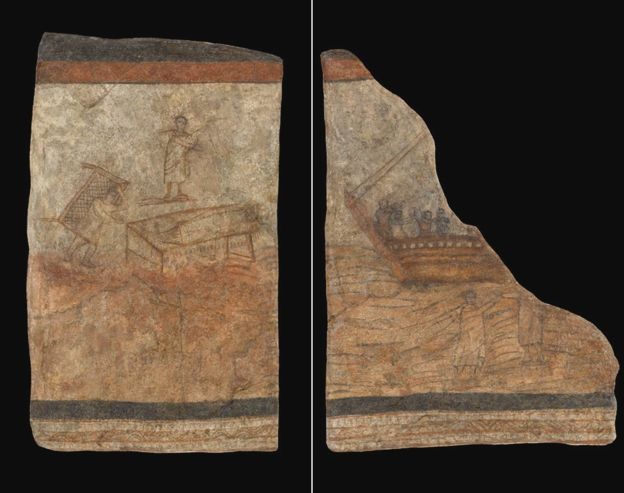
The earliest surviving paintings claimed to be of Jesus, from a church at the ruined city of Dura-Europos on the Euphrates (dating from first half of the 3rd Century AD)
By COGwriter
Many who profess Christianity attend church services that have a variety of supposedly Christian idols and icons in the buildings. Many who profess Christ tend to wear or even revere crosses as a symbol for Christians.
Does any of this come from the Bible? What did the early Church teach about these type of things? What about the second commandment? Is the prohibition against idolatry actually the 'second' of the ten commandments?
This article will provide some Old Testament and New Testament quotes related to idols and icons. It will also show writings from early (mainly 2nd century) church writers which will help demonstrate what the early church really understood about this.
Additionally, it will provide some information on when idols and icons were considered acceptable for the majority who profess Christ.
A related sermon is available: The Second Commandment, Idols, and Icons.
Nearly everyone familiar with the Bible should be familiar with this passage of the ten commandments from Exodus 20:3-5:
You shall have no other gods before Me. You shall not make for yourself a carved image, or any likeness of anything that is in heaven above, or that is in the earth beneath, or that is in the water under the earth; you shall not bow down to them nor serve them (NKJV throughout, unless otherwise noted).
However, some do not seem to be as familiar with this passage from Deuteronomy 4:15-19. Here a Catholic translation of it:
15 Keep therefore your souls carefully. You saw not any similitude in the day that the Lord God spoke to you in Horeb from the midst of the fire: 16 Lest perhaps being deceived you might make you a graven similitude, or image of male or female, 17 The similitude of any beasts, that are upon the earth, or of birds, that fly under heaven, 18 Or of creeping things, that move on the earth, or of fishes, that abide in the waters under the earth: 19 Lest perhaps lifting up thy eyes to heaven, thou see the sun and the moon, and all the stars of heaven, and being deceived by error thou adore and serve them, which the Lord thy God created for the service of all the nations, that are under heaven. (Douay-Rheims)
In other words, God is saying that one of the reasons He did not want to be seen was that He felt the people might think that they should make any idol or icon. Notice that He also said no image of any male or female.
See also Isaiah 44:9:
9 Those who make an image, all of them are useless,
And their precious things shall not profit;
They are their own witnesses;
They neither see nor know, that they may be ashamed.
This prohibition against idols was not limited to idols of foreign gods. God is also quite displeased with images that are supposed to direct worship to Him as this passage from Exodus 32:7-8 shows:
And the LORD said to Moses, "Go, get down! For your people whom you brought out of the land of Egypt have corrupted themselves. They have turned aside quickly out of the way which I commanded them. They have made themselves a molded calf, and worshiped it and sacrificed to it, and said, 'This is your god, O Israel, that brought you out of the land of Egypt!' "
The Bible shows that God did not want His people to bow down before images that humans made:
1 'You shall not make idols for yourselves; neither a carved image nor a sacred pillar shall you rear up for yourselves; nor shall you set up an engraved stone in your land, to bow down to it; for I am the Lord your God. (Leviticus 26:1)
The children of Israel were apparently not even allowed the possession of icons as Joshua 7:13 seems to show:
13 'Sanctify yourselves for tomorrow, because thus says the LORD God of Israel: "There is an accursed thing in your midst, O Israel; you cannot stand before your enemies until you take away the accursed thing from among you."
Thus all forms of idols and icons were prohibited by God in the Old Testament. Also notice that God says those with idols are like idols in that they have eyes but do not see and ears but do not hear:
The idols of the nations are silver and gold, The work of men's hands. They have mouths, but they do not speak; Eyes they have, but they do not see; They have ears, but they do not hear; Nor is there any breath in their mouths. Those who make them are like them; So is everyone who trusts in them (Psalms 135:15-18).
Furthermore, notice that in the future, God will get rid of all idols:
The LORD alone will be exalted in that day, But the idols He shall utterly abolish (Isaiah 2:17-18).
Thus says the Lord GOD: "I will also destroy the idols, And cause the images to cease..." (Ezekiel 30:13).
Idolatry is wrong for many reasons, but one is that people lie to themselves that some physical object either represents God, which it does not, or that something is more important than God, which it is not.
What is called common sense should tell people that. God had Isaiah record the following:
13 The craftsman stretches out his rule,
He marks one out with chalk;
He fashions it with a plane,
He marks it out with the compass,
And makes it like the figure of a man,
According to the beauty of a man, that it may remain in the house.
14 He cuts down cedars for himself,
And takes the cypress and the oak;
He secures it for himself among the trees of the forest.
He plants a pine, and the rain nourishes it.15 Then it shall be for a man to burn,
For he will take some of it and warm himself;
Yes, he kindles it and bakes bread;
Indeed he makes a god and worships it;
He makes it a carved image, and falls down to it.
16 He burns half of it in the fire;
With this half he eats meat;
He roasts a roast, and is satisfied.
He even warms himself and says,
"Ah! I am warm,
I have seen the fire."
17 And the rest of it he makes into a god,
His carved image.
He falls down before it and worships it,
Prays to it and says,
"Deliver me, for you are my god!"18 They do not know nor understand;
For He has shut their eyes, so that they cannot see,
And their hearts, so that they cannot understand.
19 And no one considers in his heart,
Nor is there knowledge nor understanding to say,
"I have burned half of it in the fire,
Yes, I have also baked bread on its coals;
I have roasted meat and eaten it;
And shall I make the rest of it an abomination?
Shall I fall down before a block of wood?"
20 He feeds on ashes;
A deceived heart has turned him aside;
And he cannot deliver his soul,
Nor say, "Is there not a lie in my right hand?" (Isaiah 44:13-20)
Yes, idols are obvious self-deception.
Idols were discussed by many New Testament writers.
Jesus taught:
14 But I have a few things against you, because you have there those who hold the doctrine of Balaam...to eat things sacrificed to idols (Revelation 2:14).
20 Nevertheless, I have a few things against you, because you allow...My servants to...eat things sacrificed to idols (Revelation 2:20).
Jesus also taught:
24 God is spirit, and those who worship Him must worship in spirit and truth (John 4:24).
And the truth is that God does not want to be represented by things made by man. And the truth is that since no one knows what Jesus (or God the Father for that matter) looks like--all ICONIC REPRESENTATIONS OF GOD ARE NOT SPIRIT are not true. This is part of why all idols and icons are wrong.
Notice something from the Book of Acts:
28... For we are also His offspring.' 29 Therefore, since we are the offspring of God, we ought not to think that the Divine Nature is like gold or silver or stone, something shaped by art and man's devising. (Acts 17:28-29)
29 Being therefore the offspring of God, we must not suppose the divinity to be like unto gold, or silver, or stone, the graving of art, and device of man. 30 And God indeed having winked at the times of this ignorance, now declareth unto men, that all should every where do penance. (Acts 17:29-30, Douay-Rheims)
Christians ARE NOT to represent God with icons or idols.
The following verses concern Paul and his writings on this subject:
Now while Paul waited for them in Athens, his spirit was provoked within him when he saw that the city was given over to idols...Then Paul stood in the midst of the Areopagus and said...'God, who made the world and everything in it, since He is Lord of heaven and earth, does not dwell in temples made with hands. Nor is He worshipped with men's hands, as though He needed anything' (Acts 17:16,22,24-25).
Professing to be wise, they became fools, and changed the glory of the incorruptible God into an image made like corruptible man--and birds and four footed animals and creeping things (Romans 1:22-23).
But now I have written to you not to keep company with anyone named a brother, who is...an idolater (I Corinthians 5:11).
Neither... idolators...will inherit the kingdom of God (I Corinthians 6:9-10).
And do not become idolaters as were some of them...Therefore, my beloved, flee from idolatry (I Corinthians10:7,14).
And what agreement has the temple of God have with idols? (II Corinthians 6:16).
Now the works of the flesh are evident...idolatry (Galatians 5:19,20).
For this you know that no...idolater, has any inheritance in the kingdom of Christ and God (Ephesians 5:5).
Therefore put to death...covetousness, which is idolatry (Colossians 3:5).
...you turned to God from idols to serve the living and true God (I Thessalonians 1:9).
Paul is clear, true Christians do not have idols, there are to be none in a church, idolatry is a work of the flesh, and Christians are to turn from idols to God.
Notice what the Original Rheim's New Testament teaches:
6:16. And what agreement hath the temple of God with Idols? For you are the temple of the living God. as God saith, Then I will dwell, and walk in them, and will be their God: and they shall be my people. 17. For the which cause, Go out of the midst of them, and separate yourselves. saith our Lord, and touch not the unclean: and I will receive you...
7:1 HAVING therefore these promises, my dearest, let us cleanse ourselves from all iniquities of the flesh and spirit, perfecting sanctification in the fear of God. (2 Corinthians 2:6:16-17, 7:1, Original Rheims NT)
Christians are NOT to defile themselves with idols.
The Apostle John, the last of the original apostles to die and the last writer of the New Testament, wrote:
21 Little children, keep yourselves from idols (I John 5:21).
14 But I have a few things against you, because you have there those who hold the doctrine of Balaam...to eat things sacrificed to idols (Revelation 2:14).
20 Nevertheless, I have a few things against you, because you allow...My servants to...eat things sacrificed to idols (Revelation 2:20).
20 But the rest of mankind, who were not killed by these plagues, did not repent of the works of their hands, that they should not worship demons, and idols of gold, silver, brass, stone, and wood, which can neither see nor hear nor walk (Revelation 9:20).
8 But ...idolaters...shall have their part in the lake which burns with fire and brimstone, which is the second death (Revelation 21:8).
15 But outside are...idolaters (Revelation 22:15).
John warned the church to keep away from idols and that idolaters will be punished. Thus, those who practice original Christianity would seem to not tolerate idols.
And if God actually wanted people to make icons or idols of any kind, He clearly could have had the writers of the New Testament include some type of drawing and/or instruction to make them. Instead, all the writings of the New Testament that discuss them, oppose idols of various kinds.
It should be mentioned that the Greek word often translated as "cross" in the New Testament, staros, means a pole, and not a cross. Furthermore, notice that in the second century, Polycarp of Smyrna wrote:
Let us then continually persevere in our hope, and the earnest of our righteousness, which is Jesus Christ, “who bore our sins in His own body on the tree” (Polycarp’s Letter to the Philippians, Chapter VIII. Ante-Nicene Fathers, Volume 1 as edited by Alexander Roberts & James Donaldson (American Edition, 1885; Reprint Hendrickson Publishers, 1999, pp. 33-36)
The teaching of the faithful was that Jesus was killed on a tree pole, not necessarily any type of modern cross.
It should be noted that no Christian in the New Testament is ever described as carrying an idol, having any in worship services, or wearing a cross (see also What is the Origin of the Cross as a 'Christian' Symbol?). This is not to say that all who own a cross are active idolators, but that the historical facts should give people pause to ask themselves if they should.
Furthermore, notice more from the New Testament:
7 For we walk by faith, not by sight (2 Corinthians 5:7).
17 So then faith comes by hearing, and hearing by the word of God (Romans 10:17).
8 Beware lest anyone cheat you through philosophy and empty deceit, according to the tradition of men, according to the basic principles of the world, and not according to Christ (Colossians 2:8).
18 ... knowing that you were not redeemed with corruptible things, like silver or gold, from your aimless conduct received by tradition from your fathers (1 Peter 1:18).
Thus faith does not come by seeing icons, but comes from HEARING THE WORD OF GOD and not traditions of men. Not from items made with gold or silver.
Idols and icons are just a small part of the traditions of men that should not be part of Christianity (see also Tradition and Scripture: From the Bible and Church Writings). Christ NEVER taught that idols or icons were acceptable.
While the New Testament shows that idols are not really anything, caution is advised even when doing what is allowed. Notice:
4 Therefore concerning the eating of things offered to idols, we know that an idol is nothing in the world, and that there is no other God but one. 5 For even if there are so-called gods, whether in heaven or on earth (as there are many gods and many lords), 6 yet for us there is one God, the Father, of whom are all things, and we for Him; and one Lord Jesus Christ, through whom are all things, and through whom we live.
7 However, there is not in everyone that knowledge; for some, with consciousness of the idol, until now eat it as a thing offered to an idol; and their conscience, being weak, is defiled. 8 But food does not commend us to God; for neither if we eat are we the better, nor if we do not eat are we the worse.
9 But beware lest somehow this liberty of yours become a stumbling block to those who are weak. 10 For if anyone sees you who have knowledge eating in an idol’s temple, will not the conscience of him who is weak be emboldened to eat those things offered to idols? 11 And because of your knowledge shall the weak brother perish, for whom Christ died? 12 But when you thus sin against the brethren, and wound their weak conscience, you sin against Christ. 13 Therefore, if food makes my brother stumble, I will never again eat meat, lest I make my brother stumble. (1 Corinthians 8:4-13)
Idols are nothing, but caution is advised even in practices that are allowed as encouraging any form of idolatry is prohibited.
The Church of Rome currently teaches that the prohibition against idols is part of the first commandment, and is not a separate commandment. Presumably this is to attempt to justify the use of idols in their worship.
Yet, this is a change.
The first century Jewish historian Josephus wrote:
The first commandment teaches us that there is but one God, and that we ought to worship him only. The second commands us not to make the image of any living creature to worship it. (Josephus. Antiquities of the Jews - Book III, Chapter 5, verse 5)
Not only have the Jews long considered that the command against idols was a separate, and the second commandment, this was also the view of early Christians.
As late as the early third century, even Clement of Alexandria realized this as he listed most of the ten commandments (the "ten words" or the "Decalogue"). Here are the first two he listed:
The first commandment of the Decalogue shows that there is one only Sovereign God...
The second word intimated that men ought not to take and confer the august power of God (which is the name, for this alone were many even yet capable of learning), and transfer His title to things created and vain, which human artificers have made. (Clement of Alexandria. Stromata, Book VI, Chapter 16)
Furthemore, the Eastern Orthodox church teaches:
The Second Commandment
"Thou shalt not make unto thee any graven images... Thou shalt not bow down thyself to them." "Thou shalt not make unto thee any graven image, or any likeness of any thing that is in heaven above, or that is in the earth beneath, or that is in the water under the earth: Thou shalt not bow down thyself to them, nor serve them: for I the Lord thy God am a jealous God, visiting the iniquity of the fathers upon the children unto the third and fourth generation of them that hate me: And shewing mercy unto thousands of them that love me, and keep my commandments." Ex. 20:4-6. (Mastrantonis G. The Ten Commandments. Copyright: © 1990-1996 Greek Orthodox Archdiocese of America. http://www.goarch.org/ourfaith/ourfaith7115 accessed 12/29/16)
There should be no doubt that the prohibtion against idols was considered to be the second commandment.
The Bible says God is not seen:
20 If someone says, "I love God," and hates his brother, he is a liar; for he who does not love his brother whom he has seen, how can he love God whom he has not seen? (1 John 4:20)
God also warns about judging based on sight:
24 Do not judge according to appearance, but judge with righteous judgment. (John 7:24)
6 So it was, when they came, that he looked at Eliab and said, "Surely the Lord's anointed is before Him!"
7 But the Lord said to Samuel, "Do not look at his appearance or at his physical stature, because I have refused him. For the Lord does not see as man sees; for man looks at the outward appearance, but the Lord looks at the heart." (1 Samuel 16:6-7)
7 For we walk by faith, not by sight. (2 Corinthians 5:7)
All of God's commandments are righteousness (Psalm 119:172), and God's word and law should be the basis of judgment--and it is opposed to idols (e.g. 1 John 5:21).
Notice also something that Solomon stated:
27 "But will God indeed dwell on the earth? Behold, heaven and the heaven of heavens cannot contain You. How much less this temple which I have built! (1 Kings 8:27-28)
Certainly no idol or icon conveys the truth about God.
Thus, since all idols and icons do NOT represent the truth about God, He does not want them used by His true followers (cf. John 4:24).
After John died, his disciple, Polycarp of Smyrna became perhaps the most well-known Christian leader in the second century.
Even though the Roman Catholics and Orthodox leaders consider that Polycarp was an important saint, note what Polycarp wrote in the mid-second century:
I exhort you, therefore, that ye abstain from covetousness, and that ye be chaste and truthful. "Abstain from every form of evil." For if a man cannot govern himself in such matters, how shall he enjoin them on others ? If a man does not keep himself from covetousness, he shall be defiled by idolatry, and shall be judged as one of the heathen. But who of us are ignorant of the judgment of the Lord? (Polycarp. Letter to the Philippians, Chapter XI. From Ante-Nicene Fathers, Volume 1as edited by Alexander Roberts & James Donaldson. American Edition, 1885).
Thus, Polycarp says that those who practice idolatry, even if they profess Christ, will be judged as a heathen! He also tied that commandment in with the one against covetousness.
In the early-mid second century there was an apologist named Marcianus Aristides who wrote the following to the emperor:
But it is a marvel, O King, with regard to the Greeks, who surpass all other peoples in their manner of life and reasoning, how they have gone astray after dead idols and lifeless images. And yet they see their gods in the hands of their artificers being sawn out, and planed and docked, and hacked short, and charred, and ornamented, and being altered by them in every kind of way. And when they grow old, and are worn away through lapse of time, and when they are molten and crushed to powder, how, I wonder, did they not perceive concerning them, that they are not gods? And as for those who did not find deliverance for themselves, how can they serve the distress of men?
But even the writers and philosophers among them have wrongly alleged that the gods are such as are made in honour of God Almighty. And they err in seeking to liken (them) to God whom man has not at any time seen nor can see unto what He is like. Herein, too (they err) in asserting of deity that any such thing as deficiency can be present to it; as when they say that He receives sacrifice and requires burnt-offering and libation and immolations of men, and temples. But God is not in need, and none of these things is necessary to Him; and it is clear that men err in these things they imagine (Marcianus Aristides. TRANSLATED FROM THE GREEK AND FROM THE SYRIAC VERSION BY D. M. KAY. Apology of Aristides the Philosopher, Chapter XIII. Excerpted from Ante-Nicene Fathers, Volume 9. Edited by Allan Menzies, D.D. American Edition, 1896 and 1897. Online Edition Copyright © 2005 by K. Knight).
It should be noted that Marcianus Aristides argued against the concept that it was acceptable to believe that the idols only represented God--he clearly teaches that God was not to be worshiped with idols.
Melito also wrote against idols. Melito was a bishop of Sardis and is considered to be a saint by both the Catholics of Rome and the Eastern Orthodox.
Here is what Melito wrote around 170 A.D.:
We are not those who pay homage to stones, that are without sensation; but of the only God, who is before all and over all, and, moreover, we are worshippers of His Christ, who is veritably God the Word existing before all time (Melito. Translation by Roberts and Donaldson. From the apology addressed to Marcus Aurelius Antoninus. Online version copyright © 2001 Peter Kirby. http://www.earlychristianwritings.com/text/melito.html 11/18/06).
For there are some men who are unable to rise from their mother earth, and therefore also do they make them gods. from the earth their mother; and they are condemned by the judgments of truth, forasmuch as they apply the name of Him who is unchangeable to those objects which are subject to change, and shrink not from calling those things gods which have been made by the hands of man, and dare to make an image of God whom they have not seen...
Who is this God? He who is Himself truth, and His word truth. And what is truth? That which is not fashioned, nor made, nor represented by art: that is, which has never been brought into existence, and is on that account called truth. If, therefore, a man worship that which is made with hands, it is not the truth that he worships, nor yet the word of truth..."
There are, however, persons who say: It is for the honour of God that we make the image: in order, that is, that we may worship the God who is concealed from our view. But they are unaware that God is in every country, and in every place, and is never absent, and that there is not anything done and He knoweth it not. Yet thou, despicable man! within whom He is, and without whom He is, and above whom He is, hast nevertheless gone and bought thee wood from the carpenter's, and it is carved and made into an image insulting to God. To this thou offerest sacrifice, and knowest not that the all-seeing eye seeth thee, and that the word of truth reproves thee, and says to thee: How can the unseen God be sculptured? Nay, it is the likeness of thyself that thou makest and worshippest. Because the wood has been sculptured, hast thou not the insight to perceive that it is still wood, or that the stone is still stone? The gold also the workman: taketh according to its weight in the balance. And when thou hast had it made into an image, why dose thou weigh it? Therefore thou art a lover of gold, and not a lover of God...
Again, there are persons who say: Whatsoever our fathers have bequeathed to us, that we reverence. Therefore, of course, it is, that those whose fathers have bequeathed them poverty strive to become rich! and those whose fathers did not instruct them, desire to be instructed, and to learn that which their fathers knew not! And why, forsooth, do the children of the blind see, and the children of the lame walk? Nay, it is not well for a man to follow his predecessors, if they be those whose course was evil; but rather that we should turn from that path of theirs, lest that which befell our predecessors should bring disaster upon us also. Wherefore, inquire whether thy father's course was good: and, if so, do thou also follow in his steps; but, if thy father's course was very evil, let thine be good, and so let it be with thy children after thee. Be grieved also for thy father because his course is evil, so long as thy grief may avail to help him. But, as for thy children, speak to them thus: There is a God, the Father of all, who never came into being, neither was ever made, and by whose will all things subsist...
And then shall those who have not known God, and those who have made them idols, bemoan themselves, when they shall see those idols of theirs being burnt up, together with themselves, and nothing shall be found to help them (Melito. Translation by Roberts and Donaldson. A DISCOURSE WHICH WAS IN THE PRESENCE OF ANTONINUS CAESAR, AND HE EXHORTED THE SAID CAESAR TO ACQUAINT HIMSELF WITH GOD, AND SHOWED TO HIM THE WAY OF TRUTH. Online version copyright © 2001 Peter Kirby. http://www.earlychristianwritings.com/text/melito.html 11/18/06).
Notice that Melito taught against the use of images/idols/icons AND then taught NOT to accept them even if it was handed down by fathers (in other words, do not rely on traditions that say that idols are correct). Since Melito is considered to be both a saint and a 'father' of the Church by those Roman Catholics and Orthodox, then they should heed what he said.
Melito also knew that the Apostle Paul wrote:
2 But we have renounced the hidden things of shame, not walking in craftiness nor handling the word of God deceitfully, but by manifestation of the truth commending ourselves to every man's conscience in the sight of God. 3 But even if our gospel is veiled, it is veiled to those who are perishing, 4 whose minds the god of this age has blinded, who do not believe, lest the light of the gospel of the glory of Christ, who is the image of God, should shine on them. (2 Corinthians 4:2-4)
Yet, sadly many in Melito's day and this present time have accepted idols and other doctrines that are not manifestations of the truth. They try to justify idols deceitfully as far as the word of God and often true early Christian history is concerned
About the same time that Melito was around, Theophilus also was a church writer. Theophilus of Antioch is not only considered to have been a saint by the Catholics and Orthodox, he also is in the Orthodox list of successors from the apostles. Here is a little bit of what he wrote about idols:
The divine law, then, not only forbids the worshipping of idols, but also of the heavenly bodies, the sun, the moon, or the other stars; yea, not heaven, nor earth, nor the sea, nor fountains, nor rivers, must be worshipped (Theophilus of Antioch. To Autolycus, Book 2, Chapter XXXV. Translated by Marcus Dods, A.M. Excerpted from Ante-Nicene Fathers, Volume II. Edited by Alexander Roberts & James Donaldson. American Edition, 1885. Online Edition Copyright © 2004 by K. Knight).
And concerning piety He says, "Thou shalt have no other gods before me. Thou shalt not make unto thee any graven image, or any likeness of anything that is in heaven above, or that is in the earth beneath, or that is in the water under the earth: thou shalt not bow down thyself to them, nor serve them: for I am the LORD thy God" ...Of this divine law, then, Moses, who also was God's servant (Theophilus of Antioch. To Autolycus, Book III, Chapter IX. Translated by Marcus Dods, A.M. Excerpted from Ante-Nicene Fathers, Volume 2. Edited by Alexander Roberts & James Donaldson. American Edition, 1885. Online Edition Copyright © 2004 by K. Knight).
Other second century writers, though they were probably not in the true Church of God, such as Justin Martyr, Irenaeus, Athenagoras, and Tertullian also wrote against idols.
Notice that Irenaeus actually wrote that when God was going to call Gentiles (basically quoting quoting Isaiah 17:7-8), that they would no longer have or worship idols:
And that these promises the calling from among the Gentiles should inherit, to whom also the new testament was opened up, Isaiah says thus:
These things saith the God of Israel: In that day a man shall trust in his Maker, and his eyes shall look to the Holy One of Israel: and they shall not trust in altars, nor in the work of their own hands, which their fingers have made.
For very plainly this was said of such as have forsaken idols and believed in God our Maker through the Holy One of Israel. And the Holy One of Israel is Christ: and He became visible to men, and to Him we look eagerly and behold Him; and we trust not in altars, nor in the works of our hands.
(Irenaeus, St., Bishop of Lyon. Translated from the Armenian by Armitage Robinson. The Demonstration of the Apostolic Preaching, Chapter 91. Wells, Somerset, Oct. 1879. As published in SOCIETY FOR PROMOTING CHRISTIAN KNOWLEDGE. NEW YORK: THE MACMILLAN CO, 1920).
The Catholic Encyclopedia calls Athenagoras a "Christian apologist of the second half of the second century." Here is some of what he wrote:
Because the multitude, who cannot distinguish between matter and God, or see how great is the interval which lies between them, pray to idols made of matter, are we therefore, who do distinguish and separate the uncreated and the created, that which is and that which is not, that which is apprehended by the understanding and that which is perceived by the senses, and who give the fitting name to each of them—are we to come and worship images? If, indeed, matter and God are the same, two names for one thing, then certainly, in not regarding stocks and stones, gold and silver, as gods, we are guilty of impiety. But if they are at the greatest possible remove from one another— as far asunder as theartist and the materials of his art— why are we called to account? (Athenagoras the Athenian. A Plea for the Christians, Chapter 15. Translated by B.P. Pratten. From Ante-Nicene Fathers, Vol. 2. Edited by Alexander Roberts, James Donaldson, and A. Cleveland Coxe. (Buffalo, NY: Christian Literature Publishing Co., 1885.) Revised and edited for New Advent by Kevin Knight. <http://www.newadvent.org/fathers/0205.htm>).
Notice some of what Tertullian wrote:
The principal crime of the human race, the highest guilt charged upon the world, the whole procuring cause of judgment, is idolatry...
God prohibits an idol as much to be made as to be worshipped. In so far as the making what may be worshipped is the prior act, so far is the prohibition to make (if the worship is unlawful) the prior prohibition. For this cause--the eradicating, namely, of the material of idolatry--the divine law proclaims, "Thou shall make no idol;"...All things, therefore, does human error worship, except the Founder of all Himself. The images of those things are idols; the consecration of the images is idolatry.
(Tertullian. On Idolatry, Chapters 1,4. Translated by S. Thelwall. Excerpted from Ante-Nicene Fathers, Volume 3. Edited by Alexander Roberts and James Donaldson. American Edition, 1885. Online Edition Copyright © 2004 by K. Knight).
Furthermore, there is no evidence that any who professed Christ had idols/icons, such as what are seen in the Roman Catholic and Orthodox churches, or even endorsed them in the second century. Thus, the early church was always against the use of idols and icons. Actually, they realize this as well as The Catholic Encyclopedia notes:
Long before the outbreak in the eighth century there were isolated cases of persons who feared the ever-growing cult of images and saw in it danger of a return to the old idolatry. We need hardly quote in this connection the invectives of the Apostolic Fathers against idols (Athenagoras "Legatio Pro Christ.", xv-xvii; Theophilus, "Ad Autolycum" II; Minucius Felix, "Octavius", xxvii; Arnobius, "Disp. adv. Gentes"; Tertullian, "De Idololatria", I; Cyprian, "De idolorum vanitate"), in which they denounce not only the worship but even the manufacture and possession of such images. These texts all regard idols, that is, images made to be adored (Fortescue A. Transcribed by Tomas Hancil. Veneration of Images. The Catholic Encyclopedia, Volume VII. Copyright © 1910 by Robert Appleton Company. Online Edition Copyright © 2003 by K. Knight. Nihil Obstat, June 1, 1910. Remy Lafort, S.T.D., Censor. Imprimatur. +John Cardinal Farley, Archbishop of New York).
Furthermore, notice an accusation against those who professed Christ in the second/third century (date uncertain):
Why have they no altars, no temples, no acknowledged images? (Minucius. Octavius. Excerpted from Ante-Nicene Fathers, Volume 4, Chapter 10. Edited by Alexander Roberts & James Donaldson. American Edition, 1885. Online Edition Copyright © 2004 by K. Knight).
It should be noted that no Christian prior to the late second or early third century is ever described as carrying an idol, having images in any worship services, or even wearing a cross (though some apostates started to advocate crosses in the second and third centuries).
In modern times, as well as back in the second and third centuries (and well before), green trees and wreaths were used as part of pagan worship practices.
Notice that the wreaths were specifically condemned by Tertullian:
The Minervalia are as much Minerva's, as the Saturnalia Saturn's; Saturn's, which must necessarily be celebrated even by little slaves at the time of the Saturnalia. New-year's gifts likewise must be caught at, and the Septimontium kept; and all the presents of Midwinter and the feast of Dear Kinsmanship must be exacted; the schools must be wreathed with flowers; the flamens' wives and the aediles sacrifice; the school is honoured on the appointed holy-days. The same thing takes place on an idol's birthday; every pomp of the devil is frequented. Who will think that these things are befitting to a Christian master, unless it be he who shall think them suitable likewise to one who is not a master? (Tertullian. On Idolatry, Chapter X. Translated by S. Thelwall. Excerpted from Ante-Nicene Fathers, Volume 3. Edited by Alexander Roberts and James Donaldson. American Edition, 1885. Online Edition Copyright © 2004 by K. Knight).
But "let your works shine," saith He; but now all our shops and gates shine! You will now-a-days find more doors of heathens without lamps and laurel-wreaths than of Christians. What does the case seem to be with regard to that species (of ceremony) also? If it is an idol's honour, without doubt an idol's honour is idolatry. If it is for a man's sake, let us again consider that all idolatry is for man's sake; let us again consider that all idolatry is a worship done to men, since it is generally agreed even among their worshippers that aforetime the gods themselves of the nations were men; and so it makes no difference whether that superstitious homage be rendered to men of a former age or of this. Idolatry is condemned, not on account of the persons which are set up for worship, but on account of those its observances, which pertain to demons (Tertullian. On Idolatry, Chapter XV. Translated by S. Thelwall. Excerpted from Ante-Nicene Fathers, Volume 3. Edited by Alexander Roberts and James Donaldson. American Edition, 1885. Online Edition Copyright © 2004 by K. Knight).
Green trees and wreaths remain modern idols that most who profess Christ seem to find acceptable. The Bible warns against them, never tells Christians to use them, and none were part of the practices of the early Apostles and their followers.
Since God warns against them, how can these pagan-compromised innovations please God?
The obvious answer is that they do not. Notice the following passages from the Holy Bible:
2 You shall utterly destroy all the places where the nations which you shall dispossess served their gods, on the high mountains and on the hills and under every green tree. 3 And you shall destroy their altars, break their sacred pillars, and burn their wooden images with fire; you shall cut down the carved images of their gods and destroy their names from that place. 4 You shall not worship the Lord your God with such things. (Deuteronomy 12:2-4)
2 'You must completely destroy all the places where the nations you dispossess have served their gods, on high mountains, on hills, under any spreading tree; 3 you must tear down their altars, smash their sacred stones, burn their sacred poles, hack to bits the statues of their gods and obliterate their name from that place. 4 'Not so must you behave towards Yahweh your God. (Deuteronomy 12:2-3, New Jerusalem Bible, a Catholic version)
The truth is that pagan holidays were not part of the earliest traditions of the church. The use of wreaths and evergreen trees reminds us that people are often unwilling to worship God as He intended.
Those who truly believe Jesus’ words, “Man shall not live by bread alone, but by every word that proceeds from the mouth of God” (Matthew 4:4) will not observe compromised pagan holiday such as Christmas (see also What Does the Catholic Church Teach About Christmas and the Holy Days?) because it contains practices warned against in the Bible and was never enjoined upon true believers to practice.
In the early third century, Catholic theologian and bishop Hippolytus wrote:
16:1 They will inquire concerning the works and occupations of those are who are brought forward for instruction. 2 If someone is a pimp who supports prostitutes, he shall cease or shall be rejected. 3 If someone is a sculptor or a painter, let them be taught not to make idols. Either let them cease or let them be rejected (Hippolytus. The Apostolic Tradition of Hippolytus of Rome. From the work of Bernard Botte (La Tradition Apostolique. Sources Chretiennes, 11 bis. Paris, Editions du Cerf, 1984) and of Gregory Dix (The Treatise on the Apostolic Tradition of St. Hippolytus of Rome, Bishop and Martyr. London: Alban Press, 1992) as translated by Kevin P. Edgecomb http://www.bombaxo.com/hippolytus.html viewed 08/06/09)
Thus, the production of icons was still condemned in the third century. If they were accepted, he would have likely written that they need to change and produce icons and images for churches, but instead they are told to cease from their occupation.
In the early third century, a Catholic/Orthodox theologian, Origen wrote:
Christians and Jews have regard to this command, "You shall fear the Lord your God, and serve Him alone;" and this other, "You shall have no other gods before Me: you shall not make unto you any graven image, or any likeness of anything that is in heaven above, or that is in the earth beneath, or that is in the water under the earth: you shall not bow down yourself to them, nor serve them;" and again, "You shall worship the Lord your God, and Him only shall you serve." It is in consideration of these and many other such commands, that they not only avoid temples, altars, and images, but are ready to suffer death when it is necessary, rather than debase by any such impiety the conception which they have of the Most High God (Origen. Contra Celsus, Book VII, Chapter 64, http://www.newadvent.org/fathers/04167.htm 01/23/07).
Notice this defense against the "heathen" by the third century Catholic theologian Arnobius where he clearly teaches that his faith did not have statues, images, or even incense:
1...Having shown briefly how impious and infamous are the opinions which you have formed about your gods, we have now to speak of their temples , their images also, and sacrifices, and of the other things which are nailed and closely related to them. For you are here in the habit of fastening upon us a very serious charge of impiety because we do not rear temples for the ceremonies of worship, do not set up statues and images of any god, do not build altars...do not offer...incense...
3...we rear no temples to them, and do not worship their images; we do not slay victims in sacrifice, we do not offer incense and libations of wine.
8...We have next to say something about statues and images, which you form with much skill, and tend with religious care,— wherein if there is any credibility, we can by no amount of consideration settle in our own minds whether you do this in earnest and with a serious purpose, or amuse yourselves in childish dreams by mocking at these very things. For if you are assured that the gods exist whom you suppose, and that they live in the highest regions of heaven , what cause, what reason , is there that those images should be fashioned by you, when you have true beings to whom you may pour forth prayers, and from whom you may, ask help in trying circumstances? But if, on the contrary, you do not believe, or, to speak with moderation, are in doubt, in this case, also, what reason is there, pray, to fashion and set up images of doubtful beings, and to form with vain imitation what you do not believe to exist ? Do you perchance say, that under these images of deities there is displayed to you their presence, as it were, and that, because it has not been given you to see the gods, they are worshipped in this fashion, and the duties owed to them paid? He who says and asserts this, does not believe that the gods exist ; and he is proved not to put faith in his own religion , to whom it is necessary to see what he may hold, lest that which being obscure is not seen, may happen to be vain.
9. We worship the gods, you say, by means of images. What then? Without these, do the gods not know that they are worshipped, and will they not think that any honour is shown to them by you? Through bypaths, as it were, then, and by assignments to a third party, as they are called, they receive and accept your services; and before those to whom that service is owed experience it, you first sacrifice to images, and transmit, as it were, some remnants to them at the pleasure of others. And what greater wrong, disgrace, hardship, can be inflicted than to acknowledge one god, and yet make supplication to something else — to hope for help from a deity , and pray to an image without feeling?...
10. And whence, finally, do you know whether all these images which you form and put in the place of the immortal gods reproduce and bear a resemblance to the gods? For it may happen that in heaven one has a beard who by you is represented with smooth cheeks; that another is rather advanced in years to whom you give the appearance of a youth; that here he is fair, with blue eyes, who really has grey ones; that he has distended nostrils whom you make and form with a high nose. For it is not right to call or name that an image which does not derive from the face of the original features like it...
14... Those images which fill you with terror, and which you adore prostrate upon the ground in all the temples, are bones, stones, brass, silver, gold, clay, wood taken from a tree, or glue mixed with gypsum...
16... Blush , then, even though it is late, and accept true methods and views from dumb creatures, and let these teach you that there is nothing divine in images, into which they do not fear or scruple to cast unclean things in obedience to the laws of their being, and led by their unerring instincts.
17. But you err, says my opponent, and are mistaken, for we do not consider either copper, or gold and silver, or those other materials of which statues are made, to be in themselves gods and sacred deities; but in them we worship and venerate those whom their dedication as sacred introduces and causes to dwell in statues made by workmen. The reasoning is not vicious nor despicable by which any one — the dull, and also the most intelligent — can believe that the gods, forsaking their proper seats — that is, heaven — do not shrink back and avoid entering earthly habitations; nay, more, that impelled by the rite of dedication , they are joined to images Do your gods, then, dwell in gypsum and in figures of earthenware? Nay , rather, are the gods the minds , spirits , and souls of figures of earthenware and of gypsum ? And, that the meanest things may be able to become of greater importance, do they suffer themselves to be shut up and concealed and confined in an obscure abode? Here, then, in the first place, we wish and ask to be told this by you: do they do this against their will — that is, do they enter the images as dwellings, dragged to them by the rite of dedication — or are they ready and willing ? And do you not summon them by any considerations of necessity ? Do they do this unwillingly? and how can it be possible that they should be compelled to submit to any necessity without their dignity being impaired? With ready assent? And what do the gods seek for in figures of earthenware that they should prefer these prisons to their starry seats,— that, having been all but fastened to them, they should ennoble earthenware and the other substances of which images are made?
(Arnobius. Against the Heathen (Book VI), Chapters 1,3,8,9,10,14,16,17,18. Excerpted from Ante-Nicene Fathers, Volume 6. Edited by Alexander Roberts & James Donaldson. American Edition, 1886. Online Edition Copyright © 2008 by K. Knight).
Hence, even the early Greco-Romans strongly taught against veneration of bones, idols, statues, incense, and icons. These were simply never a part of the true church. They were not significantly even part of the Greco-Roman church until after Constantine and his mother Helena came on the scene. Now, Greco-Romans will venerate/worshop such things. Notice:
20 May 2017
For the first time in nearly 1,000 years bone fragments of Saint Nicholas are being moved from their Italian resting place, to be worshipped in Russia.
The 4th-Century saint is one of the most revered figures in the Russian Orthodox Church. After his death, Italian merchants brought his body from Myra, in modern-day Turkey, to Italy.
Some fragments of his ribs are kept in Bari, southern Italy. They are being flown on a specially chartered plane to Moscow on Sunday.
"This is an unprecedented event," said Alexander Volkov, a representative of the Moscow Patriarchate. http://www.bbc.com/news/world-europe-39960384
Shortly after Constantine came into power and was was considered a Catholic-supporter, apparently Cyril of Jerusalem made up a false document to pretend that idols and shrines were used by real Christians in Jerusalem in the first century. Notice the following account by a modern Catholic scholar from a seventh century source:
Gregory Asharuni (7th cent.) {supplied information} regarding the ordering of the functions and religious pilgrimages established in the 4th century in the different shrines. He says that St. Cyril bishop of Jerusalem (313-386) sent a request to bishop Peter of Alexandria to have the ancient lectionary compiled by St. James bishop of Jerusalem; Peter found it in the monastery of St. Anthony and sent it to the Holy City. With the diffusion of this news, probably, the idea was to insinuate that the functions established in Jerusalem in the church after the erection of the various shrines, went back to the time of St. James himself, although they were not practiced by those who occupied the mother church of Sion (Bagatti, Bellarmino. Translated by Eugene Hoade. The Church from the Circumcision. Nihil obstat: Marcus Adinolfi, 13 Maii 1970. Imprimi potest: Herminius Roncari, 14 Junii 1970. Imprimatur: +Albertus Gori, die 26 Junii 1970. Franciscan Printing Press, Jerusalem, 1971, pp. 11-12).
Hence, false records were made up by Cyril to attempt to allow idolatrous shrines in Jerusalem!
And notice into the fourth century:
Palestine ecclesiastical authorities of the fourth century still held to the idea of the prohibition of sacred images ... In fact, one half century before ... Eusebius, replying to Constance, a sister of Constantine, who had asked him for an image of the Savious, had written that to paint holy images was a pagan custom (PG 20,1545) (Bagatti, Bellarmino. Translated by Eugene Hoade. The Church from the Gentiles in Palestine, Part 1, Chapter 1. Nihil obstat: Ignatius Mancini. Imprimi potest: Herminius Roncari. Imprimatur: +Albertus Gori, die 28 Februarii 1970. Franciscan Printing Press, Jerusalem, p.120).
Thus, images were not part of worship in early Christianity.
Also notice the following:
Without temples, altars, or images, the Christians assembled in houses appointed for the purpose, and, in times of persecution, in solitary places (Gieseler, Johann Karl Ludwig. A Text-book of Church History. Translated by Samuel Davidson, John Winstanley Hull, Mary A. Robinson. Harper & brothers, 1857, Original from the University of Michigan, Digitized Feb 17, 2006, p. 161).
So, there simply were not altars, idols, nor saint worship (see All Saints' Day, the Day of the Dead, and All Souls' Day) or images that were part of original Christianity.
Yet, while many Greco-Roman Catholics prefer the term 'venerate' to worship, the reality is that they are worshipping the dead. Notice the following, which admits that:
08/31/17
Saint Peter’s ancient tomb ...
Still nothing can be said about the origin of the relics or their authenticity, while those worshiped in St. Peter, in the place where the tomb of the Prince of the Apostles has been identified with certainty, are compatible with the bodily remains of a man who lived in the first century AD. New examinations and maybe a comparison between the different relics attributed to Peter within the city of Rome are scheduled, as the mystery continues. http://www.lastampa.it/2017/08/31/vaticaninsider/eng/the-vatican/rome-relics-attributed-to-peter-found-in-a-church-of-trastevere-GNeHbTZW9UtavZaLi9zxnK/pagina.html
Notice what the New Jerusalem Bible (a Catholic-approved translation into English) and the NKJV (a Protestant translation) shows:
10 ... God alone you must worship. (NJB)
10 ... Worship God! (Revelation 19:10, NKJV)
We are to worship God, not dead people considered to be saints nor idols.
The first individual associated with Christianity to utilize idols in worship may have been Simon Magus. And up until at least the early third century, these practices were normally condemned.
Here is some of what Hippolytus wrote about images and the followers of Simon Magus:
Simon then, after inventing these (tenets), not only by evil devices interpreted the writings of Moses in whatever way he wished, but even the (works) of the poets. For also he fastens an allegorical meaning on (the story of) the wooden horse and Helen with the torch, and on very many other (accounts), which he transfers to what relates to himself and to Intelligence, and (thus) furnishes a fictitious explanation of them...
The disciples, then, of this (Magus), celebrate magical rites, and resort to incantations. And (they profess to) transmit both love-spells and charms, and the demons said to be senders of dreams, for the purpose of distracting whomsoever they please. But they also employ those denominated Paredroi. "And they have an image of Simon (fashioned) into the figure of Jupiter, and (an image) of Helen in the form of Minerva; and they pay adoration to these." But they call the one Lord and the other Lady. And if any one amongst them, on seeing the images of either Simon or Helen, would call them by name, he is cast off, as being ignorant of the mysteries. (Hippolytus. Refutation of All Heresies (Book VI, Chapters XIV, XV). Translated by J. H. Machmahon. Excerpted from Ante-Nicene Fathers, Volume 5. Edited by Alexander Roberts & James Donaldson. American Edition, 1886. Online Edition Copyright © 2005 by K. Knight).
While idols were never acceptable to the New Testament writers or apparently most of those that professed Christ in the second/third century, eventually many decided that they wanted idols and icons. They also began to venerate dead Christians, their relics, and their tombs, but even then it was quite limited.
Notice the following:
There were Christians at the end of the third century who were in possession of pictures of Christ, but the Church fathers looked with scorn upon this practice. Eusebius plainly says to the Empress Helena that "such images are forbidden by the Jewish law and should not be found in churches." He continues: "Some poor woman brought me two painted figures like philosophers, and ventured to say that they represented Paul and the Saviour—I do not know on what ground. But to save her and others from offence. I took them from her and kept them by me, not thinking it right, in any case, that she should exhibit them further, that we may not seem idolaters to carry our God about with us." (Carus P. The Open court, Volume 22. The Open Court Pub. Co., 1908. Original from Harvard University, Digitized Mar 14, 2008, pp. 663-664).
It appears that Helena was converted to Christianity when she was 63 years of age. As though to compensate for the years before her conversion, she set out in the year 324 with great zeal and fervor to build churches, to restore and adorn older ones and to find precious relics...She was elevated by her son to the position of empress of the world and mistress of the empire (Cruz JC. Relics. Our Sunday Visitor Publishing, 1984, p. 255).
...thanks to Emperor Constantine...his mother Saint Helena began a campaign to recover as many relics of Christianity as she could get her hands on (John Trigilio, Kenneth Brighenti. The Catholicism Answer Book: The 300 Most Frequently Asked Questions. Sourcebooks, Inc., 2007, p. 258).
Emperor Constantine I, appointed his mother Helen as Augusta, and gave her unlimited access to the imperial treasury in order to locate the relics of Judeo-Christian tradition (Helena of Constantinople. Wikipedia, viewed 04/20/09).
Notice that even Roman Catholic scholars know that the early church was against idols and images and that the reason given to accept them appears to contradict the Bible (bolding mine):
"Thou shalt not make to thyself a graven thing, nor the likeness of any thing that is in heaven above, or in the earth beneath, nor of those things that are in the waters under the earth. Thou shalt not adore them, nor serve them: I am the Lord thy God," etc. It also explains the fact that in the first ages of Christianity, when converts from paganism were so numerous, and the impression of idol-worship was so fresh, the Church found it advisable not to permit the development of this cult of images; but later, when that danger had disappeared, when Christian traditions and Christian instinct had gained strength, the cult developed more freely (Cabrol F. Transcribed by Wm Stuart French, Jr. The True Cross. The Catholic Encyclopedia, Volume IV. Copyright © 1908 by Robert Appleton Company. Online Edition Copyright © 2003 by K. Knight. Nihil Obstat. Remy Lafort, Censor. Imprimatur. +John M. Farley, Archbishop of New York).
In other words, long after the apostles died, once non-biblical "Christianity" attained power, it allowed the veneration of images to develop. Shouldn't everyone associated with the Roman and Orthodox Catholic churches understand that there veneration of images is NOT consistent with the Bible or the practices of the "faith once for all delivered to the saints (Jude 3)?
In the area of Palestine, there were apparently no images until the time of Theodosius II (5th century)--thus strongly suggesting that this was NOT an original custom or practice of the early church:
In Palestine, the first evidence of venerated images we find in an account related to Theodosius II in which Eudoxia sent from Jerusalem to Pulcheria in Constantinople, an image of the Virgin painted by St. Luke (PG 86, 165-6), though it is not stated that the image was venerated in any church (Bagatti, Bellarmino. Translated by Eugene Hoade. The Church from the Gentiles in Palestine, Part 1, Chapter 1. Nihil obstat: Ignatius Mancini. Imprimi potest: Herminius Roncari. Imprimatur: +Albertus Gori, die 28 Februarii 1970. Franciscan Printing Press, Jerusalem, p. 120).
Of course, the Luke of the Bible did not paint that image. And even Greco-Romans who professed Christ were not supporters of images for centuries.
The 19th century Roman Catholic Cardinal Newman wrote:
The use of temples, and these dedicated to particular saints, and ornamented on occasions with branches of trees; incense, lamps, and candles; votive offerings on recovery from illness; holy water; asylums; holydays and seasons, use of calendars, processions, blessings on the fields; sacerdotal vestments, the tonsure, the ring in marriage, turning to the East, images at a later date, perhaps the ecclesiastical chant, and the Kyrie Eleison, are all of pagan origin, (Newman JH. The Protestant Idea of Antichrist. [British Critic, Oct. 1840]. Newman Reader -- Works of John Henry Newman. Copyright © 2004 by The National Institute for Newman Studies, pp. 359-360)
Christians are not to use pagan practices in worship. Shrines/temples devoted to saints and the use of holy water is pagan.
They were not Beliefs of the Original Catholic Church.
Did Jesus have long hair?
No, He did not according to what the Bible teaches.
The BBC also addressed the fact that the commonly seen pictures claimed to be Jesus are false, but instead are a Byzantine version of Zeus:
December 24, 2015
Everyone knows what Jesus looks like. He is the most painted figure in all of Western art, recognised everywhere as having long hair and a beard, a long robe with long sleeves (often white) and a mantle (often blue).
Jesus is so familiar that he can be recognised on pancakes or pieces of toast.
But did he really look like this?
Probably not.
In fact this familiar image of Jesus actually comes from the Byzantine era, from the 4th Century onwards, and Byzantine representations of Jesus were symbolic – they were all about meaning, not historical accuracy.
They were based on the image of an enthroned emperor, as we see in the altar mosaic of the Santa Pudenziana church in Rome. …
Jesus is dressed in a gold toga. He is the heavenly ruler of all the world, familiar from the famous statue of long-haired and bearded Olympian Zeus on a throne . . . Byzantine artists, looking to show Christ’s heavenly rule as cosmic King, invented him as a younger version of Zeus. What has happened over time is that this visualisation of heavenly Christ – today sometimes remade along hippie lines – has become our standard model of the early Jesus. http://www.bbc.com/news/magazine-35120965
From the above, we can also conclude when we have reports of people who claim to have seen Jesus in various ways, those who claimed He had long hair, etc. clearly were not seeing Jesus.
The same can be said of the Shroud of Turin–that could not possibly be Jesus (the individual in the Shroud is too tall and did not look like Jesus--for details, check out the article: Clear Proof that the Shroud of Turin is Fake: Debunking the 'reasons' that the Shroud of Turin is real).
It is a version of the pagan deity Zeus that many people are bowing down before or otherwise venerating (perhaps it should also be added here that many of the portrayals of Jesus’ mother Mary, came from worship of goddesses, like Diana, who the Greeks called Artemis).
While the BBC article used the expression “probably not” related to whether Jesus had long hair, the biblical answer is DEFINITELY NOT.
Notice what the Bible says:
14 Does not even nature itself teach you that if a man has long hair, it is a dishonor to him? (1 Corinthians 11:14)
Jesus did not have long hair. If He did, the Apostle Paul would not have written the above. For additional proof, consider the following:
1 Imitate me, just as I also imitate Christ. (1 Corinthians 11:1)
Paul would not be imitating Christ by denouncing His hair length. Consider also that God inspire the Apostle John to write:
6 He who says he abides in Him ought himself also to walk just as He walked. (1 John 2:6)
If Jesus had long hair, God would have not inspired John to say to walk as Jesus walked, while also inspiring Paul to write that it is a shame for a man to have long hair.
Now let’s see some more from the BBC article:
When early Christians were not showing Christ as heavenly ruler, they showed Jesus as an actual man like any other: beardless and short-haired. … in the 1st Century Graeco-Roman world, being clean-shaven and short-haired was considered absolutely essential. http://www.bbc.com/news/magazine-35120965
No early Christian ever showed Jesus as a long haired person. Having short hair was normal. The earliest found depictions of Jesus (from the 3rd century as shown at the beginning of this post) do NOT show Jesus to have had long hair.
The earliest surviving paintings claimed to be of Jesus, from a church at the ruined city of Dura-Europos on the Euphrates (dating from first half of the 3rd Century AD)
While no one knew even then what Jesus actually looked like, it took another century (and likely the influence of the idolatrous Emperor Constantine) before the longed-hair portrayals begin to appear in mass.
Furthermore, if Jesus had distinctively long hair, He would have been highly recognizable. But the Bible shows that He was not. Once, while He was speaking to the Jews during the day, they wanted to stone Him, but He escaped right after talking to them (John 10:31-39), which indicates He was not excessively tall (like the Shroud of Turin suggests) or had distinguishing features like long hair.
Furthermore, the Jewish leaders felt the need to pay Judas (Mark 14:10) to point out Jesus with a kiss so they could arrest Him (Mark 14:43-46), which they would not have needed to do if He was distinguished with features like long hair.
Getting back to the BBC article, notice why else Jesus would not have had long hair:
If he had had even slightly long hair, we would expect some reaction. Jewish men who had unkempt beards and were slightly long-haired were immediately identifiable as men who had taken a Nazirite vow. This meant they would dedicate themselves to God for a period of time, not drink wine or cut their hair – and at the end of this period they would shave their heads in a special ceremony in the temple in Jerusalem (as described in Acts chapter 21, verse 24).
But Jesus did not keep a Nazirite vow, because he is often found drinking wine – his critics accuse him of drinking far, far too much of it (Matthew chapter 11, verse 19). If he had had long hair, and looked like a Nazirite, we would expect some comment on the discrepancy between how he appeared and what he was doing – the problem would be that he was drinking wine at all. http://www.bbc.com/news/magazine-35120965
And that is correct. Notice that the Bible should Jesus did drink wine, but that the Nazirites could not:
19 The Son of Man came eating and drinking, and they say, ‘Look, a glutton and a winebibber, a friend of tax collectors and sinners!’ But wisdom is justified by her children. (Matthew 11:19)
1 Then the Lord spoke to Moses, saying, 2 “Speak to the children of Israel, and say to them: ‘When either a man or woman consecrates an offering to take the vow of a Nazirite, to separate himself to the Lord, 3 he shall separate himself from wine and similar drink; he shall drink neither vinegar made from wine nor vinegar made from similar drink; neither shall he drink any grape juice, nor eat fresh grapes or raisins. 4 All the days of his separation he shall eat nothing that is produced by the grapevine, from seed to skin. (Numbers 6:1-4)
While some claim that Jesus never made nor drank wine, but only grape juice, consuming anything from grapes was prohibited for Nazirites. Since Jesus did not sin, He certainly was not under a Nazirite vow walking around with long hair.
Sadly, many prefer to accept the Byzantine portrayal of Jesus as Zeus.
Zeus was the head of the pagan deities that Romans and Greeks (though the Greeks called Zeus ‘Jupiter’) worshiped. Christians certainly were not to continue in pagan worship practices by renaming Zeus as Jesus. Nor were they to rename other pagan deities as something else nor incorporate pagan holidays into their form of worship:
20 Rather, that the things which the Gentiles sacrifice they sacrifice to demons and not to God, and I do not want you to have fellowship with demons. 21 You cannot drink the cup of the Lord and the cup of demons; you cannot partake of the Lord’s table and of the table of demons. (1 Corinthians 10:20-21)
People are not honoring Jesus by venerating long haired portrayals of Him that came from paganism.
Nor is Jesus being honored by those who observe the date of a pagan god’s birthday as a Christian holiday (see also What Does the Catholic Church Teach About Christmas and the Holy Days?).
Keeping pagan holidays is a form of idolatry.
The use of the cross for Christians is never mentioned in the Bible. The apostles left no record of ever using or the endorsing the use of the cross.
Jesus, likely was not even crucified on a cross, as the word normally translated as cross (stauros) in the New Testament means a stake (for more details see What is the Origin of the Cross as a 'Christian' Symbol? and a related YouTube video would be Origin of the Cross).
Here is what Vine's Expository Dictionary of New Testament Words reports on the meaning of stauros and the adoption of crosses amongst professors of Christ (bolding in electronic source):
CROSS
stauros (σταυρός, NT:4716) denotes, primarily, "an upright pale or stake." On such malefactors were nailed for execution. Both the noun and the verb stauroo, "to fasten to a stake or pale," are originally to be distinguished from the ecclesiastical form of a two beamed "cross." The shape of the latter had its origin in ancient Chaldea, and was used as the symbol of the god Tammuz (being in the shape of the mystic Tau, the initial of his name) in that country and in adjacent lands, including Egypt. By the middle of the 3 rd cent. A.D. the churches had either departed from, or had travestied, certain doctrines of the Christian faith. In order to increase the prestige of the apostate ecclesiastical system pagans were received into the churches apart from regeneration by faith, and were permitted largely to retain their pagan signs and symbols. Hence the Tau or T, in its most frequent form, with the cross-piece lowered, was adopted to stand for the "cross" of Christ. (Vine's Expository Dictionary of Biblical Words (Vine's Expository Dictionary of New Testament Words), Copyright © 1985, Thomas Nelson Publishers. Note that σταυρός is defined as “ ‘upright, pointed stake’ or ‘pale’ ” in Bauer’s A Greek-English Lexicon of the New Testament, p. 941)
So as the above indicates, pagan influence slowly introduced the cross as a symbol, which later became adopted by the Greco-Romans (for more details, please see What is the Origin of the Cross as a 'Christian' Symbol? and a related YouTube video would be Origin of the Cross).
In modern times, people tend to wear crosses as a fashion item or to make suggest that they believe in Jesus, yet the reality is that many seem to think that it is a "lucky charm" which is how pagans tended to view some of their items of adornment.
Speaking of lucky charms, notice the following:
Nearly Quarter of Americans Carry Lucky Charms
Nearly one in four Americans carries a good luck charm at least occasionally, according to a new survey.
According to a YouGov poll, seven percent of Americans carry a lucky charm every day, four percent said they carry one frequently, and 13 percent said they carry one occasionally. Seventy percent said they don’t carry a charm.
A lucky charm could be a shirt, a pair of shoes, a coin, a bracelet or a piece of ribbon. In fact, at the World Cup, star Lionel Messi tied a ribbon given to him by a fan around his ankle.
According to Elle magazine, actress Cameron Diaz wears a lucky necklace, as does Lindsay Lohan. Actor Benicio Del Toro is reported to have a lucky ring.
Women are slightly more likely to carry a charm, with 26 percent saying they carry one at least occasionally, compared to 20 percent of men who say they do. 07/13/18 https://blogs.voanews.com/all-about-america/2018/07/13/nearly-quarter-of-americans-carry-lucky-charms/
So the above is talking about 80 million Americans.
However, if you include religious icons like crosses, the amount of Americans who carry 'good luck charms' is much higher. Plus, various tattoos are considered to be 'good luck.'
Back in 1971, the old Worldwide Church of God published the following about the occult, superstitions, and good luck charms:
According to one estimate, there are 20 million people in the United States alone who actually carry with them a rabbit's foot or other good-luck charms. This does not include millions more who cross their fingers, knock on wood, cower before black cats, throw salt on their shoulder, or experience triskaidekaphobia (fear of the number 13). ...
People are dissatisfied with our materialistic society. They are equally disenchanted with the standard-brand churches which seem to give no alternative to the secular world. In their frustration to find a power beyond themselves, they seem to feel the only other path open is mysticism and the psychic.
One of the major causes for the collapse of Rome was the decay of religion from the status of moral judge and champion to a hollow shell of ritual and liturgy. In desperation, people turned to astrology, sorcery, and divination, the natural refuge in a time of confusion and collapse. (Grabbe LL. The New Fad: MYSTICISM and the OCCULT. Plain Truth, November 1971)
The amount of superstitious Americans has seemingly increased over the decades.
Good luck charms are a form of idolatry.
They bring to mind something that the prophet Jeremiah wrote:
5 Like scarecrows in a cucumber patch, their idols cannot speak. They must be carried because they cannot walk. Do not fear them for they can do no harm--and they cannot do any good. (Jeremiah 10:5, CSB)
Good luck charms do not physically harm one, but they are spiritually bad.
What about the devotion to Mary? The Catholic Encyclopedia reports that this was not part of early Christianity:
Devotion to Our Blessed Lady in its ultimate analysis must be regarded as a practical application of the doctrine of the Communion of Saints. Seeing that this doctrine is not contained, at least explicitly in the earlier forms of the Apostles' Creed, there is perhaps no ground for surprise if we do not meet with any clear traces of the cultus of the Blessed Virgin in the first Christian centuries. The earliest unmistakable examples of the "worship" -- we use the word of course in the relative sense -- of the saints is connected with the veneration paid to the martyrs who gave their lives for the Faith...though writers like Tertullian, Hevidius, and possibly Hegesippus disputed the perpetual virginity of Mary, their more orthodox contemporaries affirmed it. It was natural then that in this atmosphere we should find a continually developing veneration for the sanctity and exalted privileges of Mary...Further, it is quite likely that the mention of the Blessed Virgin in the intercessions of the diptychs of the liturgy goes back to the days before the Council of Nicaea, but we have no definite evidence upon the point, and the same must be said of any form of direct invocation, even for purposes of private devotion (Herbert Thurston. Devotion to the Blessed Virgin Mary. The Catholic Encyclopedia, Volume XV. Published 1912. New York: Robert Appleton Company. Nihil Obstat, October 1, 1912. Remy Lafort, S.T.D., Censor. Imprimatur. +John Cardinal Farley, Archbishop of New York).
Scholar Jesse Hurlbut observed:
About 405 A.D. images of saints and martyrs began to appear in the churches, adored, worshiped. The adoration of the Virgin Mary was substituted for the worship of Venus and Diana (Hurlbut, JL. The Story of the Christian Church. Zondervan, 1967, p.62).
The Catholic veneration' of Mary is also conceived as idolatry by Moslems--but they, too, might fall for it for a time. Notice something from an Eastern Orthodox source:
To which Mary are Muslims and Protestants being drawn? The Protestant Reformation rejected the distorted view of Mary which had developed in the West since the Schism of 1054, and which would ultimately result in the Roman Church's proclamation of their dogma of the Immaculate Conception. But Protestantism did not just reject the Western view of Mary; it ignored Her altogether, in effect denying Her role in the Incarnation and, consequently, the part She plays in our salvation. As Rome began to see her more and more as a "goddess," a fourth Hypostasis of the Trinity, as it were, the Protestants reacted by down playing Her position and refusing to honor Her at all, this in spite of the Gospel words:"All Generations Shall Call Me Blessed."
Today, as heterodox Christians become more and more ecumenist and work toward creating a "One World Church," the search has begun for a Mary of universal recognition, one who will appeal not only to those who bear the name Christian, but apparently to Muslims and others as well, just as attempts are likewise being made to identify the "new Christ" with the Muslim concept of their coming Mahdi and with the Messiah still awaited by the Jews. This, of course, will be no Christ at all but the antichrist.
(Jackson P. ORTHODOX LIFE., No. I, 1997., Brotherhood of Saint Job of Pochaev at Holy Trinity Monastery, Jordanville, N.Y. pp. 18-22. http://fr-d-serfes.org/orthodox/theotokos.htm viewed 05/11/09)
Marianism, the view that any should pray to Mary or venerate statues of her, is idolatry. See also Mary, the Mother of Jesus and the Apparitions.
Interesting, up until the early eighth century, even the Roman Church taught against the use of the type of idols now found in Roman Catholic and Orthodox Churches.
In 599, a Bishop Serenus of Marseille, shocked by the cult of images in his diocese, ordered their destruction. Pope Gregory (reigned 590-604) wrote him that he was correct to prevent their adoration, but should preserve them as "books of for the illiterate" (Brown HOJ. Heresies: Heresy and Orthodoxy in the History of the Church. Hendrickson Publishers, Peabody (MA), 1988, p. 212).
In 726, despite the protests of Germanus, Patriarch of Constantinople, Leo the Isaurian issued his first edict against the veneration of images (O'Connor J.B. Transcribed by Anthony A. Killeen. St. John Damascene. The Catholic Encyclopedia, Volume VIII. Copyright © 1910 by Robert Appleton Company. Online Edition Copyright © 2003 by K. Knight. Nihil Obstat, October 1, 1910. Remy Lafort, S.T.D., Censor. Imprimatur. +John Cardinal Farley, Archbishop of New York).
In 787 the Council of Nicea authorized veneration (the inclination of honor) for images, but denied them latreia (adoratio, or "worship"). This distinction was lost on the Council of Frankfort {794}, which condemned the the "service and adoration of images allowed at Nicea. The Western church attempted to follow the maxim laid down by Pope Gregory I almost two centuries earlier (Brown HOJ. Heresies: Heresy and Orthodoxy in the History of the Church. Hendrickson Publishers, Peabody (MA), 1988, p. 227).
But even though early Roman Catholic leaders fought against idols and the veneration of images, the Eastern Orthodox leaders kept wanting them.
Why?
Here is an explanation from The Catholic Encyclopedia notes:
The origin of the movement against the worship of images...has been represented as an effect of Moslem influence...A more probable origin will be found in the opposition to pictures that had existed for some time among Christians. There seems to have been a dislike of holy pictures, a suspicion that their use was, or might become, idolatrous among certain Christians for many centuries before the Iconoclast persecution began. The Paulicians, as part of their heresy held that all matter (especially the human body) is bad, that all external religious forms, sacraments, rites, especially material pictures and relics, should be abolished. To honour the Cross was especially reprehensible...some Catholics, too shared their dislike of pictures and relics. In the beginning of the eighth century several bishops, Constantine of Nacolia in Phrygia, Theodosius of Ephesus, Thomas of Claudiopolis, and others are mentioned as having these views. A Nestorian bishop, Xenaeas of Hierapolis, was a conspicuous forerunner of the Iconoclasts (Hardouin, IV, 306). It was when this party got the ear of the Emperor Leo III (the Isaurian, 716-41) that the persecution began (Fortescue A. Iconoclasm. Transcribed by Michael C. Tinkler.The Catholic Encyclopedia, Volume VII. Copyright © 1910 by Robert Appleton Company. Online Edition Copyright © 2003 by K. Knight. Nihil Obstat, June 1, 1910. Remy Lafort, S.T.D., Censor. Imprimatur. +John Cardinal Farley, Archbishop of New York).
Perhaps I should add that some Roman Catholics have modified their own history and seem to wish to spin it that the Orthodox were the ones that opposed the icons. The following was written by Richard Salbato who was knighted by the Catholic order of Brotherhood of Saint Michael:
Iconoclasm
In the seventh century, Mohammad interpreted the above commandment to mean that we could not make any statue or paint any painting... even Christians in that part of the world began to compromise on this issue. In time, what is now the Orthodox Church began the Icon wars and smashed statues, burned paintings and stripped Churches of all beauty. This is now known as the Iconoclasm wars (Salbato, Richard. The Mystery of Statues and Icons. http://www.unitypublishing.com/Apparitions/StatuesIcons.htm viewed 03/19/09).
And while some Orthodox certainly, and properly, opposed icons, it was those of the Orthodox that ultimately persuaded Rome to accept icons, etc.
Actually, it was not until the ninth century that the arguments over idols were resolved between the Roman Catholics and Orthodox (the Orthodox generally wanted them, but many Roman bishops/pontiffs up until that time fought against them). The Orthodox Church teaches this:
The Seventh Ecumenical Council (787 and 843) decreed the use of icons, following in the main the teaching of St. John of Damascus" (Litsas FK. A Dictionary of Orthodox Terminology - Part 2. http://www.goarch.org/en/ourfaith/articles/article9152.asp 8/27/05) .
...within Christianity itself there had always existed a 'puritan' outlook, which condemned icons because it saw in all images a latent idolatry...The final victory of the Holy Images in 843 is known as 'the Triumph of Orthodoxy'...One of the distinctive features of Orthodoxy is the place which it assigns to icons. An Orthodox church today is filled with them...An Orthodox prostrates himself before these icons, he kisses them and burns candles in front of them...Because icons are only symbols, Orthodox do not worship them, but reverence or venerate them...icons form a part of Holy Tradition...The Iconoclasts, by repudiating all representations of God, failed to take to full account the Incarnation" (Ware T. The Orthodox Church. Penguin Books, London, 1997, pp. 31-33).
Notice that the Orthodox call that acceptance of icons as "the victory of Orthodoxy" over those of anti-idol professing Christian faiths (the date appears to have been March 11, 843).
However, since the use of idols and icons was not the position of the first or even second century church, it is truly not orthodox to use idols and icons. (More information on the Orthodox Church can be found in the article Some Similarities and Differences Between the Orthodox Church and the Continuing Church of God.)
One Protestant scholar noted:
For the Jews and the early Christians, all attempts to create a likeness of God were prohibited...Gradually this reluctance faded, and at the beginning of the eighth century we find images in widespread use in the East; in the West they were less common (Brown HOJ. Heresies: Heresy and Orthodoxy in the History of the Church. Hendrickson Publishers, Peabody (MA), 1988, p. 212).
But why did idols win? It is my opinion that the Romans felt that they needed unity with the Orthodox in order to put up a united front against Islam. Islam was properly against idols, and apparently Rome felt that its historically correct position against idols portrayed a divided "Christianity," hence this was one additional major compromise for it.
Perhaps it should be mentioned that I read one Orthodox account that said since Jesus was on Earth and could be seen, that this meant that idols and icons were acceptable and that this did away with the Old Testament restrictions against any type of idol. And while it is true that Jesus was on the Earth, there is no indication in the Bible or in early Church writings that suggest He felt that images to Him should be made. Nor did any earlier leader that the Orthodox consider to be a saint interpret that Jesus being on earth meant that idols or icons were acceptable--as the previous quotes demonstrated, they condemned all forms of idols/icons associated with any worship. If God has wanted statues to be made of Jesus He either 1) would have had it recorded in the Bible or at least 2) had one of the original apostles or their immediate successors make images that may actually have looked like Jesus. Yet, neither of those events occurred.
Interestingly, the prophet Isaiah noted this about Jesus:
2 He has no form or comeliness; And when we see Him, There is no beauty that we should desire Him (Isaiah 53:2).
And that would seem to include images or icons of Him. Hence, the Bible is teaching that no one should desire his image.
Furthermore, notice this prophecy about Jesus:
"Behold! My Servant whom I uphold,My Elect One in whom My soul delights!I have put My Spirit upon Him;He will bring forth justice to the Gentiles. 2 He will not cry out, nor raise His voice,Nor cause His voice to be heard in the street. 3 A bruised reed He will not break,And smoking flax He will not quench;He will bring forth justice for truth. 4 He will not fail nor be discouraged,Till He has established justice in the earth;And the coastlands shall wait for His law." 5 Thus says God the Lord,Who created the heavens and stretched them out,Who spread forth the earth and that which comes from it, Who gives breath to the people on it,And spirit to those who walk on it: 6 "I, the Lord, have called You in righteousness,And will hold Your hand; I will keep You and give You as a covenant to the people,As a light to the Gentiles, 7 To open blind eyes, To bring out prisoners from the prison, Those who sit in darkness from the prison house. 8 I am the Lord, that is My name; And My glory I will not give to another, Nor My praise to carved images. (Isaiah 42:1-8)
Notice that the above prophecy shows that even after Jesus was to be sent, God did not want praise to be given to carved images--this would include the type of icons that the Orthodox venerate and praise.
Thus the Orthodox and those who follow their lead are simply not following the writings of the Bible or the practices of the early Christian church. Early Christians simply did not have nor allow idols or icons.
The oldest claimed portraits of the Apostles Peter, Paul, Andrew, and John were publicly announced in June 2010:
Oldest portraits of Christ's apostles found
Reuters - June 23, 2010Archaeologists and art restorers using new laser technology have discovered what they believe are the oldest paintings of the faces of Jesus Christ's apostles.
The images in a branch of the catacombs of St Tecla near St Paul's Basilica, just outside the walls of ancient Rome, were painted at the end of the 4th century or the start of the 5th century.
Archaeologists believe these images may have been among those that most influenced later artists' depictions of the faces of Christ's most important early followers.
"These are the first images that we know of the faces of these four apostles," said Professor Fabrizio Bisconti, the head of archaeology for Rome's numerous catacombs, which are owned and maintained by the Vatican...
The full-face icons include visages of St Peter, St Andrew, and St John, who were among Jesus' original 12 apostles, and St Paul, who became an apostle after Christ's death.
The paintings have the same characteristics as later images, such as St Paul's rugged, wrinkled and elongated forehead, balding head and pointy beard, indicating they may have been the ones which set the standard.
The four circles, about 50cm in diameter, are on the ceiling of the underground burial place of a noblewoman who is believed to have converted to Christianity at the end of the same century when the emperor Constantine made it legal.
Professor Bisconti explained that older paintings of the apostles show them in a group, with smaller faces whose details are difficult to distinguish.
"This is a very important discovery in the history of the early Christian communities of Rome," he said.
Laser surgery
The frescoes inside the tomb measuring about two metres by two metres were covered with a thick patina of powdery calcium carbonate caused by extreme humidity and no air circulation.
"We took our time to do extensive analysis before deciding what technique to use," said Barbara Mazzei, who headed the project.
She explained how she used a laser as an "optical scalpel" to make the calcium carbonate fall off without damaging the paint.
"The laser created a sort of a mini explosion of steam when it interacted with the calcium carbonate to make it detach from the surface," she said.
The result was stunning clarity in the images that were before blurry and opaque...
"It was very, very emotional to discover this," Ms Mazzei said.
http://www.abc.net.au/news/stories/2010/06/23/2934293.htm?section=justin
Now, as the above shows, there simply were not early (first or second century) portraits of of these apostles. Hence, whoever made their portraits did not see those apostles while they were alive nor spoke to anyone who could have seen what they actually looked like.
Despite this fact, notice the following from Eastern Orthodox scholar Leonid Ouspensky:
The Orthodox church has never accepted the paintings of icons according to the imagination of the artist or from a living model, which would signify a conscious and total break from the prototype. The name which the icon bears would then no longer correspond to the person represented, and this would be a flagrant lie which the church could not tolerate…The ancient iconographers knew the faces of the saints as well as they knew those of their close relatives. They painted them from memory or by using a sketch of portrait ... all kinds of accounts, and particularly sketches … were preserved on icons. (Ouspensky L. Theology of the Icons. Translated by Anthony Gythiel and Elizabeth Meyendorf, 1992. As cited in Clendenin, p. 48)
But theological scholar Daniel Clendenin included a report that at least part of the above was false:
This general rule has frequently been broken or abused in the past few centuries. (Clendenin D.B. ed. Eastern Orthodox Theology, 2nd ed. Baker Academic, 2003, p. 48)
Furthermore, the Orthodox never did have original sketches/portraits of Jesus, the original apostles, early martyrs, etc. Hence, based upon Orthodox logic, since the iconographers did not actually know what the early saints really looked like, then all the icons of them are a lie. And the truth is that they are lies since the earliest "portraits" of the Apostles seem to date from no earlier than the third or fourth centuries.
Even 21st century Eastern Orthodox theologians realize that how they currently treat icons is different than the original practice of their church:
...one will not find in the early Church any clear exposition of the current Eastern Orthodox theology of icons (Cleenewerck L. His Broken Body: Understanding and Healing the Schism Between the Roman Catholic and Eastern Orthodox Churches (An Orthodox Perspective). Euclid University Consortium Press, Washington (DC), 2007, p. 43)
According to Orthodox bishop Timothy Kallistos Ware:
In every Orthodox church the sanctuary is divided from the rest of the interior by the iconostasis, a solid screen, usually of wood, covered with icons ... Orthodox churches are full of icons ... When Orthodox people enter a church, their first action will be to buy a candle, cross themselves, kiss the icon, and light a candle in front of it ... (Clendenin, pp. 17,18)
Yet, despite claiming 'original' Christianity, Eastern Orthodox churches are filled with idols and icons--more so than most Roman Catholic churches.
Annually, over a million normally gather to see and try to touch the corss carrying "Black Nazarene" in the Philippines. Many intentionally walk barefoot to cause themselves pain that they apparently believe gives them favor in the sight of the idol (who cannot see, of course). It is demons that want to cause pain like this (cf. Mark 9:22; Matthew 5:2-5).
Some true Christians were known as Paulicians by their opponents (note: all called Paulicians were not true Christians). As shown earlier, The Catholic Encyclopedia calls the Paulicians heretics because they were basically against idolatry and Roman Catholic ritualism.
Unlike certain Romans, the true "Pergamos era" Paulicians did not have any the heretical practices associated with Simon Magus such as statues, revering a woman (Simon's "wife" and later Mary), the doctrine of the immortal soul, incantations, mystic priests, claiming divine titles for leaders, accepting money for religious favors, preferring allegory and tradition over many aspects of scripture, having a leader who wanted to be thought of as God/Christ on earth, and being divorced from Christian biblical practices considered to be Jewish, (detailed information on what the Bible and mainly Roman sources wrote about Simon is found in the article Simon Magus, What Did He Teach?).
The following is from the Catholic Priest Basil Sarkisean's work Manichaean Paulician Heresy and is from a 987 A.D. letter written by Gregory of Narek against the Paulicians (note I have left out additions by the editor/translator F. Conybeare):
Then among the observances which we know to have been repudiated by them as neither apostolic or divine the mysterious prayers of genuflexion...
The Font is denied by them...
the communion of immortality...is denied...
We know that they deny the adored sign, which God, made man, raised and carried on his shoulders (Conybeare F.C. Addend ix I in: The Key of Truth: A Manual of the Paulician Church of Armenia. Clarendon Press, Oxford, 1898, p. 127).
The following is apparently from the work History of Armenia by Chamich and is from a 1054-1058 A.D. letter written by Gregory Magistros against the Manichaean (note I have left out additions by the editor/translator F. Conybeare):
...they represent our worship of God as worship of idol. As if we, who honour the sign of the cross and the holy pictures, were still engaged in worshiping devils (Conybeare F.C. Addend ix III in: The Key of Truth: A Manual of the Paulician Church of Armenia. Clarendon Press, Oxford, 1898, p. 149).
It is of historical interest to note the following doctrinal admissions in the article on the Paulicians in The Catholic Encyclopedia (bolding mine):
They honoured not the Cross, but only the book of the Gospel. They were Iconoclasts, rejecting all pictures...
The whole ecclesiastical hierarchy is bad, as also all Sacraments and ritual. They had a special aversion to monks...
Since Gibbon the Paulicians have often been described as a survival of early and pure Christianity, godly folk who clung to the Gospel, rejecting later superstitions, who were grossly calumniated by their opponents...
In Armenia the sect continued in the "Thonraketzi" founded by a certain Smbat in the ninth century. Conybeare attributes to this Smbat a work, "The Key of Truth", which he has edited. It accepts the Old Testament and the Sacraments of Baptism. Penance, and the Eucharist. This work especially has persuaded many writers that the Paulicians were much maligned people. (Fortescue, Adrian. Paulicians. The Catholic Encyclopedia. Vol. 11. Nihil Obstat. February 1, 1911. Remy Lafort, S.T.D., Censor. Imprimatur. +John Cardinal Farley, Archbishop of New York. New York: Robert Appleton Company, 1911. 23 May 2010 <http://www.newadvent.org/cathen/11583b.htm>)
Interestingly, The Catholic Encyclopedia article also admits:
The emperor Alexius Comnenus is credited with having put an end to the heresy. During a residence at Philippopolis, he argued with them and converted all, or nearly all, back to the Church (so his daughter: "Alexias", XV, 9). From this time the Paulicians practically disappear from history. But they left traces of their heresy. In Bulgaria the Bogomile sect, which lasted through the Middle Ages and spread to the West in the form of Cathari, Albigenses, and other Manichaean heresies, is a continuation of Paulicianism. In Armenia, too, similar sects, derived from them, continue till our own time.
Notice that, even some Roman Catholic scholars know that it is possible that the Paulicians were the survivors of an early and pure Christianity and that they had spiritual descendants that continued into the future (such as those within the Thyatira era), as well into modern times!
Notice what some believed in the 11th century:
About the year 1040, the Paterines had become very numerous at Milan, which was their principal residence, and here they flourished at least two hundred years. They had no connection with the [Catholic] church; for they rejected not only Jerome of Syria, Augustine of Africa, and Gregory of Rome, but Ambrose of Milan ; considering them, and other pretended fathers, as corrupters of Christianity. They particularly condemned pope Sylvester as Antichrist. They called [the adoration of] the cross the mark of the beast. They had no share in the state, for they took no oaths and bore no arms. (THE HISTORY CHRISTIAN CHURCH, THE BIRTH OF CHRIST TO THE XVIII. CENTURY: IKCLCDIXC THE VERY INTERESTING ACCOUNT WALDENSES AND ALBIGENSES. BY WILLIAM JONES. TWO VOLUMES IN ONE. THIRD AMERICAN FROM THE FIFTH LONDON EDITION. PUBLISHED BY R. W. POMEROY., p. 289)
Furthermore, near the early part of the 14th century, notice what an inquisitor recorded about some he was torturing:
They assert, moreover, that the cross of Christ should not be adored or venerated, because, as they urge, no one would venerate or adore the gallows upon which a father, relative, or friend had been hung. They urge, further, that they who adore the cross ought, for similar reasons, to worship all thorns and lances, because as Christ's body was on the cross during the passion, so was the crown of thorns on his head and the soldier's lance in his side (From the Inquisitor's Manual of Bernard Gui [d.1331], early 14th century, translated in J. H. Robinson, Readings in European History, (Boston: Ginn, 1905), pp. 381-383, http://essenes.crosswinds.net/albe.html 05/27/07)
Would true Christians be tortured for refusing idolatry or would they be the ones doing the torturing? According to Jesus, true Christians would be the ones subject to the persecution (cf. John 15:20).
Thus there have been those among people who professed Christ who opposed the worship of idols and the adoration of crosses throughout history. And true Christians do so even to this day. For more details on who opposed crosses, please see What is the Origin of the Cross as a 'Christian' Symbol?
The Bible clearly warns that the final beasts will insist on idolatry:
11 Then I saw another beast coming up out of the earth, and he had two horns like a lamb and spoke like a dragon. 12 And he exercises all the authority of the first beast in his presence, and causes the earth and those who dwell in it to worship the first beast, whose deadly wound was healed. 13 He performs great signs, so that he even makes fire come down from heaven on the earth in the sight of men. 14 And he deceives those who dwell on the earth by those signs which he was granted to do in the sight of the beast, telling those who dwell on the earth to make an image to the beast who was wounded by the sword and lived. 15 He was granted power to give breath to the image of the beast, that the image of the beast should both speak and cause as many as would not worship the image of the beast to be killed. 16 He causes all, both small and great, rich and poor, free and slave, to receive a mark on their right hand or on their foreheads, 17 and that no one may buy or sell except one who has the mark or the name of the beast, or the number of his name.
18 Here is wisdom. Let him who has understanding calculate the number of the beast, for it is the number of a man: His number is 666. (Revelation 13:11-18)
Idols are to be avoided by real Christians.
In addition to the veneration of crosses and statues, as well as keeping demonic holidays, there are a couple of other forms of idolatry we see today. The old Radio/Worldwide Church of God put out the following:
One of the most common forms of modern idolatry is the making of an idol out of one’s church ... If you blindly obey the dictates of your family, your church or society instead of the direct commands of God, you are guilty of IDOLATRY. That group or institution becomes an IDOL to you in place of the true God!...You must study God’s Word-willingly be corrected by it-and TREMBLE before its authority over your very life!" (Second Commandment. Plain Truth, March 1960, p. 27).
Perhaps covetousness is the major form of national idolatry in America. Covetousness rears its ugly head in myriads of ways in the United States. Take TV quiz shows. Watch one if you get a chance. The contestants sometimes become so mentally incapacitated with lust that it's embarrassing. They gibber; they can't remember their own names for the moment; their eyes bulge out; they're gasping; they hug and kiss the master of ceremonies; they jump up and down at the prospect of owning that fantastic new sports model on the other side of the curtain. The lust, the greed, and the vanity you see exposed in these people's eyes is nothing short of incredible.
In the United States today, we worship automobiles, money, and the status that money brings with it — material possessions, fine homes, and swimming pools. James Moffatt put the words of the prophet Isaiah in the modern vernacular: "They worship the things that their hands make" (Isa. 2:8). (Idolaters? Who, Us? Plain Truth, October 1976)
Idolatry exists.
Pope Pius XII explained that his faith enjoined pagan practices. In his 1951 Encyclical Letter, Evangelii Praecones, he wrote:
"The Church from the beginning down to our own time has always followed this wise practice: let not the Gospel, on being introduced into any new land, destroy or extinguish whatever its people possess that is naturally good, just or beautiful. For the Church, when she calls people to a higher culture and a better way of life under the inspiration of the Christian religion, does not act like one who recklessly cuts down and uproots a thriving forest. No, he grafts a good scion upon the wild stock that it may bear a crop of more delicious fruit. http://cogiw.org/articles/other/benedictOnSunday.html
He also wrote in his 1951 Encyclical Letter, Evangelii Praecones:
"This is the reason why the Catholic Church has neither scorned nor rejected the pagan philosophies. Instead, after freeing them from error and all contamination she has perfected and completed them by Christian revelation. So likewise the Church has graciously made her own the native art and culture which in some countries is so highly developed. She has carefully encouraged them and has brought them to a point of aesthetic perfection that of themselves they probably would never have attained. By no means has she repressed native customs and traditions but has given them a certain religious significance; she has even transformed their feast days and made them serve to commemorate the martyrs and to celebrate mysteries of the faith" (Pius XII, Pope as cited in Jesus Christ and the Gentile Mission. Gregorian Biblical BookShop, 2002, p. 355)
The Old Testament condemns idols, even if they are supposedly directly to the true God. The Old Testament condemns even the possession of icons. The Church of Rome does not. Acceptance of idols and icons were NOT Beliefs of the Original Catholic Church.
Greco-Roman Catholics have prophecies that those who do not accept idols will be subject to their persecution. Here is one such prophecy:
Anne Catherine Emmerich (October, 1820): citizens and peasants, many of whom were marked on the forehead with a red cross. As this army drew near, the captives and oppressed were delivered and swelled the ranks whilst the demolishers and conspirators were put to flight on all sides (Emmerich AC. The Life of Lord Jesus Christ and Biblical Revelations. Schmöger edition, Vol. IV. Nihil Obstat: D. Jaegher, 14 Februari 1914. Imprimatur: A.C. De Schrevel, Brugis, 14 Februari 1914. Reprint TAN Books, Rockford (IL), 2004, pp. 290-291).
The true Christian church should never be persecuting (see Persecutions by Church and State and Where is the True Christian Church Today?).
The truth is that New Testament also condemns idols. Notice, according to Protestant and Catholic translations, what Jesus Himself taught:
23 But the hour is coming, and now is, when the true worshipers will worship the Father in spirit and truth; for the Father is seeking such to worship Him. 24 God is Spirit, and those who worship Him must worship in spirit and truth. (John 4:23-24, NKJV).
23 But the hour cometh, and now is, when the true adorers shall adore the Father in spirit and in truth. For the Father also seeketh such to adore him. 24 God is a spirit; and they that adore him, must adore him in spirit and in truth. (John 4:23-24, Douay-Rheims)
And the truth is that God does not want to be represented by things made by man. Furthermore, the truth is that since no one knows what Jesus (or God the Father, either) looks like--all ICONIC REPRESENTATIONS OF GOD ARE NOT SPIRIT and are not true.
Jude told Christians to:
3 ... contend earnestly for the faith which was once for all delivered to the saints. (Jude 3)
Idols and icons were NOT part of the original faith (see also the free online book Beliefs of the Original Catholic Church).
The early church is warned not to associate with any "Christian" who is involved with idolatry; and pictures of Jesus were not endorsed by even early Greco-Roman leaders, despite the fact that Jesus walked the earth. The New Testament warns that idolaters are considered to be heathen and will be judged as such (please see the article Hope of Salvation).
The church writers of the second century, even the unfaithful ones, wrote against idols and idolatry. Because of Constantine and Helena, images started to become popular, but then not as they now are within the Greco-Roman faiths.
It was only in the ninth century that the Roman Church accepted idols once and for all, and even the scholars of that church admit that it was not a practice of early Christians. And even then, there were those who remained faithful and opposed such reprehensible practices.
Various writings, biblical and non-biblical, warn about images associated with the Beast and Antichrist. This seems to specifically include crosses and other idols. The Bible warns Christians repeatedly against the use of images and idols. The Continuing Church of God is repeating this warning.
Furthermore, there is no evidence that any who professed Christ had idols/icons, such as what are seen in the Roman Catholic and Orthodox churches, or even endorsed by them in the second century. Thus, the early church was always against the use of idols and icons.
And the true Church of God still is.
A related sermon is available: The Second Commandment, Idols, and Icons.
For more details about crosses, see What is the Origin of the Cross as a 'Christian' Symbol? and/or watch a related YouTube video Origin of the Cross.
Some other items of interest may include the following:
Beliefs of the Original Catholic Church. Did the original “catholic church” have doctrines held by the Continuing Church of God? Did Church of God leaders uses the term “catholic church” to ever describe the church they were part of? Here are links to related sermons: Original Catholic Church of God?, Original Catholic Doctrine: Creed, Liturgy, Baptism, Passover, What Type of Catholic was Polycarp of Smyrna?, Tradition, Holy Days, Salvation, Dress, & Celibacy, Early Heresies and Heretics, Doctrines: 3 Days, Abortion, Ecumenism, Meats, Tithes, Crosses, Destiny, and more, Saturday or Sunday?, The Godhead, Apostolic Laying on of Hands Succession, Church in the Wilderness Apostolic Succession List, Holy Mother Church and Heresies, and Lying Wonders and Original Beliefs.
The Ten Commandments: The Decalogue, Christianity, and the Beast This is a free pdf book explaining the what the Ten Commandments are, where they came from, how early professors of Christ viewed them, and how various ones, including the Beast of Revelation, will oppose them. A related sermon is titled: The Ten Commandments and the Beast of Revelation.
FIRST COMMANDMENT: Priorities and the Most Broken Commandment Which commandment is broken the most? Which one is most involved with what should be your top priority? Here is a link to a related sermon: The Most Violated Commandment and Priorities.
SECOND COMMANDMENT: What Did the Early Church Teach About Idols and Icons? Did the early Church use icons? What was the position of Christians about such things? A related sermon is available: The Second Commandment, Idols, and Icons.
THIRD COMMANDMENT: Words Matter Are you obeying the Third Commandment? Are you sure? Could you be blaspheming with your euphemisms or life actions? Here is a link to a related sermon: Third Commandment Plus: Words Matter. Here is a link to a shorter video: Was Increased Cursing Prophesied?
FOURTH COMMANDMENT: The Sabbath in the Early Church and Abroad Was the seventh-day (Saturday) Sabbath observed by the apostolic and post-apostolic Church? Here is a link to a related sermon: Fourth Commandment: Saturday or Sunday?
FIFTH COMMANDMENT: Honor and Be Honorable The fifth commandment involves family relationships. Is it more than parents and children? What about love and ruling well your household? Here is a link to a related sermon: Honor Your Parents and Rule Honorably.
SIXTH COMMANDMENT: Anger, Murder, Abortion, Sports, Self-Control, & Kindness Is there more to the 6th commandment than not murdering? What about abortion, hate, and violent sports? What is the attitude real Christians should have? Here is a link to a related sermon:: Murder, anger, kindness, and love.
SEVENTH COMMANDMENT: Love and Faithfulness, Not Sexual Immorality The seventh commandment prohibits adultery. Jesus made it clear that it involved more than marital infiedlity. What about the LGBTQ+ movement and the Bible? Here is a link to a related video sermon: 7th Commandment: Love and Faithfulness.
EIGHTH COMMANDMENT: Give not take. The eighth commandment prohibits stealing. This includes thievery, not tithing, debasing currency, cheating, and many other wrong acts.
NINTH COMMANDMENT: For a Better World What were the first lies in the Bible? What would happen if people obeyed God and did not bear false witness?
Back to early Christianity page
Thiel B., Ph.D. What Did the Early Church Teach About Idols and Icons? www.cogwriter.com (c) 2006/2007/2007/2008/2009/2010/2011/2012/2013/2014/2016/2017/2018/2022 / 2024 0710